Smithers, an independent packaging testing organization, built its Enhanced Compression Testing program specifically to study how time and warehouse stacking affect compression resistance, with the stated goal of reducing shipment damage and the costs that come with it.
That's where ISO 12048 comes in. It's one of the internationally recognized methods for measuring box compression strength, giving manufacturers, labs, and retailers a common language for comparing results across suppliers and countries. This guide breaks down what the standard covers, how the test actually runs, and where accredited independent testing fits into your packaging validation process.
TL;DR
- BCT measures the maximum load a box withstands before collapsing under stacking
- ISO 12048 covers compression and stacking tests, distinct from ASTM D642 and TAPPI T 804
- Testing prevents transit damage, supports lightweighting, and validates packaging pre-production
- B83 Testing & Engineering, an ISO/IEC 17025-accredited lab, delivers traceable, defensible BCT results
What Is a Box Compression Test (BCT) Per ISO 12048?
ISO 12048, formally titled Packaging — Complete, filled transport packages — Compression and stacking tests using a compression tester, defines two distinct procedures for evaluating package strength.
The first, the compression test, applies a constant rate of platen movement until the box fails. This gives you the maximum load the container can bear in a single, controlled event. The second, the stacking test, holds a constant load on the package for a defined period, mimicking what happens when boxes sit at the bottom of a pallet stack for days or weeks.
Both procedures use the same compression tester, just configured differently. A box that survives an instant crush test might still fail after three weeks under sustained warehouse load. That's the scenario the stacking test is built to catch.
Key Terms & Parameters
A few terms show up in every BCT report:
- BCT value/force: the peak load the box withstands before collapse, recorded as the test's headline result
- Platen type: fixed platens push failure toward the box's strongest point; a swiveling platen targets its weakest point, changing your numbers
- Specimen conditioning: samples are conditioned at controlled temperature and humidity before testing, since moisture content changes fiberboard strength
- Test state: boxes may be tested empty or filled, closed or open, depending on what the design needs to prove
One distinction trips up a lot of packaging teams: BCT is not the Edge Crush Test (ECT). ECT measures a raw material property, the edge strength of the corrugated board itself, using a lab-controlled coupon.
BCT measures how that material performs once it's converted into a finished box, complete with score lines, flute orientation, and whatever's packed inside. More on that comparison below.
Why BCT Testing to ISO 12048 Is Critical for Manufacturers
A box's real-world performance depends on three things working together: material, structural design, and how it's converted on the line. Edge Crush numbers or board specs alone can't predict how a finished box behaves once it's filled and stacked ten pallets high in a hot trailer.
That's why BCT testing to ISO 12048 earns a place in packaging development, not just the quality binder.
It catches under-engineered packaging before it becomes a field problem. Once packaging fails in distribution, tracing the root cause gets expensive fast, and the fix usually means reworking tooling that's already running production.
Lightweighting decisions get validated, not guessed at. Structural improvements, like wraparound box formats designed to enhance compression strength, can enable fiber reduction without sacrificing performance. BCT data is what confirms a lighter board grade still holds up before you commit to it at scale.
Stacking assumptions get proven against real-world conditions, not theoretical ones. Stacking pattern alone can swing usable compression strength dramatically. The Fibre Box Association's 2021 pallet study measured compression losses of 12% to 20% for columnar-aligned loads, but 49% to 54% for interlocked pallet patterns, using the same board grade throughout.
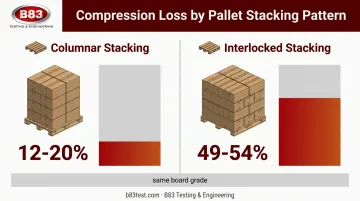
If your warehouse team interlocks pallets differently than your spec assumed, that safety margin can disappear.
Beyond the engineering case, ISO 12048 testing gives you:
- A standardized benchmark for qualifying multiple suppliers or board grades against the same criteria
- Documentation retailers and freight carriers increasingly require before approving a packaging spec
- A defensible paper trail if a damage claim or compliance question surfaces later
None of that happens with ECT numbers or a spec sheet alone. It happens when someone puts an actual converted box on a compression tester and measures what it does.
How BCT Testing Works Per ISO 12048 – Step by Step
Getting a compliant BCT result isn't complicated, but it's easy to get wrong. The two most common causes of invalid data: skipping specimen conditioning and running the test on an uncalibrated machine. Here's what the process looks like when it's done right.
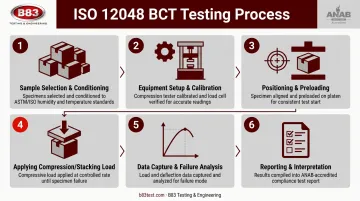
Sample selection & conditioning: Pull a statistically valid sample set, commonly around 10 boxes per material or design combination, and condition them at controlled temperature and humidity before testing. Moisture content changes fiberboard strength, so skipping this step skews results before the test even starts.
Equipment setup & calibration: Choose the platen configuration suited to the test objective and verify the compression tester's load cell calibration meets required accuracy. This is where testing at an ISO/IEC 17025-accredited lab like B83 Testing & Engineering matters, since calibration traceability is built directly into the accreditation.
Positioning & preloading: Center the box between the platens and apply a light preload to remove slack. Decide whether to test the box filled or empty, open or closed, based on the question the test needs to answer.
Applying the compression or stacking load: For a compression test, the platen moves at a constant rate until failure. For a stacking test, the machine holds a constant load for a defined duration to simulate warehouse storage over days or weeks.
Data capture & failure analysis: The tester records a force-deformation curve throughout. Analysts identify peak load, deformation at critical points such as headspace loss, and, for stacking tests, time to failure if the box doesn't hold.
Reporting & interpretation: Analysts compare results against the calculated required stack load, factoring in stack height, box weight, and a safety margin, then document findings in a compliance report referencing ISO 12048.
Skip conditioning and your peak load numbers won't reflect real-world humidity. Skip calibration verification and you can't defend the result if a customer challenges it later.
BCT vs Edge Crush Test (ECT) & Other Standards
BCT and ECT get confused constantly, but they answer different questions. ECT measures the compressive strength of the corrugated board material itself, an edge-on-edge test on a small sample. BCT measures the finished, converted box, the same material now scored, slotted, and shaped into a container, under real stacking conditions.
Estimation formulas like the McKee formula can predict BCT from ECT values and board thickness, useful for quick screening during design. But it has real limits:
- Designed in 1963 for symmetric fluting constructions only
- Functions as a prediction model, not a substitute for physical testing
- Loses accuracy for filled boxes, closed assemblies, or non-standard designs
Once any of those conditions apply, physical BCT testing per ISO 12048 confirms performance.
ISO 12048 isn't the only recognized compression standard clients reference:
| Standard | Scope | Typical Use Case |
|---|---|---|
| ISO 12048 | Complete filled transport packages, compression and stacking | International shipments, global customer specs |
| ASTM D642 | Shipping containers, components, unit loads | U.S. domestic specs |
| ASTM D4577 | Constant load over time, empty or filled containers | Long-duration stacking simulation |
| TAPPI T 804 | Corrugated/solid-fiber shipping containers | Paper industry quality studies |
| DIN 55440-1 | Constant conveyance speed compression | European customer specifications |
B83 Testing & Engineering tests to whichever standard a client's spec calls for, whether ISO 12048, ASTM D642, or another option above. If a customer specifies ISO 12048 by name, it's usually because they're shipping internationally or working with suppliers across multiple countries who need directly comparable numbers.
How B83 Testing & Engineering Can Help
B83 Testing & Engineering is an engineer-owned, ANAB-accredited ISO/IEC 17025:2017 independent testing laboratory based in Milwaukee, Wisconsin. Compression testing sits within B83's accredited scope, and the lab's engineers can develop test protocols aligned with ISO 12048 methodology, along with equivalent standards like ASTM D642.
Because ISO 12048 isn't automatically a checkbox item on every accredited lab's scope document, it's worth a direct conversation about your specific packaging design before the project kicks off.
Beyond technical scope, what sets an independent lab apart is straightforward: results come from a third party with no stake in the outcome. That matters when a manufacturer, retailer, or regulator needs data they can trust for compliance or liability protection.
That same independence matters when compression data needs to fit into a bigger picture. B83 also runs distribution-simulation and environmental testing that round out a packaging validation program:
- ISTA, Amazon, and SAMS package testing
- Vibration and mechanical shock testing
- Environmental conditioning, including temperature cycling and thermal shock
Combining compression data with these tests shows how packaging performs across an entire transport cycle, not just under a static load.
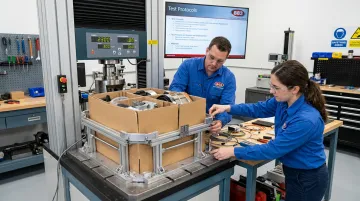
Standard rigs don't always fit the product, though. Non-standard box sizes, filled assemblies, and unusual stacking configurations often need custom fixtures — a core part of what B83's engineering team does daily, building test setups around the actual product rather than forcing it into a generic rig.
Manufacturers across automotive, medical device, consumer product, and industrial sectors already rely on B83 for accredited mechanical and environmental testing. If packaging validation is next on your list, reach out at (414) 449-9396 or sales@b83test.com to scope out testing to ISO 12048 or whatever standard your customer requires.
Frequently Asked Questions
What is a Box Compression Test?
A Box Compression Test measures the maximum vertical force a box can withstand before it collapses. Manufacturers use it to validate packaging strength for stacking, warehousing, and transport before a design goes into production.
What is the difference between Box Compression Test and edge crush test?
Edge Crush Test measures the raw corrugated board material's edge strength using a lab coupon. Box Compression Test measures the finished, converted box as a whole, including scoring and fill condition, under real load.
What is the ISO standard for Box Compression Test?
ISO 12048 governs compression and stacking tests for complete, filled transport packages using a compression tester. ASTM D642 is a commonly referenced alternative, particularly for U.S. domestic packaging specs.
How many boxes should be tested to get a valid BCT result?
Industry studies commonly test around 10 boxes per material or design combination to get a statistically consistent average. ISO 12048 doesn't publish a fixed minimum, so confirm expectations with your lab or customer spec.
What factors most affect BCT results?
Flute structure, board grade, and moisture content all influence compression strength. Box size, orientation, and platen type (fixed versus swiveling) also affect where and how a box fails.
Is BCT testing required for shipping or retail compliance?
BCT testing isn't always legally mandated, but many retailers, carriers, and quality programs require documented BCT data before approving a packaging specification. Skipping it can mean delays or rejected submissions later.