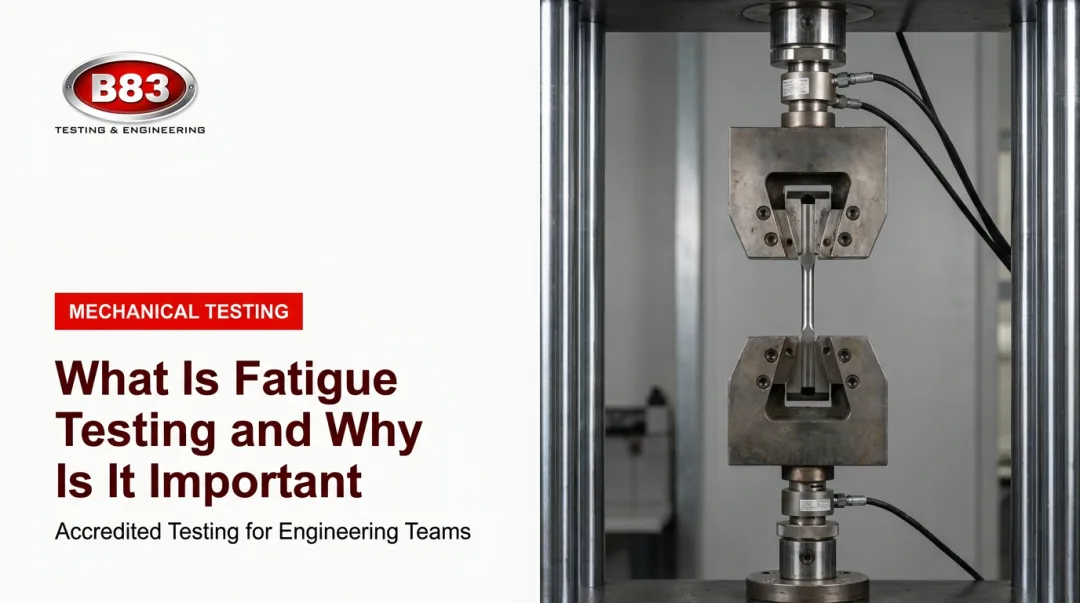

Most people grasp the concept: stress a product until you know how it breaks. But the real value shows up in the decisions it changes — which material gets specified, which design gets scrapped, and which cost gets avoided before it ever reaches a customer. This article covers what durability testing actually involves, the main test types manufacturers rely on, and why companies across industries build it into their process long before launch day.
Key Takeaways
- Durability testing simulates real-world wear and stress to predict product lifespan.
- Test types range from vibration and shock to fatigue and thermal cycling.
- Catching defects before launch costs far less than managing a recall.
- Accredited, third-party lab results carry more weight than internal-only testing.
- Skipping durability testing raises the risk of field failures and costly redesigns.
What Is Durability Testing?
Durability testing subjects a product or component to accelerated real-world stresses (vibration, shock, load, temperature, humidity) to verify it performs reliably for its expected service life. It goes by other names too: reliability testing, endurance testing. The terminology varies by industry, but the goal stays consistent.
Testing scope varies just as widely, spanning individual components, subassemblies, and finished products:
- Component level: a single hinge tested on its own
- Subassembly level: a group of connected parts tested together
- Full product level: a tractor cab tested as a complete structure
Durability testing works best as a decision-support tool, not a pass/fail formality added at the end of development. Engineers use the data to choose materials, adjust tolerances, and validate design changes before those choices get locked into tooling and production.
Common Types of Durability Tests
The right combination of tests depends on the product, its application, and how it's expected to fail in the field. That's why testing scope is almost always customized rather than pulled from a generic checklist.
Vibration and Mechanical Shock Testing
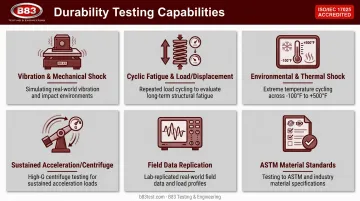
Electro-dynamic shakers apply controlled vibration profiles that simulate transportation, road input, or continuous operational use. Force capacity determines what size component fits on the table. B83's fleet of five shakers spans 4,000 to 18,000 lbf, covering everything from delicate electronic assemblies to large structural parts.
Shock testing adds another layer: classic shock pulses and Shock Response Spectra (SRS) analysis reveal how a product handles sudden impact, like a dropped tool case or a component during rough transport.
Cyclic Fatigue and Load/Displacement Testing
Repeated loading cycles show how many stress cycles a part can endure before cracking. This matters most for anything that moves constantly:
- Hinges and latches on repeated open/close cycles
- Structural joints under fluctuating loads
- Components subject to torsional twisting over time
Load/displacement testing measures how much a part deforms under applied force, which reveals stiffness limits and helps engineers catch a weak joint before it becomes a warranty claim.
Environmental and Thermal Shock Testing
Climatic chambers expose products to temperature extremes, humidity, and rapid thermal transitions to check for material degradation, corrosion, or seal failure. B83 operates nine chambers covering -100°F to +500°F, enough range to simulate an Arctic cold-start or a desert engine bay in the same testing program.
Thermal shock specifically targets rapid transitions, moving a part from freezing to scalding in minutes, to expose cracking or warping that slow, gradual cycling might miss.
Sustained Acceleration (Centrifuge) Testing
Standard shakers replicate vibration well, but they can't hold a sustained g-force. Centrifuge testing fills that gap, simulating the continuous acceleration experienced in transport, aerospace, or heavy equipment applications. It's a less common capability among independent labs, which makes it a differentiator for manufacturers whose components face sustained load environments.
Field Data Replication Testing
Field data replication (often called RPC®-based testing) captures real-world usage data, including actual field loads and vibration signatures, and replays that exact profile in a controlled lab setting. Instead of testing against a theoretical stress curve, engineers test against what the product genuinely experiences in use.
Standards bodies like ASTM also publish industry-specific protocols so results stay comparable across labs. ASTM's concrete durability standards (freeze-thaw resistance, chloride penetration) belong to a separate discipline entirely, governing construction materials rather than components or assemblies.
Key Advantages of Durability Testing
These advantages tie directly to metrics that manufacturers, product managers, and executives already track: cost, risk, compliance, and reputation.
Early Defect Detection and Reduced Warranty/Recall Costs
Durability testing surfaces design flaws, weak materials, and manufacturing defects before customers ever see the product. Accelerated testing compresses years of wear into days or weeks, giving engineers time to redesign before tooling gets locked in.
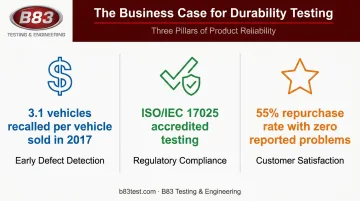
Recalls aren't rare, either. In 2017, the U.S. saw 3.1 vehicles recalled for every vehicle sold, according to McKinsey's analysis of the automotive recall resurgence. Catching a defect during pre-production testing is far cheaper than managing a recall campaign after mass production: no tooling rework, no field logistics, no reputational cleanup.
KPIs impacted:
- Warranty claim rate
- Cost per unit repaired
- Recall frequency
- Time-to-market delays from late-stage redesigns
This advantage matters most for high-volume products, safety-critical components, and anything with a 10+ year expected service life.
Regulatory Compliance and Reduced Liability Risk
Automotive, medical device, and aerospace industries all require documented durability testing to satisfy regulatory or contractual standards. Third-party, ISO/IEC 17025-accredited testing provides objective documentation that internal-only testing simply can't match. It demonstrates due diligence in product validation, which matters when a lawsuit or audit shows up.
B83 Testing & Engineering, for instance, holds ANAB accreditation under ISO/IEC 17025:2017 across mechanical, environmental, and specialized testing disciplines. That accreditation signals to regulators, insurers, and customers that results were generated under an internationally recognized quality system, not an internal shortcut.
KPIs impacted:
- Compliance audit pass rate
- Insurance premium and legal reserve costs
- Time spent on regulatory documentation
Regulated sectors such as medical, automotive, aerospace, and electrical power controls feel this most, particularly when entering a new market with strict compliance requirements.
Improved Customer Satisfaction and Competitive Reputation
Products proven to survive real-world stress translate into fewer field failures and stronger brand trust. J.D. Power's 2016 U.S. Vehicle Dependability Study found that 55% of owners who reported no problems repurchased the same brand, compared to just 41% among owners with three or more problems, according to J.D. Power's 2016 dependability findings. Reliability and repeat purchase behavior are clearly linked.
Durability data also shows up in sales conversations. Manufacturers use it to differentiate against competitors and, in some cases, to justify extended warranty terms or higher performance claims.
KPIs impacted:
- Customer satisfaction scores
- Net Promoter Score
- Repeat purchase rate
- Brand perception metrics
- Online review ratings
Highest impact: competitive consumer markets and B2B equipment sales where buyers actively compare reliability data before purchasing.
What Happens When Durability Testing Is Missing or Ignored
Skipping durability testing doesn't eliminate risk — it just delays when you discover it. Common downstream consequences include:
- Inconsistent field performance with unpredictable failure timing across otherwise identical units
- Higher warranty and recall rates, discovered only after mass production is already underway
- Reactive engineering: redesigning after customer complaints instead of before launch
- Rising long-term costs from repeated fixes, legal exposure, and lost customer trust
- Difficulty scaling production confidently without an established reliability baseline
A well-documented example: NHTSA's investigation into Firestone Wilderness AT tires found that indoor drum testing did not predict field performance. Tires from plants with high failure rates in the field still passed the lab tests used at the time.
The agency's Firestone tire investigation report concluded the tread separations constituted a safety-related defect. It's a costly lesson: lab methods must reflect actual field conditions, not just pass a standard checklist.
How to Get the Most Value from Durability Testing
Durability testing pays off most when it's an ongoing practice, not a one-time pre-launch checkbox. As materials, designs, or usage conditions change, test protocols should get reviewed and updated to match. Results should also be checked against real field performance whenever that data is available.
A few practical guidelines:
- Treat testing as continuous, not a single gate before launch
- Review protocols periodically as materials or usage conditions evolve
- Compare lab results to field data whenever possible to validate the test methodology itself
- Partner with an accredited lab rather than relying solely on internal testing
That last point matters more than it sounds. Working with an independent, ISO/IEC 17025-accredited lab gives you unbiased results and custom fixture design for non-standard parts, ideally with multiple testing disciplines under one roof.
B83 Testing & Engineering, for example, runs vibration, shock, fatigue, environmental, and centrifuge testing from a single Milwaukee facility. This removes the coordination overhead of shipping test articles between vendors and reconciling data from different sources.
Conclusion
Durability testing delivers value well beyond the pass/fail report at the end: it provides control, clarity, and risk reduction throughout a product's lifecycle. Lower warranty costs, reduced liability exposure, stronger customer trust — these advantages compound over time as testing data feeds back into better design decisions.
Treat durability testing as an ongoing investment in product reliability rather than a one-time internal exercise. Partnering with an experienced, ISO/IEC 17025-accredited lab like B83 Testing & Engineering helps catch failure modes that generic in-house methods might miss.
Frequently Asked Questions
What are durability tests?
Durability tests evaluate how a product or material withstands wear, stress, and environmental exposure over its intended service life. The goal is predicting real-world lifespan before customers ever encounter the product.
What is an example of a durability test?
A car door hinge cycled thousands of times via servo motor to simulate 20+ years of opening and closing is a classic example. The test compresses decades of real-world use into a matter of days.
What is the ASTM concrete durability test?
ASTM maintains specific standards for concrete durability, covering things like freeze-thaw resistance and chloride penetration. These are construction material standards, separate from mechanical or product durability testing.
What are the different types of durability tests?
The main categories are vibration, mechanical shock, cyclic fatigue, thermal/environmental, sustained acceleration (centrifuge), and field data replication. Each targets a different failure mode, so most products need a combination rather than a single test type.
How long does durability testing take?
Duration varies by product and test type, but accelerated methods compress years of real-world wear into days or weeks. The exact timeline depends on sample count, cycle profile, and the acceleration model used.
How much does durability testing cost?
Cost depends on test complexity, duration, and number of samples tested. Partnering with an experienced lab helps balance thorough testing with a realistic budget, since project scope is usually quoted individually rather than priced from a fixed rate sheet.