This breakdown is written for automotive engineers, quality managers, and suppliers who need to know where DV fits in product development, and why OEMs and Tier 1 suppliers require it before signing off on any part.
"DV testing" gets thrown around constantly in sourcing and quality conversations, but it's often confused with PV testing, EV testing, or informal pre-DV screening. Each term means something different, and mixing them up can cost real money once tooling gets committed. This article breaks down what DV testing actually involves, how the process flows step-by-step, and when it applies compared to the other verification stages.
Key Takeaways
- DV testing validates a design against engineering and safety requirements using prototype parts
- PV testing confirms mass-production tooling can consistently replicate that same design
- DV typically covers vibration, shock, thermal, and electrical stress testing, documented in a DVP&R
- Skipping DV risks field failures, warranty claims, and costly redesigns after tooling is locked in
- Independent ISO/IEC 17025-accredited labs keep DV results objective and defensible
What Is DV Testing?
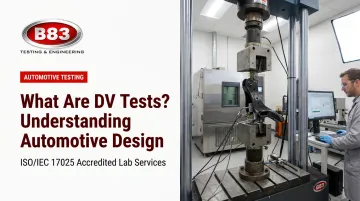
DV, or Design Verification testing, is the structured process of physically and analytically confirming that a component's design meets its specified functional, durability, and safety requirements, before mass-production tooling is finalized.
DV testing produces documented, evidence-based proof (or rejection) of the design, not a subjective gut check. That evidence is captured formally in a Design Verification Plan and Report (DVP&R).
Ford's engineering requirements, for example, specify that DV must demonstrate conformance to the applicable Attribute Requirements List and System Design Specification, with results tied directly to the DVP&R record.
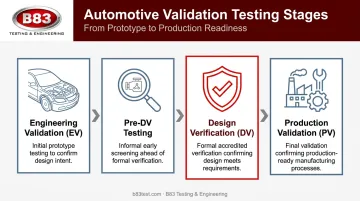
Meeting that standard starts with knowing what's actually being tested. DV testing is typically run on prototype, pre-production, or "soft-tooled" parts — not parts pulled from final production tooling. That distinction matters, because it separates DV from other stages engineers frequently mix up:
- Engineering Validation (EV) happens earlier in the process, testing functional prototypes before the design itself is finalized.
- Production Validation (PV) happens after DV, confirming that parts made on final, committed production tooling meet the same requirements consistently, lot after lot.
- Pre-DV testing happens informally before the DVP&R is approved, catching obvious design flaws early without replacing DV's accredited, documented rigor.
Why DV Testing Matters in Automotive Design
Automotive components live under punishing, unpredictable conditions — road shock, temperature swings from engine bays to arctic parking lots, constant vibration, electrical noise. Physical verification isn't optional here. You can't simulate your way past a part that's about to see 200,000 miles of vibration and thermal cycling.
What OEMs and safety frameworks demand:
- Consistency and traceability across every test run
- Documented proof of compliance with standards like ISO 16750 (environmental conditions for road vehicle E/E equipment) or ISO 26262 (functional safety for safety-critical systems)
- Conformance to OEM-specific specifications, such as GMW, MBN, or GS series documents
When DV testing gets skipped or under-scoped, weaknesses that should've been caught in a lab show up later: in the field, as warranty claims, or worse, as recalls. The scale of that exposure is significant.
NHTSA's 2025 annual recalls report recorded 997 total recalls affecting more than 31.2 million products that year. On the cost side, McKinsey estimates global automotive warranty expenses reached roughly $58 billion in 2024, about 2.2% of industry sales and over 4% of revenue for some manufacturers.
These numbers don't prove every recall traces back to a skipped DV step. But they show exactly what's at stake when design flaws aren't caught before tooling is committed.
DV testing isn't just a regulatory checkbox for safety-critical parts either. It's operationally smart even for non-safety components too, since it cuts liability and reduces expensive rework down the line.
That's why many manufacturers turn to independent, ISO/IEC 17025-accredited labs like B83 Testing & Engineering to run DV testing. Third-party results carry more weight than in-house-only data when quality disputes or field issues come up later, and the ISO/IEC 17025 standard exists precisely to demonstrate that a lab's methods hold up to international scrutiny.
How DV Testing Works: The Process Flow
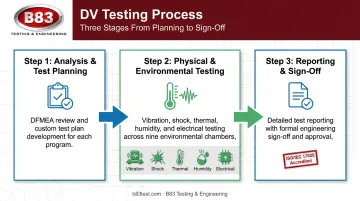
DV testing follows a structured sequence: requirements and failure-mode analysis, test planning, physical and analytical testing, and reporting. Inputs include the design requirements, functional specifications, and findings from a DFMEA (Design Failure Mode and Effects Analysis) — which flags where the design is most likely to fail and needs the toughest scrutiny.
Once testing begins, prototype or pre-production samples undergo the environmental, mechanical, and electrical stress tests defined in the DVP&R. Acceptance criteria, test specifications, and sample sizes stay locked in upfront, so there's no ambiguity about what "pass" looks like.
The outcome is binary: the design earns confirmation as ready for production tooling, or engineers flag deficiencies and route them back for redesign before PV even starts.
Step 1: Analysis and Test Planning
Engineers use DFMEA results and requirement analysis to determine which components and failure modes deserve the most rigorous testing. That analysis feeds directly into a DV Plan (DVP) — a document listing test names, applicable specifications, sample counts, and the facilities where testing will happen.
Step 2: Physical and Environmental Testing
This is where samples go through the paces defined in the DVP&R. Testing covers:
- Random vibration exposure
- Mechanical shock loading
- Thermal cycling across extreme ranges
- Humidity exposure
- Electrical stress conditions
Testing happens either at the manufacturer's own facility or at an accredited independent lab.
This is also where equipment capability starts to matter. At B83 Testing & Engineering, for example, this phase runs across nine environmental chambers covering a -100°F to +500°F range, alongside a fleet of five electro-dynamic shakers rated from 4,000 to 18,000 lbf. That combination supports everything from small electronic subassembly vibration testing to full cab durability work on servo-hydraulic systems, covering the range automotive DV programs typically demand.
Step 3: Reporting and Sign-Off
Test teams compile results into the DVP&R itself, showing pass/fail status against each acceptance criterion. Engineers document any non-compliances alongside corrective actions before the design earns formal approval to move forward toward production tooling.
Where DV Testing Applies & What Affects the Results
DV testing applies to individual components, subsystems, and occasionally full assemblies, specifically at the point where a design is feature-complete but tooling isn't finalized yet. Unlike PV, which recurs with every production lot, DV is typically a one-time, gated milestone per design. It only gets repeated if the design undergoes a substantial change.
A handful of factors shape how a DV program plays out and what the results actually mean:
- Sample fidelity: how closely prototypes match final production intent
- Test facility capability and calibration: equipment that isn't properly calibrated produces results nobody can trust
- Rigor of acceptance criteria: loose criteria let marginal designs slip through
- **Applicable industry or customer specifications**: ISO standards, OEM-specific requirements, or both
Component complexity also drives scope. A simple mounting bracket might need one or two test types. A safety-critical electronic control unit could require FMEDA and fault tree analysis on top of standard environmental and vibration testing. That's a much heavier lift, and rightly so.
Common Misconceptions & When DV Testing Alone Isn't Enough
Passing DV doesn't guarantee identical performance once mass production starts. DV confirms design intent, nothing more. Manufacturing repeatability is PV's job, not DV's. Confusing the two is one of the most common and costly mistakes in automotive quality planning.
A few other misconceptions worth clearing up:
- DV and PV are not interchangeable. Skipping DV risks costly late-stage redesign, while skipping PV misses process defects that DV can't catch since it never touches production tooling.
- Pre-DV isn't a substitute for formal DV. Informal pre-DV results don't satisfy the DVP&R requirement: pre-DV is exploratory, while DV is documented and accredited.
- Full DV cycles aren't always necessary. Low-risk, non-safety components with a long production history and solid field data may only need simplified validation instead of a complete DV cycle.
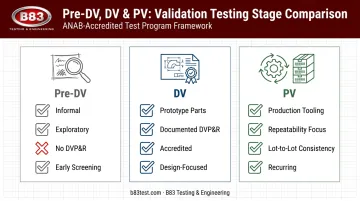
Understanding where DV, pre-DV, and PV each apply helps teams put the right level of rigor at the right stage — not too little, and not more than the risk warrants.
Partnering with an experienced, ISO/IEC 17025-accredited independent lab like B83 Testing & Engineering keeps DV results accurate and objective. That way, the paper trail is ready whenever an OEM or customer asks for it.
Frequently Asked Questions
What is DV testing?
DV (Design Verification) testing is the physical and analytical process of confirming a component's design meets functional, durability, and safety requirements before production tooling is committed. Results are documented in a DVP&R.
What is the difference between PV and DV testing?
DV tests the design itself using prototype or pre-production parts. PV validates that mass-production tooling and processes can consistently reproduce that same design once manufacturing is underway.
What does DVP stand for in testing?
DVP stands for Design Verification Plan, the document outlining test names, specifications, sample sizes, and acceptance criteria. Combined with test results, it forms the full DVP&R.
What is pre-DV testing?
Pre-DV testing is informal, exploratory testing done before the formal DVP&R is finalized. It's used to catch obvious design issues early, reducing the risk of failing the formal DV cycle later.
What automotive standards govern DV testing?
Common references include ISO 16750 for environmental conditions, ISO 26262 for safety-critical systems, and OEM-specific specifications like GMW or MBN, depending on the customer and component type.
Who typically performs DV testing — OEMs or independent labs?
Both. Suppliers and OEMs often run DV testing internally, but many prefer independent, ISO/IEC 17025-accredited labs for objective, third-party-verified results that hold up during quality disputes.