Introduction
A pallet shifts during a cross-country truck haul. A parcel gets dropped twice on a conveyor belt.
A container sits in a humid warehouse for three weeks before reaching a retailer's shelf. Every one of these ordinary events can crack, crush, or corrode a product before a customer ever opens the box.
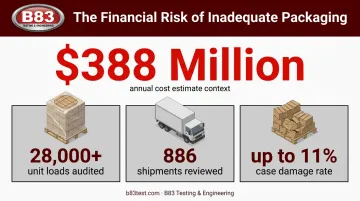
Shipping damage is more common than most manufacturers realize. Industry audits have found case damage on up to 11% of inbound unit loads, with an average closer to 2%, according to Packaging Digest's reporting on supply chain damage trends.
That's why standards bodies like ISTA, ASTM, ISO, and EUMOS created shipping test standards: documented lab procedures that simulate vibration, shock, drops, and compression before products ever leave the warehouse.
This guide breaks down what these standards are, who publishes them, the major test types, and how working with an accredited lab like B83 Testing & Engineering helps you validate packaging before a single unit ships.
Key Takeaways
- Shipping test standards simulate real transportation hazards like vibration, shock, and climate extremes in a lab
- ISTA, ASTM, ISO, and EUMOS each maintain distinct test series with different scopes and applications
- Catching packaging weaknesses in testing is far cheaper than absorbing damage claims after distribution
- An ISO/IEC 17025-accredited lab ensures your test data withstands scrutiny from retailers, insurers, and regulators
What Are Shipping Test Standards?
Shipping test standards are documented procedures, published by recognized standards organizations, that specify exactly how to simulate distribution hazards on a packaged product in a laboratory setting. Instead of guessing whether a package survives a 1,000-mile truck route or a series of forklift handoffs, engineers subject it to controlled vibration tables, drop testers, compression platens, and climate chambers.
The purpose is simple: find the weak point before mass production, not after a customer complaint. A packaging redesign costs far less on paper than a warehouse full of returned, damaged inventory.
Package Testing vs. Shipping Testing
These terms get used interchangeably, but they're not identical.
- Package testing is the broader category — measuring any packaging characteristic across its life cycle, including seal integrity, material strength, or barrier performance
- Shipping (or transport) testing specifically simulates the distribution environment: the vibration, impacts, stacking loads, and climate swings a package encounters between the factory and the end user
- The overlap: shipping testing is essentially a subset of package testing, narrowed specifically to distribution hazards rather than shelf life or general durability
Compliance isn't always optional. Regulated products face mandatory rules: dangerous goods packaging must pass drop and stacking qualification under 49 CFR, for example. For most consumer, industrial, and retail goods, though, testing is a business risk-management decision rather than a legal requirement.
Standards give everyone in the supply chain, from manufacturers to carriers to retailers, a shared, repeatable definition of what "safe for distribution" actually means. Without that common language, every party ends up guessing.
Major Shipping Test Standards Organizations
Several international bodies maintain the standards companies rely on. Each has a different scope, and most companies end up using more than one.
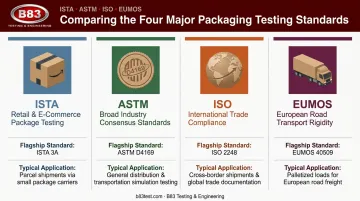
ISTA (International Safe Transit Association)
ISTA is a member-based nonprofit whose stated purpose is minimizing product damage throughout distribution while optimizing resource use in package design. Its procedures are organized into series:
| Series | What it does |
|---|---|
| 1 | Non-simulation integrity — tests product-package strength without mimicking a specific environment |
| 2 | Partial simulation — combines basic integrity elements with some transport simulation |
| 3 | General simulation — replicates typical transport motions and sequences |
| 4 | Enhanced simulation — adds elements tied to known distribution conditions |
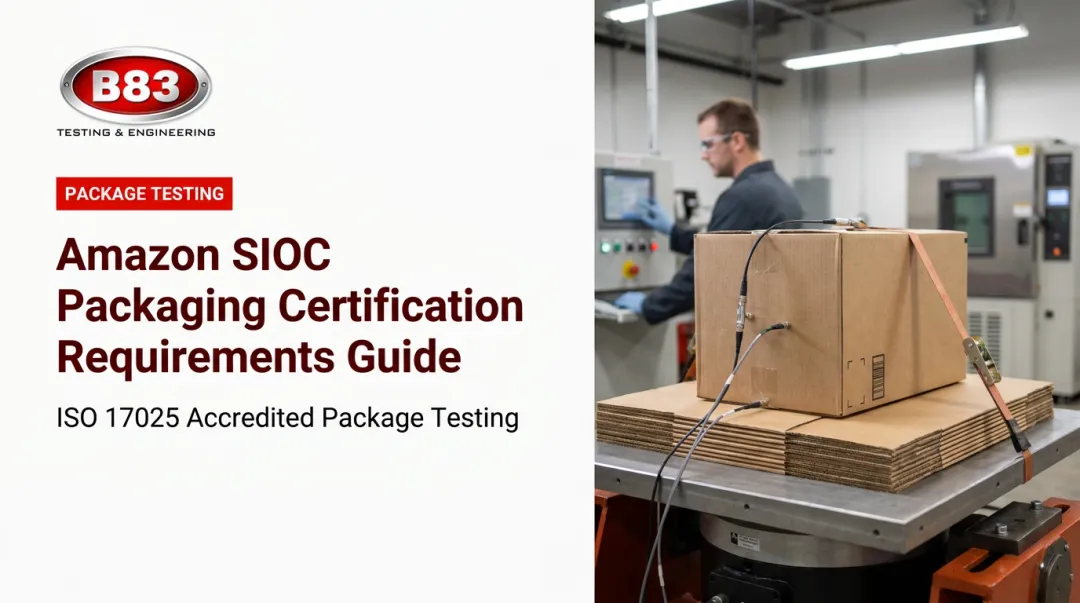
| 6 | Member performance — protocols built for a specific retailer, like Amazon's SIOC program or Sam's Club requirements |
| 7 | Development testing — compares container designs against each other |
Note: ISTA's own 2017 guidance identifies Series 5 as inactive, so not all seven numbered series are currently in use. Series 6 protocols, including Amazon's over-boxing and ship-in-own-container requirements, are what most e-commerce sellers encounter first.
ASTM International
Where ISTA protocols often center on retailer-specific requirements, ASTM International standards apply more broadly across industries. ASTM publishes thousands of voluntary consensus standards through its Committee D10 on Packaging. The flagship for transport testing is ASTM D4169, a standard practice for performance-testing shipping containers and systems against a defined distribution cycle. Unlike single-hazard tests, D4169 applies multiple hazards sequentially to the same unopened container — closer to how damage actually accumulates in the real world.
Other frequently used ASTM methods include:
- D999 — vibration testing using repetitive-shock and resonance methods
- D4728 — random vibration testing of filled shipping containers
- D5276 — free-fall drop testing of loaded containers
- D4003 — programmable horizontal-impact testing (not a drop test, despite sometimes being confused with one)
- D642 — compressive resistance of shipping containers and unit loads
ISO (International Organization for Standardization)
While ASTM standards dominate U.S. practice, ISO extends similar principles to international trade. ISO's transport packaging standards focus on keeping goods safe through handling, storage, and shipping on a global scale. Two standards apply most directly to transport testing: ISO 4180, which sets rules for compiling sequential performance-test schedules for complete, filled transport packages (dangerous goods excluded), and ISO 12048, which covers compression-resistance and stacking tests using a compression tester.
EUMOS and Other Regional Standards
Beyond these international frameworks, regional mandates add another layer of compliance. EUMOS 40509 governs dynamic testing of load-unit rigidity, including elastic and plastic deformation limits. It matters most for companies distributing goods by road across Europe, where it's referenced in EU Directive 2014/47/EU. Regional and retailer-specific protocols often layer on top of these international frameworks, so a single product might need to satisfy two or three standards simultaneously.
Common Types of Shipping and Package Tests
Most shipping test standards draw from the same core hazard categories. Here's what each one measures and why it matters.
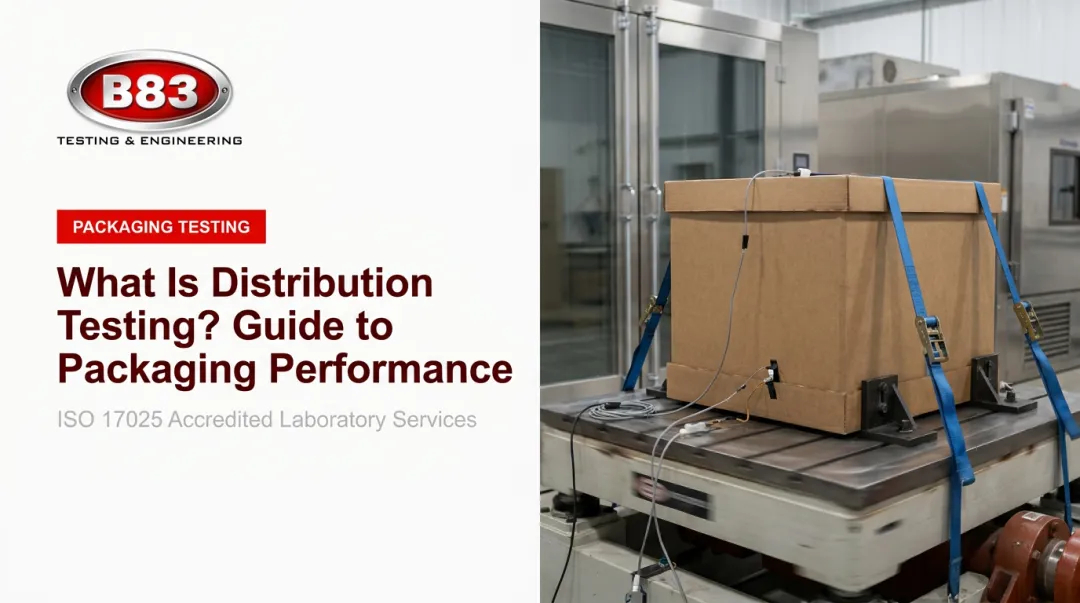
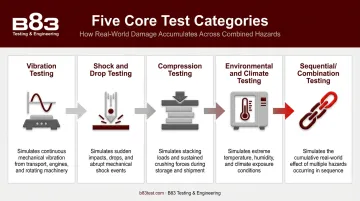
Vibration testing replicates the stresses of truck, rail, or air transport using random or sinusoidal vibration tables. A few hours on the table can simulate days of real-world road transit.
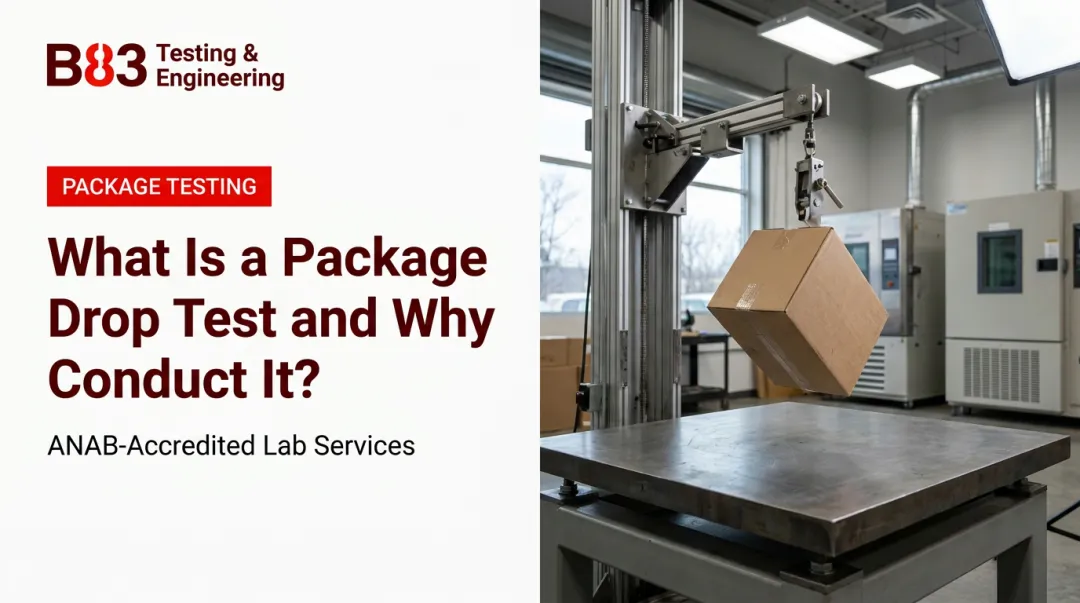
Shock and drop testing simulates handling impacts, forklift drops, and railcar coupling shocks using incline impact testers and free-fall drop testers.
Compression testing measures whether a package or unit load can withstand stacking and warehouse storage forces without crushing.
Environmental and climate testing uses temperature and humidity chambers to simulate extreme transit conditions. This is especially critical for temperature-sensitive goods like pharmaceuticals, electronics, and perishables.
Sequential/combination testing, following the ASTM D4169 approach, combines multiple hazards in a defined order on the same package rather than testing each hazard in isolation. This sequencing matters because real distribution damage rarely comes from a single event; it accumulates from vibration, then a drop, then weeks of stacking pressure.
B83 Testing & Engineering runs these hazard types under one roof, including:
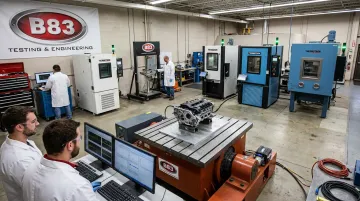
- Vibration testing across a fleet of five electro-dynamic shakers ranging from 4,000 to 18,000 lbf
- Mechanical shock and drop testing
- Sustained acceleration (centrifuge) testing for high-G scenarios
- Environmental and thermal shock testing across 9 chambers spanning -100°F to +500°F
- Cyclic fatigue testing for products that need to survive repeated handling stress, not just a single event
Having vibration, shock, and climate capabilities in one facility means test engineers can schedule and execute multi-hazard protocols without shipping test articles between labs.
Why Shipping Test Standards Matter for Your Business
Standardized testing catches packaging and product weaknesses before they become customer-facing problems. That translates into fewer warranty claims, less liability exposure, and lower replacement costs.
The financial exposure is real. A 2006 audit of more than 28,000 unit loads across 886 shipments estimated that inadequate unit-load wrapping alone could cost CPG companies roughly $388 million annually, according to a 2006 unit-load audit covered by Packaging World.
That figure reflects wrapping issues specifically, not every damage cause, but it illustrates how quickly small packaging gaps scale into large losses across a distribution network.
Documented, accredited test results also do more than prevent damage:
- Support insurance negotiations by demonstrating proactive risk management
- Satisfy retailer and customer compliance requirements, including Amazon's ISTA 6-Series protocols
- Protect brand reputation by reducing the volume of damaged-goods complaints and returns
- Give engineering teams objective data to defend design decisions internally
Independent labs like B83 Testing & Engineering run ISTA and Amazon protocols under ISO/IEC 17025 accreditation, producing results that satisfy retailers and insurers.
None of this guarantees zero damage. ISTA itself states that its screening tests provide confidence that serious transport damage risk has been minimized, not eliminated entirely. Testing reduces exposure; it doesn't erase it.
Choosing the Right Testing Partner
Not every lab that offers "package testing" can back it up with accreditation. When evaluating a testing partner, look for:
- ISO/IEC 17025 accreditation through a recognized body like ANAB, confirming the lab's competence and impartiality per ISO's own standard
- Breadth of capabilities spanning vibration, shock, compression, environmental, and fatigue testing under one roof
- Independence from manufacturing bias — a lab with no stake in your product's outcome delivers more defensible data
- **A defined scope of accreditation** that lists the exact methods you need tested, not just a general 17025 claim
B83 Testing & Engineering checks each of these boxes. The lab is engineer-owned, ANAB-accredited to ISO/IEC 17025, and based in Milwaukee, Wisconsin, operating since 2002. It conducts ISTA-based package and pallet testing alongside Amazon and Sam's Club compliance protocols, serving industries from automotive and medical devices to agriculture, construction, and consumer products.
If your product needs a standard compliance test or a custom multi-hazard protocol built around your specific distribution route, reach out to B83's team. Call (414) 449-9396 or email sales@b83test.com to scope out the right test plan.
Frequently Asked Questions
What is package testing?
Package testing measures packaging materials, components, and completed packages to verify they protect their contents throughout the product's life cycle. It covers everything from material strength to barrier performance, not just transport hazards.
What are the different types of packaging tests?
The main categories are vibration, shock/impact, drop, compression, climate/environmental, and barrier/leak testing. Each one targets a different hazard a package might face between the factory and the end user.
What is ASTM D4169 testing?
ASTM D4169 is a standard practice for performance-testing shipping containers and systems. It applies multiple hazards sequentially to the same unopened unit, simulating a full distribution cycle rather than a single isolated event.
How do I know which shipping test standard applies to my product?
It depends on your product type, distribution method, and any retailer requirements, such as Amazon's ISTA 6-Series protocols. An accredited testing lab can help determine the right combination of standards for your situation.
What's the difference between ISTA and ASTM testing standards?
ISTA focuses on retail and e-commerce-driven protocols, including retailer-specific tests like Amazon's SIOC program. ASTM offers broader, industry-agnostic test methods. Many companies use both together for full coverage.
How long does shipping or package testing typically take?
Mechanical tests like vibration, shock, and compression often finish in under a day. Protocols that include climate conditioning can extend to two or three days, depending on the full scope of the test plan.