Get the wrong test — or skip testing altogether — and the consequences compound fast. The Arecibo Observatory's 900-ton platform collapsed in 2020 after cable sockets that passed short-duration qualification tests failed under years of sustained tensile load, according to the National Science Foundation's forensic investigation. No injuries occurred, but the facility was a total loss.
This guide breaks down what separates tensile from compression testing, where each one applies, and how to decide which your product actually needs.
Key Takeaways
- Tensile testing measures resistance to pulling; compression testing measures resistance to crushing
- Concrete, foam, and cast materials often perform well one way, poorly the other
- Bending and torsion create tensile and compressive stress in the same part simultaneously
- Automotive and off-road parts with multi-directional loads usually need both tests
- Accredited labs can run tensile, compression, fatigue, and vibration tests within one project
Tensile vs Compression Testing: Quick Comparison
Here's how the two tests stack up side by side before we get into the mechanics of each.
| Category | Tensile Testing | Compression Testing |
|---|---|---|
| Force direction | Pulling/stretching along the material's axis | Pushing/squeezing toward the material's center |
| Material response | Elongates, narrows, then fractures | Shortens, widens, may buckle or crush |
| Key metrics | Ultimate tensile strength, yield strength, elongation, modulus of elasticity | Compressive strength, yield point, deformation/buckling limit |
| Failure mode | Necking, then tearing apart | Crushing, buckling, or bulging |
| Common applications | Cables, fasteners, textiles, structural tension members | Columns, foundations, packaging, foam/concrete parts |
A quick way to remember it: tensile tests answer "how hard can I pull before it snaps?" Compression tests answer "how hard can I push before it collapses?"
What Is Tensile Testing?
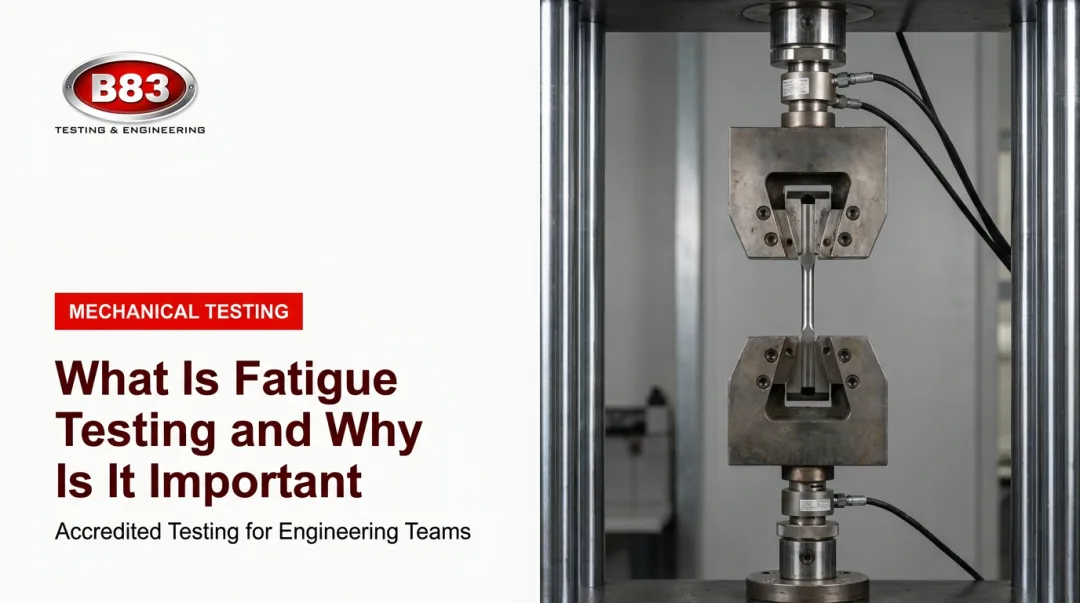
Tensile testing is a controlled pulling test. A specimen gets clamped in grips on either end and stretched at a fixed rate while a load cell and extensometer record force and elongation. Plot that data and you get a stress-strain curve, the fingerprint of how a material behaves under tension.
That curve tells you three things that matter on a shop floor:
- Tensile strength: the maximum pulling force the material handles before fracture
- Yield strength: the point where the material stops springing back and starts deforming permanently
- Elongation: how much the material stretches before it breaks, a proxy for ductility
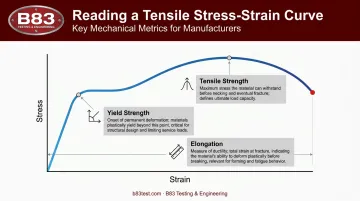
For manufacturers, these numbers translate directly into fewer warranty claims. A fastener spec'd with the wrong yield strength typically fails in the field, usually at the worst possible time.
Testing Standards Vary by Material
Not every material gets tested the same way. ASTM E8/E8M governs tension testing for metals, using round or rectangular reduced-section coupons for sheet, bar, tube, and structural shapes. ASTM D638 covers plastics, using dogbone-shaped Type I-V specimens selected based on material thickness and rigidity.
Composites typically need their own specimen geometry entirely, since fiber orientation changes how the material fails.
Use Cases of Tensile Testing
Tensile testing shows up at multiple checkpoints in a product's life:
- Incoming material verification: confirming a supplier's raw stock actually meets its certified spec
- Design validation: proving a new fastener, cable, or bracket handles its rated load before production tooling gets built
- Failure analysis: pulling apart a returned part to figure out why it broke in the field
The industries leaning hardest on tensile data include automotive fasteners, railroad couplings, wire rope, medical device components, and agricultural equipment linkages, wherever a part's job is to hold two things together against a pulling force.
A real example: in January 2024, a routine supplier pull test on a 2023 Nissan Rogue seat-belt pretensioner found a partially crimped connection that didn't meet tensile strength requirements. Nissan traced it to a supplier manufacturing error and issued a recall before any reported injuries occurred. That's a production-line pull test catching a defect a visual inspection would have missed entirely.
What Is Compression Testing?
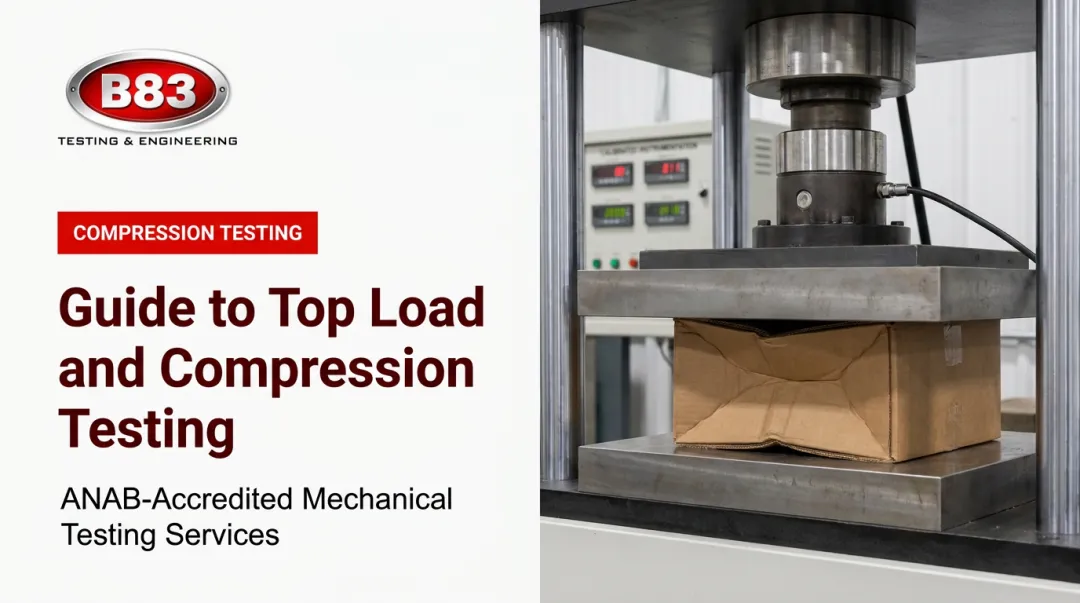
Compression testing works the opposite way. A specimen sits between two flat platens, and a load frame pushes them together at a controlled rate until the material deforms, buckles, or crushes. The result is a compressive stress-strain curve.
Where tensile testing tells you how much pull a part can survive, compression testing tells you:
- Compressive strength — the maximum crushing force before failure
- Stiffness — how much the material resists deforming under load
- Buckling/deformation limits — the point where the shape gives out, even if the material itself hasn't fractured
This matters most for parts that carry load by sitting under weight rather than being pulled apart, such as structural columns, packaging, and foam or elastomer cushioning.
Testing Standards Vary by Material Class
Each standard fits a different material behavior:
- ASTM E9: Axial compression testing of metals, using short cylindrical specimens to avoid invalid buckling
- ASTM D695: Rigid plastics and composites, tested on right-cylinder or prismatic specimens between flat bearing surfaces
- Foams and elastomers: Rarely fracture cleanly, so testing relies on custom fixtures and a specified deformation limit instead of a break point
B83 Testing & Engineering builds custom fixtures for exactly this reason: foam and elastomer specimens need different setups than rigid metal or plastic parts, keeping testing on schedule regardless of material class.
Use Cases of Compression Testing
Compression testing fits into a manufacturer's process at these stages:
- Structural verification: Confirms a frame or column holds its rated load without buckling
- Packaging validation: Top-load tests on bottles and cartons catch crush risk during capping, stacking, and warehouse storage
- Cushioning material qualification: Verifies foam or padding absorbs impact without bottoming out
Industries where this test dominates include construction equipment frames, electrical power control housings, protective packaging, and off-road suspension components. Packaging engineers commonly run axial top-load tests on containers before finalizing wall thickness, since peak load alone can approve a bottle that still deforms too much for automated capping lines.
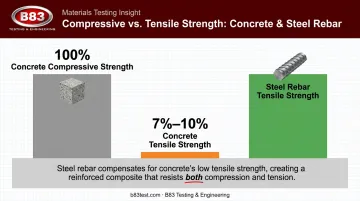
Note on concrete: direct tensile strength averages only about 10% of compressive strength, dropping to 7-8% for high-strength mixes, according to the International Code Council. That's why reinforced concrete pairs concrete's compression strength with steel rebar's tensile strength, since neither material alone covers both directions.
Tensile vs Compression Testing: Which Do You Need?
The answer comes down to one question: which direction does the force actually travel in service?
Weigh these factors:
- Primary load direction: Is the part's main job to resist pulling, pushing, or both?
- Material type: Some materials (concrete, foam, cast iron) behave very differently in tension versus compression.
- Industry standards: Your certification requirements may dictate a specific test method regardless of preference.
- Combined loading risk: Does the part bend or twist in operation?
Situational recommendation:
- Choose tensile testing if the failure risk is pulling apart: fasteners, cables, tension members, structural tie-rods
- Choose compression testing if the failure risk is crushing or buckling: columns, packaging, foam components, footings
Here's the complication: bending creates tension on one face and compression on the opposite face, simultaneously. A shaft under torsion resolves into tensile and compressive stresses at equal magnitude on its outer surface.
Most real-world components (automotive suspension arms, agricultural linkages, construction frames) experience exactly this kind of combined loading. Testing only one direction leaves half the failure picture unexamined.
This is where B83 Testing & Engineering fits in. As an ISO/IEC 17025 ANAB-accredited, engineer-owned independent lab in Milwaukee, B83 runs tensile and compression testing under the same roof, alongside fatigue, vibration, and shock testing.
That means manufacturers can validate a part's full loading profile without shuttling samples between multiple labs. It matters most in automotive, agricultural, and construction equipment, where B83 already serves clients navigating these multi-directional load scenarios.
Real-World Testing Case Study
Seat belt assemblies offer a clear illustration of what's at stake when tensile validation happens at the right level.
The challenge: Automotive seat-belt pretensioners rely on a crimped connection between the belt webbing and the anchor hardware. A weak crimp isn't visible from the outside: it looks identical to a properly formed one until load is applied.
What triggered the test: A supplier's routine production pull test on a batch of 2023 Nissan Rogue front seat-belt assemblies applied tensile load to the crimped joint, per standard quality protocol.
The outcome: The sample failed to meet its tensile-strength requirement. Investigation traced it to a partially crimped connection caused by a manufacturing process error. According to NHTSA recall filing records, Nissan replaced the affected front seat-belt assemblies across the recall population; the filing noted no accidents or injuries had been reported in connection with the defect.
Key takeaway: A material can meet every raw-stock spec and still fail at the joint. Component-level tensile testing, not just coupon testing on raw material, is what catches this kind of defect before it reaches a customer's vehicle.
If your product has a crimped, welded, bonded, or fastened joint that carries load, that connection deserves its own tensile or compression validation. B83 Testing & Engineering can help scope a testing program specific to your part's actual failure risk. Contact us at (414) 449-9396 or sales@b83test.com to discuss your testing needs.
Conclusion
Tensile and compression testing serve different purposes rather than competing for the same test budget. Each method answers a distinct question about how a part performs under real-world forces. The right choice depends on what forces your product will face once it leaves the factory floor — for many components, that means running both.
Getting this right pays off in concrete ways: fewer field failures, lower warranty costs, stronger compliance documentation, and more confidence in a design before it goes into mass production. Partnering with B83 Testing & Engineering, an ANAB-accredited, engineer-owned lab, turns that confidence into documented, defensible data.
Frequently Asked Questions
How do I know if a force is compressive or tensile?
It depends on the direction of the applied force relative to the material. Forces pulling the material apart along its axis are tensile; forces pushing it together are compressive.
Is tension or compression testing better?
Neither is inherently better; the right choice depends on the material's application and the type of load it faces in actual service conditions.
Can a tensile force also be compressive?
A single force is either tensile or compressive by definition. However, components under bending or torsion can experience both tensile and compressive stresses simultaneously in different regions.
What's the basic difference between tension and compression?
Tension refers to forces that stretch or elongate a material. Compression refers to forces that squeeze or shorten it.
What standards govern tensile and compression testing?
Common standards include ASTM E8 (metals) and D638 (plastics) for tensile testing, and ASTM E9 (metals) and D695 (rigid plastics) for compression testing. B83 Testing & Engineering, an ANAB-accredited ISO/IEC 17025 laboratory, follows these standards to deliver repeatable, defensible results.
Which industries typically need both tensile and compression testing?
Automotive, construction, agricultural equipment, and aerospace industries often require both, since their components regularly face multi-directional loads in real-world use.