This matters to manufacturers, fabricators, riggers, and quality or safety engineers working with cranes, hoists, slings, and lifting attachments across construction, agriculture, automotive, rail, and industrial sectors. A missed or improperly executed test can mean liability exposure, regulatory violations, or worse.
Many people use "proof load testing" and "load testing" interchangeably. They're not the same thing. Proof testing is one specific method within a broader category that also includes dynamic, operational, and break testing.
This article breaks down what proof load testing actually is, when it's required, how the process works step-by-step, and what factors determine whether your results hold up.
Key Takeaways
- Proof load testing applies a load above rated capacity to verify structural integrity.
- Percentages and hold times vary by equipment, from 110% for cranes to 200% for slings.
- OSHA sets enforceable minimums; ASME B30 and CMAA add best-practice guidance.
- Annual inspection, periodic re-testing, and idle-equipment checks are distinct, not interchangeable requirements.
- Third-party ISO/IEC 17025 accredited labs provide documentation that holds up under audit or litigation.
What Is Proof Load Testing?
Proof load testing means applying a load that exceeds the equipment's maximum rated or working load limit, holding it for a defined time, then confirming there's no permanent deformation or failure. The goal is simple: establish a documented safety margin before the equipment goes into service, or back into service after repair.
Proof testing is one specific method under the broader umbrella term "load testing." Each type answers a different question:
- Operational testing checks that a crane functions correctly under its rated load
- Dynamic testing evaluates performance while equipment is moving
- Proof testing focuses solely on static structural strength at a load above normal capacity
Proof testing is not a break test. Equipment isn't loaded until it fails. It's loaded to a defined, calculated margin above its rated capacity, then released, with no expectation of damage if the equipment is sound.
Typical Load Percentages and Hold Times
There's no single universal number here, despite what a lot of blog posts claim. The required percentage depends heavily on the equipment type and the governing standard:
| Equipment Type | Typical Test Load | Hold Time | Governing Rule |
|---|---|---|---|
| Overhead/gantry crane | Up to 125% of rated capacity | Not specified | OSHA 1910.179(k) |
| Wire rope sling (welded end attachment) | 200% of rated capacity | Not specified | OSHA 1910.184 |
| Repaired synthetic web sling | 200% of rated capacity | Not specified | OSHA 1910.184 |
| Custom rigging accessory | 125% of rated load | Not specified | OSHA 1926.251(a)(4) |
| Personnel platform & rigging | 125% of rated capacity | 5 minutes, suspended | OSHA 1926.1431(j) |
Notice the sling values jump to 200%. That's double the "100-125%" figure you'll see repeated across the industry. If you're relying on a blanket percentage for compliance purposes, check the clause that actually applies to your equipment class before you test.
Why and When Proof Load Testing Is Required
Manufacturing defects, weld flaws, and material weaknesses don't always show up under normal working loads. A crane can lift its rated capacity a thousand times without issue, then fail on the thousand-and-first lift because a weld had a hidden flaw from day one. Proof testing surfaces these problems before the equipment is in a position to hurt someone.
Is this regulation-driven or best practice? Both, depending on the equipment. Several frameworks define the requirements:
- OSHA mandates rated-load testing for new or altered overhead cranes (1910.179(k)), sling proof testing (1910.184), and personnel platform testing (1926.1431(j)).
- ASME B30 subsections organize consensus requirements by device type, including B30.9 for slings, B30.10 for hooks, and B30.20 for below-the-hook devices.
- CMAA Specification 78 adds a best-practice layer for overhead cranes, recommending a 100% load test at least once every four years, paired with pre- and post-test inspections.
More testing isn't automatically safer. In a documented 1988 case, Boeing submitted a 200% proof test program run every 90 days on synthetic web slings.
OSHA reviewed the data and concluded that repeated overload testing wasn't a recognized inspection substitute and could violate rated-capacity rules without manufacturer authorization. The lesson: follow the applicable standard's interval rather than an arbitrary "more is better" schedule.
When Proof Load Testing Is Triggered
- New equipment before first use: installation and commissioning of cranes, hoists, slings, and attachments require testing before they enter service.
- After major repairs or modifications: welding a hook, altering load path components, or reconfiguring a crane's rated capacity triggers retesting under the applicable clause.
- Periodic intervals per equipment class: CMAA recommends a 100% load test every four years for overhead cranes; other equipment types follow manufacturer specifications or the relevant ASME B30 subsection.
- Extended idle periods: OSHA requires a frequent inspection for equipment idle 1-6 months and a complete inspection for equipment idle over 6 months. Many facilities also re-verify structurally sensitive equipment before returning it to service.
How Proof Load Testing Works (Conceptual Flow)
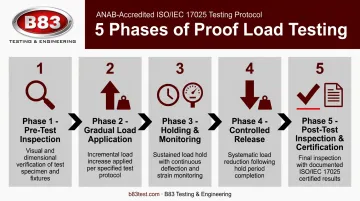
At a high level, the process runs through five phases: pre-test inspection, gradual load application, holding the load while monitoring, controlled release, and post-test inspection with certification. The inputs feeding this process include the equipment's rated capacity data, manufacturer specifications, and calibrated instrumentation, whether that's test weights, hydraulic cylinders, or load cells.
The core action is straightforward in concept but demands precision in execution: the load is raised incrementally toward the target threshold and held while technicians watch for deflection, cracking, or permanent set.
Step 1: Pre-Test Inspection and Setup
Before any load goes on, technicians perform a visual inspection for wear, corrosion, and existing damage. They verify rated-load markings match documentation and check prior certification records. The test site itself needs preparation too, including exclusion zones to keep personnel clear of the load path in case something goes wrong.
Step 2: Applying and Holding the Proof Load
Calibrated test weights, water bags, or hydraulic systems gradually bring the load up to the target threshold. Once there, it's held for the required duration while load cells and visual monitoring track for warning signs:
- Cracking or fracturing at stress points
- Unusual deflection beyond expected tolerances
- Any indication of permanent deformation
At B83 Testing & Engineering, this stage relies on servo-hydraulic load frames paired with real-time data acquisition, capturing deflection and load data continuously rather than through spot checks.
Step 3: Post-Test Inspection, Documentation, and Certification
After the load releases, the equipment gets re-inspected for structural changes, cracks, or permanent set that wasn't present before. A formal test report or certificate follows.
Working with an independent, ISO/IEC 17025 accredited lab makes a practical difference here. Third-party documentation carries more weight in an audit or a liability dispute than in-house paperwork alone, since it removes any question of bias in how results were recorded.
Key Factors That Influence Proof Load Testing Results
A proof test is only as good as the conditions surrounding it. Several variables affect whether your results are reliable:
- Material condition and inputs — prior corrosion, weld quality, and material grade affect how equipment responds under test load. Hidden weld porosity, for example, can cause unpredictable behavior even below rated capacity.
- Calibration accuracy — test weights, load cells, and hydraulic systems need to be calibrated and traceable. OSHA requires that the load-measurement method be sufficiently accurate and reliable, not just "close enough."
- Equipment type and applicable standard — cranes, hoists, slings, and below-the-hook devices each fall under different ASME B30 subsections with their own percentage and hold-time requirements. Always check the specific clause.
- Environmental and site conditions — wind, temperature extremes, and unstable ground can all compromise test validity. Manufacturer restrictions and the applicable standard, not a universal limit, govern acceptable conditions.
Common Misconceptions and When Proof Load Testing May Not Be Enough
Misconception #1: Passing a proof test means the equipment performs well operationally. Not true. Proof testing confirms static structural strength at the moment of testing. It says nothing about how the equipment behaves under repeated cycles, at speed, or under dynamic loading conditions common in daily use.
Misconception #2: A passed test guarantees future reliability. It doesn't. A proof test is a snapshot, not a warranty. Equipment that passes today can develop fatigue cracks, corrosion, or wear over the following months. This is exactly why ongoing inspection routines exist alongside proof testing rather than instead of it.
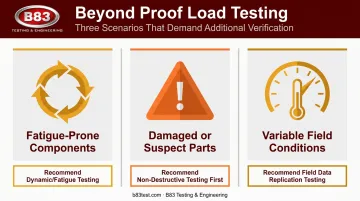
Some situations call for more than a proof test:
- Fatigue-prone components subjected to constant cyclic loading (think crane hooks in high-throughput operations) benefit from dynamic or fatigue testing that a single static proof test can't replicate.
- Damaged or suspect parts should undergo non-destructive testing before any load is applied at all. Loading a component with an unknown internal flaw straight to 125% of capacity is a gamble, not a verification step.
- Equipment exposed to variable field conditions, such as temperature swings or irregular duty cycles, may need field data replication testing to confirm real-world performance a lab proof test can't predict.
Proof load testing is one piece of a larger inspection and certification program. Working with an engineer-owned, ISO/IEC 17025 accredited independent lab like B83 Testing & Engineering ensures the correct standard gets applied to your specific equipment, rather than a generic percentage pulled from an unrelated clause.
Frequently Asked Questions
What is lifting testing?
Lifting testing is a broad umbrella term covering visual inspection, non-destructive testing, and load testing (including proof, dynamic, and operational methods). Together, these verify that lifting equipment is safe for continued use.
What are the four types of load testing for lifting equipment?
Industry discussions commonly reference static/proof, dynamic, operational, and break testing. Each serves a different purpose, from confirming structural strength to evaluating performance under motion or determining ultimate failure point.
What is the 3-3-3 rule for lifting?
This term is sometimes referenced in manual lifting or rigging discussions, but it isn't part of any OSHA, ASME, or CMAA proof load testing standard. Don't confuse it with structural testing requirements.
How often should lifting equipment be tested?
Intervals depend on equipment type. CMAA recommends a 100% load test every four years for overhead cranes as best practice. Other equipment classes follow separate annual inspection or manufacturer-specified schedules.
What percentage of rated capacity is used in a proof load test?
It varies by equipment. Cranes commonly test up to 125%, while certain slings and repaired components require 200% under OSHA 1910.184. Always check the specific clause for your equipment type, since requirements vary by governing standard.
Who is qualified to perform proof load testing?
Certified, trained technicians, often through an accredited independent testing lab like B83 Testing & Engineering, should perform and document proof load tests. This ensures objective results and standards-compliant paperwork that holds up under regulatory or legal scrutiny.