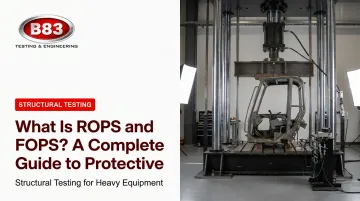
Many equipment owners assume a roll bar or a canopy automatically means their machine is protected. That assumption gets people hurt. ROPS and FOPS are distinct engineering systems, tested against different standards, and a modification as small as an unauthorized weld can void either certification.
This guide breaks down what ROPS and FOPS actually mean, how they're built, which standards govern them, and how to keep a machine's protection intact through years of field use.
Key Takeaways
- ROPS protects against rollovers; FOPS protects against falling objects.
- Mining and forestry equipment often needs both ROPS and FOPS certification.
- Testing includes static load, impact, and crush tests against SAE, ISO, and OSHA standards.
- Unapproved welding, drilling, or repairs void a structure's certification.
- Daily visual checks and bolt-torque verification keep structures compliant and safe.
What Is ROPS (Roll-Over Protective Structure)?
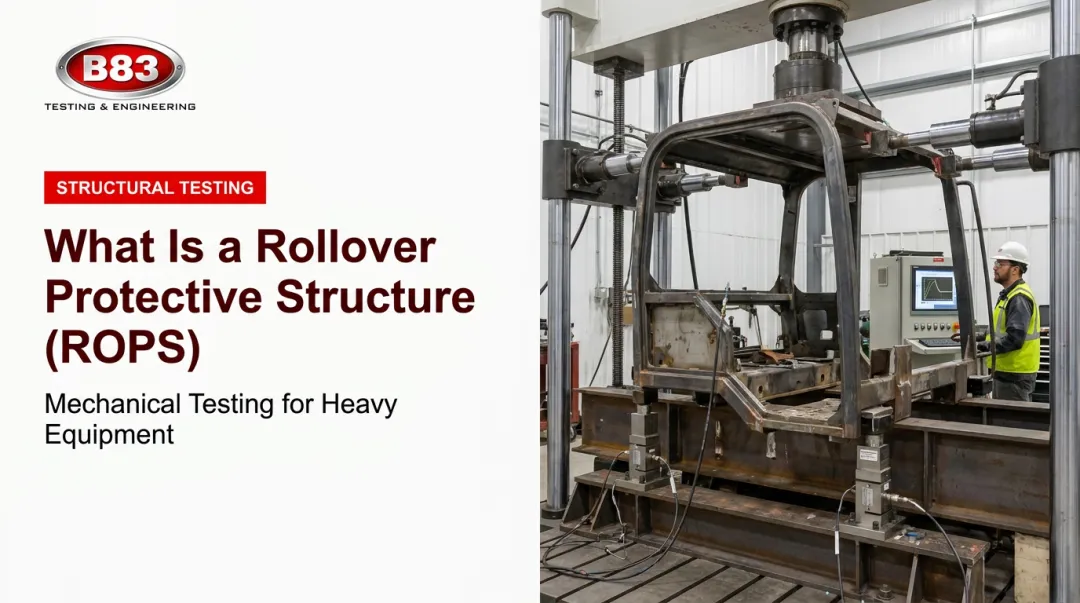
A ROPS is a reinforced frame, roll bar, or cab structure mounted to a machine's frame or axles. Its job is straightforward: maintain a survival zone around the operator if the machine tips or rolls.
Here's the part people get wrong. ROPS doesn't prevent a rollover. It's engineered to absorb and dissipate impact energy while keeping the operator compartment from collapsing. The structure works alongside a properly worn seatbelt, which keeps the operator inside that protected zone instead of being thrown clear.
That protection is proven: NIOSH reports that ROPS combined with a seatbelt are 99% effective at preventing death and serious injury during a rollover, according to CDC's ROPS rebate program bulletin. Skip the seatbelt, and that protection largely disappears.
Types of ROPS Structures
Not every ROPS looks the same. Design depends on machine size, weight, and application:
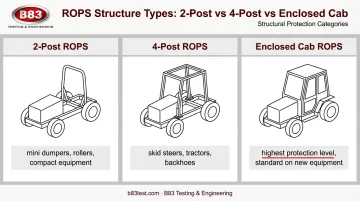
- 2-Post ROPS: Mounted to the rear axle, common on mini dumpers, rollers, and smaller compact equipment. Can be foldable (for low-clearance work) or rigid.
- 4-Post ROPS: Anchored to both axles and the frame, offering broader lateral protection. Standard on mid-size skid steers, tractors, and backhoes.
- Enclosed Cab ROPS: Manufacturer-integrated into the cab itself, complete with safety glass. This is the highest level of rollover protection and increasingly the default on new equipment.
Multiple standards govern ROPS certification, and the correct one depends on machine type and application:
- SAE J2194: wheeled agricultural tractors
- OSHA 1928.51: agricultural tractor ROPS requirements
- ISO 3471: earth-moving machinery over 700 kg (dozers, loaders, backhoe loaders, graders)
- ASABE S478.1: compact utility tractors
- CSA B352.0: Canadian requirements spanning agricultural, construction, and mining machinery
Tractors, skid steers, excavators, backhoes, and forklifts typically fall under one of these standards, depending on jurisdiction and machine class. Independent, accredited labs like B83 Testing & Engineering perform the servo-hydraulic and static load testing manufacturers need to certify these structures against the applicable standard.
What Is FOPS (Falling Object Protective Structure)?
FOPS reinforces the roof or canopy of an operator's cab to stop falling debris from penetrating into the operator's space. Think tree limbs during forestry work, loose rock at a quarry, or tools and bricks dropping from a demolition zone.
FOPS matters most in a handful of high-risk applications:
- Forestry operations, where felling and limbing create constant overhead hazards
- Mining and quarry sites, where rockfall is a routine risk
- Demolition zones, where structural debris falls unpredictably
- Front-end loader work near stockpiles or elevated material
FOPS Protection Levels
FOPS certification isn't one-size-fits-all. ISO 3449 defines two distinct performance levels based on impact energy:
- Level I: Withstands a 1,365-joule impact, sufficient for smaller falling objects like hand tools and bricks, typical of general construction and highway maintenance work.
- Level II: Withstands a much higher 11,600-joule impact — required where trees, rocks, or heavier debris are a realistic hazard, such as forestry, mining, and overhead demolition.
SAE J231 also establishes minimum FOPS performance criteria for machines under SAE J1040c, though its publicly listed abstract doesn't break out the same Level I/Level II energy figures found in ISO 3449. Forestry equipment has its own dedicated standard, ISO 8083, tailored to logging and site-clearing machinery.
B83 Testing & Engineering performs FOPS testing to ISO 3449, SAE J231, and ISO 8083 requirements, confirming a structure's rated impact performance before it goes into service.
One misconception worth correcting: not every overhead canopy is a FOPS. A shade canopy or aftermarket roof might look protective, but only structures that have been engineered, laboratory-tested, and labeled to a recognized standard actually qualify.
ROPS vs. FOPS: Key Differences
The core distinction comes down to force direction. ROPS addresses lateral and frame forces generated during a rollover, while FOPS addresses vertical impact forces from objects falling from above. These hazards call for separate engineering approaches and separate certifying tests, even when both structures are built into a single cab.
| Factor | ROPS | FOPS |
|---|---|---|
| Hazard addressed | Rollover / tip-over | Falling objects |
| Force direction | Lateral / frame | Vertical / overhead |
| Key standards | SAE J2194, ISO 3471, OSHA 1928.51 | ISO 3449, SAE J231, ISO 8083 |
| Common equipment | Tractors, skid steers, backhoes | Forestry, mining, demolition machines |
Many jobsites present both hazards at once. Mining operations combine rollover risk on uneven terrain with rockfall from above. Forestry work pairs tip-over risk on sloped ground with falling branches during felling. In these environments, equipment often needs both certifications to be legally compliant and genuinely safe.
Manufacturers have taken notice. Caterpillar's Cat 735 articulated truck carries a ROPS meeting ISO 3471 and a Level II FOPS meeting ISO 3449 in the same cab structure. Deere's forestry feller bunchers market a similar "integral ROPS, FOPS, and OPS" cab design.
Combining both protections into one structure, without adding excess weight or blocking visibility, requires validated test data for each standard. Independent labs like B83 Testing & Engineering perform the servo-hydraulic and mechanical testing needed to confirm a single cab structure satisfies both ROPS and FOPS requirements.
How ROPS and FOPS Are Tested and Certified
Certification isn't a sticker a manufacturer slaps on after a design meeting. It requires actual structural testing performed against SAE, ISO, or OSHA specifications, including:
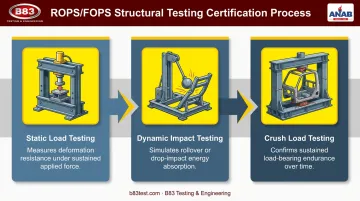
- Static load testing: applying controlled loads to measure how much force a structure absorbs before deforming into the operator's zone
- Dynamic impact testing: simulating real rollover or drop conditions to measure energy absorption in motion
- Crush load testing: applying sustained force (often double the machine's weight) to confirm the structure holds under prolonged pressure
This kind of testing depends on accredited laboratory infrastructure, not a shop floor guess. Independent labs accredited to ISO/IEC 17025 provide that third-party validation.
B83 Testing & Engineering, an ISO/IEC 17025-accredited lab in Milwaukee, Wisconsin, supports equipment manufacturers with ROPS, FOPS, and OPS certification testing as part of its accredited scope of services.
FOPS crush and impact evaluations typically run on servo-hydraulic systems, while related vibration and shock work uses electro-dynamic shakers. This gives manufacturers a single accredited source for the mechanical validation their protective structures require before reaching the market.
A proper certification label isn't optional either. It must include:
- Manufacturer name and address
- Structure identification or model number
- Machine make, model, and mass
- The applicable test standard (for example, ISO 3471 or ISO 3449)
Here's the detail that trips up a lot of equipment owners: any weld, drilled hole, or unapproved repair voids certification, unless a manufacturer or a registered professional engineer specifically signs off on it. Skipping that step can mean the difference between a structure that holds up in a real incident and one that fails without warning.
For manufacturers, investing in independent structural testing pays off well beyond the compliance checkbox. Documented, third-party test results translate into reduced liability exposure, lower warranty costs, and a far stronger legal position if a structure is ever challenged after an incident.
Maintenance, Inspection & Compliance Best Practices
A certified structure doesn't stay certified by default. It stays certified because someone checks it.
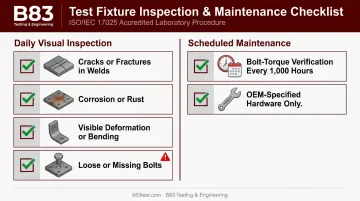
Daily visual inspections should look for:
- Cracks or fractures in welds and mounting brackets
- Corrosion or rust weakening structural members
- Visible deformation, bending, or misalignment
- Loose, missing, or damaged mounting bolts
Beyond daily checks, bolt-torque verification should happen on a set schedule, commonly every 1,000 operating hours or per the manufacturer's specific guidance. Missing or damaged bolts should only be replaced with OEM-specified hardware. Substituting generic bolts is one of the most common ways operators unknowingly compromise a certified structure.
One rule matters above all others: any impact event (a rollover, a rockfall strike, a hard collision) should trigger immediate re-inspection. If damage is found, the machine needs re-certification before it goes back into service.
Independent, ISO/IEC 17025-accredited labs like B83 Testing & Engineering can perform this re-certification testing to confirm the structure still meets ROPS/FOPS requirements. Running a compromised structure, even briefly, defeats the entire purpose of having one installed.
Frequently Asked Questions
What do ROPS and FOPS stand for?
ROPS stands for Roll-Over Protective Structure, and FOPS stands for Falling Object Protective Structure. Both are certified operator safety systems built into heavy equipment cabs and frames.
What is FOPS and its purpose?
FOPS reinforces a cab's roof or canopy to prevent falling debris, like rocks, tools, or tree limbs, from penetrating into the operator's space. It's most critical in mining, forestry, and demolition work.
Do I need both ROPS and FOPS on my equipment?
Yes, if your work environment presents both hazards. Mining and forestry operations, for example, commonly require dual certification because rollover risk and falling-object risk exist simultaneously.
Can I repair or modify a ROPS/FOPS structure myself?
No. Unauthorized welding, drilling, or repair voids certification immediately. Any modification must be approved by the original manufacturer or a registered professional engineer familiar with protective structure design.
How often should ROPS/FOPS structures be inspected?
Perform daily visual checks for cracks, corrosion, or loose bolts, plus scheduled bolt-torque verification (often every 1,000 hours). Any impact event should trigger immediate re-inspection before further use.
What standards govern ROPS and FOPS certification?
Key standards include SAE J2194 and J231, ISO 3471 and 3449, and OSHA 1928.51 in the US. Equipment class and application determine which standard applies, and ANAB-accredited labs like B83 Testing & Engineering test structures against these requirements to verify compliance.