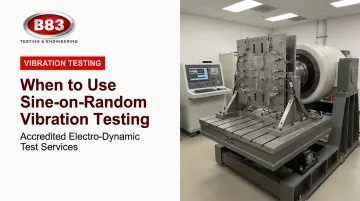
The real question isn't which test is more advanced. It's which test matches your product's actual field environment. Run a random-only PSD test when damaging sine tones are present, and spectral averaging smooths out the tone's peak amplitude, letting a weak design pass the lab and fail in the field.
This article covers exactly when SoR is the right call, the warning signs in your field data, when to skip it, and how to implement it correctly.
Key Takeaways
- SoR replicates aircraft, rotating machinery, and vehicle-mounted environments where sine tones ride on random vibration
- Harmonically-spaced FFT peaks or steady tones on a random noise floor signal the need for SoR
- Standard PSD averaging under-tests sine damage, preserving tone energy while suppressing peak amplitude
- Purely random or purely sinusoidal environments don't need SoR, since it only adds cost and complexity
What Is Sine-on-Random Vibration Testing?
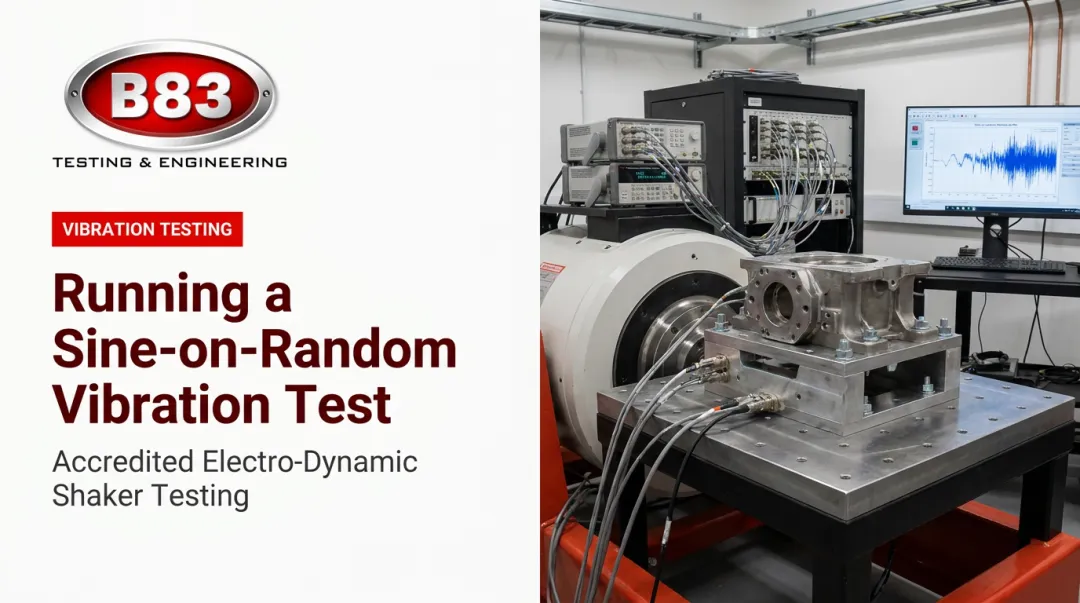
SoR runs one or multiple sine tones simultaneously with a random vibration profile on the shaker table. The goal is to recreate a combined-mode field environment instead of isolating one vibration type at a time.
Here's the core technical problem SoR solves: PSD-based random testing assumes stationary, random data. When a sine tone gets folded into that spectrum through averaging, the tone's total energy stays intact, but its damaging peak amplitude gets pulled down.
According to Vibration Research, this averaging effect means a random-only conversion doesn't recreate the same high-amplitude tone your product will actually see in service.
Modern controllers solve this by tracking the sine tone's frequency separately from the random average, rather than notching it out. Notching under-tests the background vibration around the tone; separate tracking keeps both components honest.
How Many Tones Can a Controller Handle?
Controller capacity varies by mode. Crystal Instruments specifies up to 12 tones in free-sweeping mode, up to 20 in harmonic mode, and as many as 32 simultaneous tones when random-on-random control is disabled. That range gives engineers flexibility for anything from a single engine-order tone to a complex multi-harmonic rotor signature.
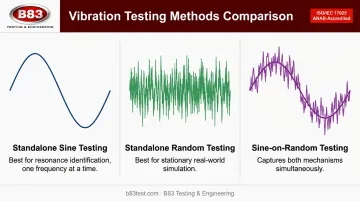
Where SoR fits relative to standalone tests:
- Standalone sine testing: best for resonance identification, one frequency at a time
- Standalone random testing: best for broadband, stationary real-world simulation
- SoR: captures both mechanisms simultaneously, for environments where they occur together
B83 Testing & Engineering's ISO/IEC 17025:2017-accredited lab runs sine, random, and combined SoR profiles on its electro-dynamic shakers, building each profile around a client's specific field environment rather than a generic template.
When to Use Sine-on-Random Testing: Key Scenarios
The decision to run SoR comes down to one question: does the product's actual service environment contain simultaneous sinusoidal and broadband random vibration? Convenience or habit shouldn't drive the choice.
Based on Equipment and Vibration Source Type
Products mounted near or containing rotating or reciprocating machinery (engines, turbines, rotors, pumps, motors) are prime SoR candidates when that machinery also sits on a structure experiencing broader random vibration.
The classic example is an aircraft: turbine engine or rotor-driven sine tones ride on top of airframe random vibration. MIL-STD-810H Method 514.8 specifically identifies engine rotational speed, propeller and turbine-blade passage, and rotor-blade harmonics as quasi-periodic sources relevant to mixed-mode testing.
Based on Field Data Characteristics
Field recordings tell you what your test should look like. Engineers typically confirm SoR-appropriate content using:
- Harmonic cursor analysis on an FFT: reveals harmonically spaced peaks that indicate a rotating source
- Spectrogram review: shows whether a tone maintains consistent amplitude over time
- Tachometer RPM correlation: confirms sine content tracks directly with rotating equipment speed
If sine content is minor relative to the random background, a standard random test may be sufficient. If the sine amplitude is significant, it needs to be included through SoR. Otherwise, you're testing a different environment than the one your product will actually see.
Based on Industry and Application
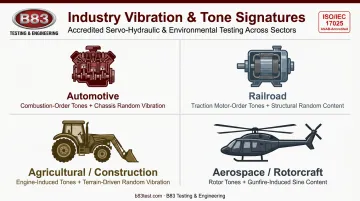
Several industries in B83's client base run into combined-mode environments routinely:
- Automotive: engine-mounted electronics exposed to combustion-order tones plus chassis random vibration
- Railroad: traction motor components subjected to motor-order tones and structural random content
- Agricultural and construction equipment: engine-induced tones combined with terrain-driven random vibration
- Aerospace and rotorcraft: avionics and connectors exposed to rotor tones or, in a well-documented extreme case, gunfire-induced sine content
That helicopter gunfire scenario is one of the most cited SoR examples in the industry. Vibration Research documents it as background random vibration from flight, combined with high-g sinusoidal tones from onboard gunfire, layered together in a way single-mode testing simply doesn't capture.
Based on Standards and Program Requirements
Some qualification programs mandate SoR profiles outright. MIL-STD-810H Method 514.8 addresses mixed-mode and SoR testing directly, and its Annex D includes category profiles for propeller aircraft and rotary-wing platforms. When field data isn't available, these standard profiles give you a defensible starting point, though they're meant to be tailored to your actual application, not applied blindly.
Signs Your Product Needs SoR Testing
Not sure if your product qualifies? Watch for these signals:
- Field-recorded data shows both a broadband random floor and one or more narrowband tones with consistent frequency and amplitude
- The product includes or sits near rotating components (motors, fans, compressors) while riding on a vehicle, aircraft, or platform experiencing random structural vibration
- A prior sine-only or random-only qualification test didn't correlate with observed field failures — signaling an unaccounted-for combined vibration mechanism
If any of these apply, pull the field data and check for harmonic content before committing to a test plan.
When to Avoid Sine-on-Random Testing
SoR isn't the default answer, and forcing it into every program adds cost without adding accuracy. Skip it when:
- The environment is purely random, with no measurable sine content: a standard PSD-based random test is sufficient and more cost-effective
- A single steady-state sine tone dominates, with negligible random background: a swept-sine or sine dwell test handles it with less complexity
- Field data is unavailable or unreliable, and no applicable standard calls for SoR: a three-mode test built without real data behind it risks results that aren't repeatable or defensible
This isn't just a cost judgment call, either. MIL-STD-810H Method 514.8 warns against combining spectra that don't belong together, specifically flagging the mismatch between broadband wheeled-vehicle vibration and helicopter-style SoR profiles. Match the test method to the environment the product actually faces, not the other way around.
What Happens If You Use the Wrong Vibration Test Method
Getting this decision wrong carries real cost, whichever way you err.
Running random-only when sine tones are present under-tests the product. Because PSD averaging suppresses the tone's damaging peak amplitude, a component can pass lab qualification and still fail faster in service than a comparable part designed against real combined loading. The helicopter gunfire scenario illustrates this: components validated against random-only helicopter vibration behaved differently once actual gunfire-induced sine tones entered the picture.
Running sine-only or unnecessary SoR when it's not warranted creates the opposite problem: added test time and cost that don't buy you anything, since the resulting stress levels won't correlate with real service conditions. That's wasted budget and, in some cases, a false failure that sends engineering back to the drawing board for a non-issue.
Skipping a required SoR test carries a compliance risk too. If a customer specification or standard like MIL-STD-810H mandates a combined-mode profile, bypassing it can delay or jeopardize certification and contract acceptance entirely.
Best Practices for Implementing Sine-on-Random Testing Correctly
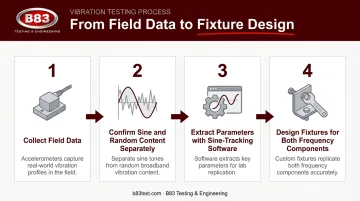
Getting SoR right starts with data, not assumptions.
- Collect field data first. Mount accelerometers or data recorders on the actual product installation before assuming a test profile.
- Confirm sine and random content separately. Use harmonic cursor analysis, spectrogram review, and tachometer correlation to verify both components exist and quantify their levels.
- Extract parameters with sine-tracking software. Order-analysis tools pull accurate sine tone levels and random content from field recordings rather than relying on estimates.
- Design fixtures for both frequency components. A fixture that introduces its own resonance can distort either the sine tone or the random floor, invalidating the test.
Because fixture design and equipment capability go hand in hand, choosing the right lab partner is critical. B83 Testing & Engineering operates as an engineer-owned, ISO/IEC 17025:2017 ANAB-accredited independent lab in Milwaukee, Wisconsin, with field data replication (RPC®) capability.
Its five electro-dynamic shakers range from 4,000 to 18,000 lbf, covering everything from delicate electronic assemblies to large mechanical assemblies across automotive, aerospace, rail, agricultural, and industrial applications.
Even with the right lab and equipment in place, there's no universal "correct" vibration test. The right method depends entirely on your product's actual environment, and validating that environment with real data is what makes qualification results reliable — and cost-effective.
Frequently Asked Questions
What is the difference between sine and random vibration?
Sine vibration applies one frequency at a time with a defined amplitude, while random vibration applies all frequencies within a range simultaneously and unpredictably. Sine-on-random combines both into a single test.
What is sine vibration?
Sine vibration is a single-frequency oscillation with a defined amplitude and frequency, sometimes swept across a range. It's often generated by rotating or reciprocating equipment like motors or engines.
What is the formula for a sine sweep?
The standard logarithmic sweep rate is octaves per minute: R = log2(f2/f1) / T, where f1 and f2 are the start and end frequencies and T is the one-way sweep time in minutes.
What are the four types of vibration?
Industry training commonly references sine, random, shock/transient, and mixed-mode (such as sine-on-random) as the four categories. This is a widely used industry taxonomy rather than a formal universal standard definition.
When is sine-on-random testing required by military or industry standards?
MIL-STD-810H Method 514.8 addresses SoR profiles for products exposed to combined rotational and broadband vibration, particularly in aerospace and defense platforms like propeller and rotary-wing aircraft.
How can I tell if my field data has both sine and random vibration components?
Use harmonic cursor analysis on an FFT and review a spectrogram for consistent-amplitude tones over time. Then correlate a tachometer RPM trace with any narrowband peaks to confirm combined content.