
Introduction
In 1989, NASA's Galileo spacecraft launched toward Jupiter carrying a high-gain antenna that had performed flawlessly through pre-flight checks. But vibration during ground transport overloaded the antenna's restraint pins.
The antenna never fully deployed in flight, permanently limiting the mission's data return (NASA flight system integration lessons learned). No design review caught it. No paper analysis flagged it.
That's the gap vibration testing is built to close. Loose fasteners, fatigue cracks, and cracked solder joints rarely show up on a spec sheet. They show up on a shaker table, or worse, in the field.
Yet too many manufacturers still treat vibration testing as a compliance checkbox, something to complete right before shipment. Its real value sits upstream, catching failure modes before they become recalls, warranty claims, or safety incidents.
This article breaks down what vibration testing actually involves, why it has become standard practice across automotive, aerospace, medical, and industrial sectors, and how to get genuine engineering value out of it, not just a passing grade.
TL;DR
- Sine, random, and shock testing catch design flaws before customers ever see them
- Documented testing reduces warranty costs, liability exposure, and recall risk
- ISO/IEC 17025 accreditation gives regulators and OEMs trusted third-party proof
- Skipping vibration testing doesn't eliminate risk. It only delays costs into recalls and redesigns
What Is Vibration Testing?
Vibration testing subjects a product or component to controlled mechanical vibration, using an electrodynamic shaker, sensors, and a control system, to measure how it responds and whether it survives.
Engineers mount the test article to a shaker table, attach accelerometers to track its response, and run a defined vibration profile while watching for structural damage, loose connections, or performance degradation.
Three Stages of Vibration Testing
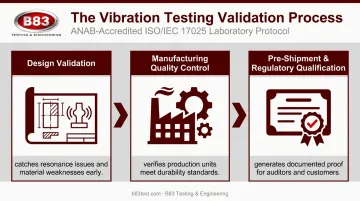
It's applied at three main stages:
- Design validation: testing prototypes to catch resonance issues and material weaknesses early
- Manufacturing quality control: verifying production units meet the same durability standards as validated designs
- Pre-shipment and regulatory qualification: generating documented proof for customers, auditors, and certification bodies
Industries relying on this process include automotive, rail, aerospace, medical devices, and consumer electronics, anywhere a product will encounter road vibration, transport handling, or operational shock.
Vibration testing exists to generate proof, not just data. Independent labs such as B83 Testing & Engineering run these programs on electro-dynamic shakers rated from 4,000 to 18,000 lbf, giving manufacturers the confidence to finalize design, production, and go-to-market decisions.
Key Advantages of Vibration Testing
These advantages tie directly to cost, risk, compliance, and speed to market, not just engineering theory. They compound most when vibration testing runs systematically across the product lifecycle, from early design through ongoing production QC, rather than as a single pre-launch check.
Prevents Field Failures and Reduces Warranty & Liability Costs
Vibration testing identifies weak points such as loose fasteners, fatigue cracks, and solder joint failures before a product ever reaches a customer. Engineers run sine, random, or field-data-replication (FDR) tests to compress years of real-world vibration exposure into hours or days of controlled testing.
Catching a failure mode on a shaker table costs a fraction of catching it in the field. Allianz's analysis of 367 insured recall claims across 12 sectors found that a "significant" recall, defined by Allianz as at least €5 million, averaged more than $12 million (Allianz Global Corporate & Specialty), with automotive representing the largest share of losses analyzed.
Documented, third-party testing also demonstrates due diligence, an asset when defending liability claims or negotiating insurance coverage.
KPIs impacted: warranty claim rate, cost of quality, recall frequency, insurance premiums, customer satisfaction scores.
This advantage matters most in high-volume production, safety-critical components, and products destined for harsh environments such as off-road, rail, or aerospace applications, where one overlooked weak point can affect thousands of units.
Ensures Compliance with Industry & Regulatory Standards
Many industries require documented vibration test results against recognized standards before a product can be sold or certified. Common examples include MIL-STD-810 for defense materiel, ISO 16750 for road vehicle electronics, IEC 60068-2-27 for mechanical shock, and DO-160 for airborne equipment.
Testing performed by an independent, accredited lab, following defined test profiles and reporting formats, carries weight with auditors, OEM customers, and regulators that in-house-only testing typically doesn't. Ford's 2024 customer-specific requirements, for example, direct suppliers to approve outside labs using criteria based on ISO/IEC 17025 or a national equivalent. Boeing's Aerospace Composites Center purchase-order terms go further, requiring outside commercial labs to hold ISO/IEC 17025 accreditation outright when invoked.
That's the standard B83 Testing & Engineering operates under: ANAB-accredited ISO/IEC 17025 testing, recognized across the automotive, aerospace, rail, and medical device sectors it serves.
KPIs impacted: audit pass rate, certification turnaround time, supplier qualification status, customer trust scores.
Expect this benefit to matter most in regulated industries such as aerospace, medical devices, and rail, or whenever selling to OEMs with strict supplier quality requirements.
Validates Design Decisions Early and Speeds Time-to-Market
Vibration testing during the design phase, not just at the end, reveals resonance issues, material weaknesses, or fixture problems while changes are still cheap to make. Engineers use resonance search and dwell testing, or combined profiles like sine-on-random, to map a structure's natural frequencies before tooling is finalized.
Finding a design flaw early is dramatically cheaper than finding it late.
A NASA study of five spacecraft projects, combined with data from 231 hardware errors on a major aircraft program, tracked how correction costs escalate at each project stage. Costs ran 3x-8x during design, 7x-16x during manufacturing, and 21x-78x during integration and test, relative to fixing the same issue at the requirements stage (NASA error cost escalation study).
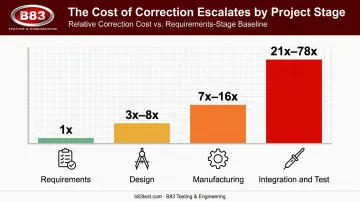
Early validation doesn't just avoid rework. It builds confidence to push a validated design into new use cases or harsher operating environments with data behind the decision, rather than guesswork.
KPIs impacted: design cycle time, prototype iteration count, time-to-market, engineering rework hours.
This becomes critical for new product introductions, novel designs without established field history, or products entering harsher operating environments than earlier generations.
What Happens When Vibration Testing Is Missing or Ignored
Skipping or under-scoping vibration testing doesn't eliminate risk. It just delays where that risk shows up.
Common consequences include:
- Inconsistent product quality: unpredictable failure rates across production batches with no data explaining why
- Reactive firefighting: warranty costs and field returns pile up after products are already in customers' hands
- Audit and certification friction: difficulty passing OEM audits, regulatory certification, or insurance underwriting reviews without documented test evidence
- Compounding long-term costs: recalls, redesigns, and lost customer trust that far exceed what upfront testing would have cost
NHTSA processed roughly 1,000 vehicle safety recalls in 2023, covering more than 39 million vehicles and equipment items, according to NHTSA recall data.
Not every one traces back to a missed vibration test, but the sheer scale shows how much rides on getting durability validation right before launch.
How to Get the Most Value from Vibration Testing
Vibration testing delivers the most value when it's built into the product lifecycle early, not bolted on right before shipment. Get more from your testing program by:
- Testing at multiple milestones: design validation, prototype, pre-production, and ongoing production QC, rather than a single pre-launch formality
- Using real-world profiles: field data replication or industry-standard test profiles relevant to your product's actual use environment, not generic assumptions
- **Partnering with an accredited lab**: independent, ISO/IEC 17025-accredited testing provides unbiased, defensible results that hold up with auditors and customers alike
B83 Testing & Engineering, an ANAB-accredited ISO/IEC 17025 lab in Milwaukee, Wisconsin, works this way with clients across automotive, rail, aerospace, and industrial sectors. Its fleet of five electrodynamic shakers, ranging from 4,000 to 18,000 lbf, covers everything from delicate electronic assemblies to large mechanical structures. Engineer-led test design and custom fixture development are built in from the first conversation.
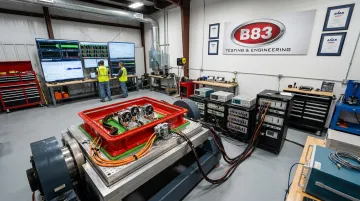
That combination of real-world test profiles, accredited results, and engineer involvement from day one is what turns vibration testing into a genuine safeguard against field failures, not just a formality.
Conclusion
Vibration testing delivers real value well beyond the certificate at the end: reduced risk, regulatory confidence, validated designs, and fewer surprises after launch.
Those benefits compound when testing runs consistently across design validation, prototypes, and production, rather than as a one-time pre-launch event.
Treat vibration testing as an ongoing engineering discipline and partner with an experienced, ANAB-accredited lab like B83 Testing & Engineering to run it. That investment is minor compared to discovering a weak fastener or a resonance problem after the product has already shipped.
Frequently Asked Questions
What is vibration testing?
Vibration testing is the process of subjecting a product to controlled mechanical vibration using a shaker system to evaluate its durability and performance. It reveals weaknesses that design reviews alone can't catch.
Why is vibration testing important for product development?
It catches design and manufacturing flaws early, before they become field failures, reducing liability exposure and warranty costs. It also generates documented evidence that satisfies industry standards and OEM requirements.
What are the main types of vibration tests?
The main types are sine (single frequency), random (broadband frequency), shock (transient impact), and field data replication, which reproduces actual recorded field conditions on a lab shaker.
What industries require vibration testing?
Automotive, aerospace, rail, medical device, and industrial or consumer equipment manufacturers all rely on vibration testing to validate products before launch and throughout production.
What standards govern vibration testing?
Common standards include MIL-STD-810 for defense equipment, ISO 16750 for road vehicle electronics, IEC 60068-2-27 for mechanical shock, and DO-160 for airborne equipment.
How do I choose the right vibration testing lab or equipment?
Look for ISO/IEC 17025 accreditation, like the ANAB-accredited scope B83 Testing & Engineering holds, along with shaker capacity and frequency range matched to your product, and engineers experienced in test and fixture design for your specific application.