Introduction
A tractor overturn takes about two seconds. That's often all the time an operator has before a machine that weighs several tons ends up on its side or its roof.
Rollovers remain one of the deadliest hazards in agriculture and heavy equipment work. Tractor overturns alone caused 1,538 U.S. agricultural-production worker deaths between 1992 and 2007, averaging 96 fatalities a year, according to CDC/NIOSH agricultural injury surveillance data.
A rollover protective structure, or ROPS, is the engineered frame designed to stop that outcome. This article breaks down what a ROPS actually is, why it matters, which standards govern it, and how manufacturers get one tested and certified.
Key Takeaways
- ROPS "survival zones" cut rollover death risk by roughly 99% when paired with a seatbelt.
- OSHA 29 CFR 1928.51 and SAE J2194 govern tractor ROPS; ISO and OECD codes cover construction, mining, and forestry gear.
- Certified ROPS require physical destructive testing, not just visual sturdiness or computer modeling.
- Folded ROPS and uncertified homemade structures offer little to no real protection.
What Is a Rollover Protective Structure (ROPS)?
A ROPS is a structural frame or cab attached to a vehicle's chassis. Its job is simple to state but hard to engineer: maintain a protective zone around the operator's seat if the machine tips over, rolls, or overturns completely.
NIOSH defines it as a structural component, either an enclosed cab or an unenclosed frame, built specifically to protect the operator during an overturn. The concept only works as a system, though. A ROPS by itself does nothing to keep an operator inside that protected zone. That's the seatbelt's job.
Nebraska rollover data from 1967 to 1992 makes the point plainly: 40% of 250 operators on unprotected tractors died, compared with just 1 of 61 operators on ROPS-equipped tractors (that one fatality involved an unbelted, ejected operator).
Combined ROPS-and-seatbelt use is now recognized as 99% effective at preventing rollover deaths and serious injuries, per NIOSH's 2017 bulletin.
Core Components and Design
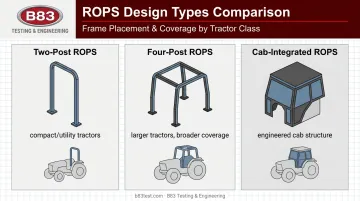
Most agricultural ROPS fall into three design categories:
- Two-post ROPS: a rigid or foldable roll bar mounted behind the seat, common on compact and utility tractors
- Four-post ROPS: a sturdier frame offering broader coverage, often standard on larger tractors
- Cab-integrated ROPS: the enclosed operator cab itself is engineered and tested as the protective structure
Regardless of design, every ROPS must meet performance-based criteria, not just look strong. OSHA 29 CFR 1928.52 evaluates energy absorption, applied force, deformation limits, and crushing resistance under load. High-strength steel is standard, and OSHA even requires low-temperature toughness testing (Charpy V-notch criteria) so the structure doesn't become brittle and fail in cold climates.
Common Equipment That Uses ROPS
ROPS aren't limited to farm tractors. They're required or standard across:
- Agricultural tractors (wheel-type, per OSHA 1928.51)
- Construction machinery — dozers, loaders, graders, skid-steers, and scrapers (OSHA 1926 Subpart W)
- Mining and off-road fleet vehicles (30 CFR 56.14130 and 77.403-1)
- Forestry equipment, including self-propelled machines with booms (ISO 8082-2)
- Utility and off-road vehicles, though coverage here varies by model and application
ROPS vs. Related Protective Structures
ROPS often get grouped with FOPS (Falling Object Protective Structures), but they solve different problems. ROPS addresses crush injuries from a rollover. FOPS addresses impact and penetration from objects falling onto the cab.
A single cab structure can be tested and certified for both hazards, which is common on excavators and loaders working near overhead debris. However, meeting the ROPS standard doesn't automatically satisfy FOPS requirements. The two are evaluated under separate standards (ISO 3471 for ROPS, ISO 3449 for FOPS) and require independent certification.
Why ROPS Matter: The Safety Case for Rollover Protection
Rollovers aren't rare edge cases. NIOSH's farm safety data found 365 overturn deaths among 2,233 total agricultural-production deaths from 2003 to 2007, with tractors involved in 36% of all fatalities in that period.
Here's what makes rollovers especially dangerous: they can happen on flat ground, not just hillsides. A sudden ditch, a shifting load, or a snagged implement can tip a tractor before the operator even reacts.
The University of Iowa's Great Plains Center for Agricultural Health puts the lifetime risk starkly: roughly 1 in 10 tractor operators will experience an overturn at some point in their career.
The historical trendline backs up why ROPS adoption matters so much:
- Tractor-related death rates fell from 17.6 per 100,000 tractors in 1969 to 6.8 per 100,000 in 1992
- The overturn-specific fatality rate declined another 28.5% between 1992 and 2007
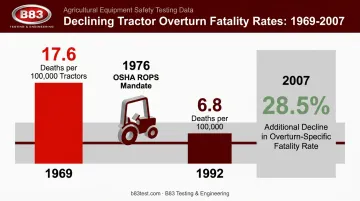
OSHA's 1976 mandate requiring ROPS on new agricultural tractors didn't eliminate rollover risk overnight — older, unprotected tractors stayed in service for decades. But the correlation between rising ROPS adoption and falling fatality rates is hard to ignore.
ROPS Standards and Regulations
ROPS compliance isn't optional guesswork. It's governed by a layered set of U.S. and international standards, each targeting specific equipment categories.
In the United States:
- OSHA 29 CFR 1928.51 covers agricultural tractors, mandating ROPS and seatbelts on covered equipment manufactured after October 25, 1976
- SAE J2194 sets performance and testing criteria for wheeled agricultural tractor ROPS, accepting either ISO 5700 static or ISO 3463 dynamic test routes
Internationally:
- ISO 3471 governs static ROPS testing for earthmoving machinery
- OECD Codes 4, 6, and 7 cover agricultural and forestry tractor protective structures, including narrow-track configurations
- ISO 12117-2 applies to hydraulic excavators between 6,000 and 50,000 kg
| Region | Governing Standard | Applies To |
|---|---|---|
| United States (Agriculture) | OSHA 29 CFR 1928.51 / SAE J2194 | Wheeled agricultural tractors |
| United States (Construction) | OSHA 1926 Subpart W | Dozers, loaders, graders, skid-steers |
| International | ISO 3471, OECD Codes 4/6/7 | Earthmoving, forestry, ag tractors |
| Canada | CSA B352.0 / B352.1 | Cross-border equipment compliance |
Every certified ROPS must carry a permanent label listing:
- Manufacturer's name and address
- ROPS model number
- Specific tractor makes and models it fits
- Compliance statement confirming testing under the applicable standard
That label matters more than it might seem. An uncertified or homemade ROPS can look just as sturdy as a certified one, but real rollover forces expose the difference fast.
Without documented load and energy-absorption testing, there's no way to know whether a structure will actually preserve the operator's survival zone. That gap creates both a safety risk and a serious liability exposure for fleet owners and fabricators alike.
It's also why accredited labs like B83 Testing & Engineering run ROPS certification testing to ISO 3471 and SAE J2194 protocols, producing the documented proof that a structure meets its rated standard.
How ROPS Are Tested and Certified
Certification isn't a paperwork exercise. It requires physical, destructive testing against defined performance criteria.
Two test types form the core of ROPS certification:
- Static crush/load testing: controlled longitudinal, lateral, and vertical loads are applied while engineers measure force and deflection to calculate absorbed energy
- Dynamic energy-absorption testing: pendulum impacts simulate actual rollover loading, following protocols like ISO 3463 or the static route under ISO 5700
During testing, engineers evaluate several factors simultaneously:
- Structural integrity under multi-directional loading
- Deflection limits (how far the frame can bend before intruding into the operator's clearance zone)
- Total energy absorption capacity
- Material toughness, including low-temperature performance
This is where independent, accredited labs become essential. Manufacturers and fabricators building new ROPS designs, or modifying existing structures, need testing that stands up to regulatory and legal scrutiny. That means real destructive testing, documented force and deflection data, and traceable accreditation, not a simulation run on a laptop.
B83 Testing & Engineering, an ANAB-accredited ISO/IEC 17025 independent testing laboratory based in Milwaukee, Wisconsin, provides structural load/displacement testing and cyclic fatigue testing capabilities relevant to validating safety-critical structural components like ROPS. That combination matters for two reasons:
Load/displacement testing measures stiffness, strength, and failure thresholds under applied force, the same data points used to evaluate ROPS performance limits. Cyclic fatigue testing assesses how a structure holds up under repeated loading over its service life, complementing the single-event loading required by certification standards.
For manufacturers across agricultural, construction, and industrial equipment sectors, working with an accredited lab means test data that holds up when it matters. That data needs to satisfy a regulatory auditor or defend a product in litigation.
Types of ROPS and Where They're Used
Not every ROPS looks or functions the same way, and knowing the differences matters for day-to-day safety.
Foldable ROPS
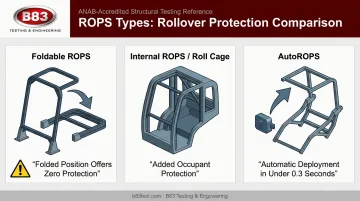
Foldable ROPS show up on compact tractors and mowers that need extra clearance for low doorways or overhanging branches. Here's the catch: a folded ROPS provides zero rollover protection. Operators must raise and lock it upright during operation to preserve the certified clearance zone. If it's temporarily folded for a specific task, guidance recommends skipping the seatbelt during that window and re-raising the structure immediately afterward.
Internal ROPS (Roll Cages)
Internal ROPS, often called roll cages, sit inside cabs on mining and off-road fleet vehicles. They add occupant protection without altering the exterior body design. Without proper testing and labeling, though, an unmarked internal cage shouldn't be treated as certified protection. Independent labs verify that certification through standardized testing protocols.
AutoROPS: The Next Generation
AutoROPS represents where the technology is heading. This NIOSH research prototype stays retracted for clearance during normal operation, then deploys automatically when sensors detect rollover conditions, locking into position in under 0.3 seconds. It's promising, but it remains a research technology rather than standard production equipment for now.
Frequently Asked Questions
What is a ROPS system?
A ROPS system is an engineered structure, either a frame or an integrated cab, that protects operators during a vehicle rollover by maintaining a survival zone around the seat. It works together with a seatbelt to keep the operator inside that protected space.
What is the ROPS process?
The ROPS process covers design, physical destructive testing, certification against applicable standards, and, where needed, retrofit installation on older equipment. Each stage must follow standards like SAE J2194 or ISO 3471 depending on the equipment type.
Is a ROPS required by law?
Yes, for most covered equipment. OSHA 29 CFR 1928.51 requires ROPS on agricultural tractors manufactured after October 25, 1976. Similar mandates apply to construction equipment (OSHA 1926 Subpart W) and mining machinery (30 CFR 56/77).
Can I retrofit an older tractor or machine with a ROPS?
Yes. Certified aftermarket ROPS kits exist for many older tractor models. NIOSH's National ROPS Rebate Program has funded more than 2,300 installations across seven states, covering roughly 70% of ROPS and installation costs.
What is the difference between ROPS and FOPS?
ROPS protects against crush injuries during a rollover, while FOPS protects against impact from falling objects like debris or rocks. Equipment operating in overhead-hazard environments, such as excavation or forestry sites, may need certification for both.
Do I still need to wear a seatbelt if my equipment has a ROPS?
Yes, absolutely. A ROPS only maintains the survival zone — it doesn't keep you inside it. Without a seatbelt, an operator can be ejected from that protected zone during a rollover, which defeats the structure's entire purpose.