Introduction
Most mechanical parts don't fail because someone overloaded them once. They fail because of repeated stress, cycle after cycle, until a crack finally wins.
NASA's own fatigue data found that for some products, fatigue accounts for more than 80% of all observed service failures. According to NASA's fatigue failure analysis, some materials researchers put the mechanical failure contribution closer to 90%.
That statistic is exactly why the LCF versus HCF distinction matters. Pick the wrong test protocol and you end up with one of two expensive problems: an under-designed part that fails in the field, or an over-engineered one that costs more than it needs to.
This article breaks down what separates low-cycle from high-cycle fatigue testing, where each applies, and how to decide which one your component actually needs. B83 Testing & Engineering, an ANAB-accredited ISO/IEC 17025 independent lab in Milwaukee, Wisconsin, runs this type of cyclic fatigue testing across automotive, aerospace, agricultural, and industrial sectors. The same logic applies no matter your industry.
Key Takeaways
- LCF fails within 10,000 cycles above yield strength, with visible deformation
- HCF endures millions of cycles below yield strength, with no visible deformation
- Strain-life (E-N) analysis models LCF; stress-life (S-N) analysis models HCF
- Aerospace, automotive, and power generation parts often require both test types
- Choose based on stress amplitude, cycle count, and real-world operating conditions
LCF vs HCF: Quick Comparison
| Factor | LCF | HCF |
|---|---|---|
| Stress level | Exceeds yield strength; drives plastic deformation | Stays predominantly elastic |
| Cycles to failure | Generally under 10,000 (some methods extend toward 100,000) | Roughly 10,000 into the millions |
| Material behavior | Permanent (plastic) deformation before failure | Little to no visible deformation before fracture |
| Governing curve | Strain-life (E-N), per ASTM E606 | Stress-life (S-N), per ASTM E466 |
| Control method | Strain-controlled | Force/stress-controlled |
A quick way to think about it: LCF is what happens when a part gets pushed hard and infrequently, like a turbine spinning up from a cold start. HCF is what happens when a part vibrates constantly at modest stress, like a bracket bolted near a running engine for 10 years straight.
Test frequency also differs in practice. LCF testing tends to run slower because strain-controlled loading at high amplitude generates heat and requires careful control. HCF testing can run considerably faster since the loads stay in the elastic range.
Exact frequencies vary by material, geometry, and lab setup. Treat any specific Hz figure as a starting point for discussion, not a fixed rule.
What is Low-Cycle Fatigue (LCF) Testing?
LCF testing measures how a material or component behaves when stress repeatedly climbs above its yield strength. Once a material moves past yield, stress and strain no longer move in lockstep, so strain becomes the more reliable variable to control and measure. That's the core reason LCF testing is strain-controlled rather than stress-controlled.
Why Strain-Based Data Matters
Strain-life data lets engineers predict crack initiation in parts that see occasional but severe loading, such as thermal transients or start-stop cycles. This directly reduces warranty exposure because it catches failure modes that a simple stress-based model would miss entirely.
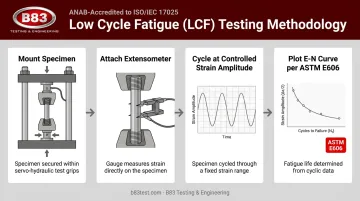
The methodology itself is straightforward:
- Mount the specimen in a servo-hydraulic test frame
- Attach an extensometer to track strain directly on the gauge section
- Cycle the part at controlled strain amplitude, typically at low frequency
- Plot the resulting cycles-to-failure data as an E-N curve following ASTM E606, the standard method for strain-controlled fatigue testing
LCF isn't limited to spinning machinery, either. Seismic events push structural steel into strain values several times greater than yield strain during a single earthquake. That's why bridge columns and structural connections get evaluated under LCF protocols too.
Use Cases of LCF
LCF testing typically enters the picture during design validation, well before a part ships, when engineers need to understand behavior under infrequent but severe loading:
- Turbine blades and disks subjected to thermal and centrifugal start-stop cycles
- Pressure vessels and nuclear reactor components exposed to periodic overload events
- Automotive suspension components handling occasional pothole or curb-strike impacts
- Structural steel connections in seismic-zone construction
NASA's work on powder-metallurgy turbine disk alloys is a good illustration of the stakes. Strain-controlled testing at 650°C found that seeded surface inclusions as small as 54 micrometers cut fatigue life by roughly 20 times, and larger inclusions cut it by up to 100 times. That kind of finding only surfaces through proper strain-controlled LCF testing, not stress-based screening.
What is High-Cycle Fatigue (HCF) Testing?
HCF testing evaluates how a component holds up under a very large number of low-amplitude cycles, well below yield strength. Because the material stays in its elastic range throughout the test, stress-based analysis works fine here and is far more practical than tracking strain at every cycle.
Endurance Limits and Mean Stress Correction
The main payoff of HCF testing is identifying a component's endurance limit, the stress level below which it can theoretically survive indefinitely. That number lets manufacturers set safe operating parameters and realistic maintenance intervals for parts under constant vibration.
At independent labs like B83 Testing & Engineering, HCF methodology follows a familiar pattern using servo-hydraulic systems:
- Apply constant-amplitude, force-controlled loading on a servo-hydraulic frame
- Run at higher frequency than LCF testing since strains stay elastic
- Plot results as an S-N (Wöhler) curve per ASTM E466, the standard practice for force-controlled constant-amplitude axial fatigue testing
Lab tests rarely match field loading exactly, which is where mean stress correction methods come in:
| Method | Formula Basis | Notes |
|---|---|---|
| Goodman | Linear, uses ultimate strength | Common default, moderately conservative |
| Gerber | Parabolic, uses ultimate strength | Less conservative, fits some ductile metals better |
| Soderberg | Linear, uses yield strength | Generally the most conservative option |
NASA testing on single-crystal and directionally solidified superalloys found these standard corrections could actually be unconservative for certain materials, meaning material-specific validation still matters more than defaulting to a textbook formula.
Use Cases of HCF
HCF applies wherever a component sees continuous vibration or millions of load reversals over its life:
- Wind and gas turbine blades under constant aerodynamic loading
- Automotive engine and drivetrain components subjected to ongoing vibration
- Medical device housings that must survive years of handling and transport vibration
- Electrical power control hardware mounted near rotating or vibrating equipment
A published 2023 study on 42CrMo crankshafts evaluated fatigue limits at 10 million cycles, using a drop in natural frequency as the failure signal. The approach cut experimental time by more than 30% while keeping residual-life prediction error under 5%, demonstrating that frequency-based failure detection can shorten HCF test campaigns without sacrificing reliability.
LCF vs HCF: Which Testing Does Your Component Need?
Deciding between LCF, HCF, or both comes down to three questions:
- What's the expected stress amplitude relative to yield strength? If loading regularly pushes past yield, you need LCF. If it stays comfortably elastic, HCF applies.
- How many load cycles will the part see over its service life? Fewer than 10,000 severe cycles point to LCF; tens of thousands to millions of mild cycles point to HCF.
- What's the operating environment? Thermal cycling, seismic exposure, and start-stop operation favor LCF; continuous vibration and rotation favor HCF.
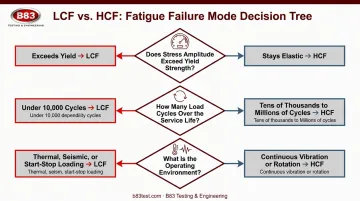
Choose LCF when a part experiences infrequent but severe loading: thermal shock, start-stop cycles, or occasional overload events. Choose HCF when a part experiences continuous, low-amplitude vibration or rotation over a long service life.
Many critical components need both. Aerospace turbine parts, for instance, experience LCF from thermal and centrifugal start-stop cycles alongside HCF from continuous vibration during operation. In practice, engineers often test full-scale turbine blades under both regimes simultaneously to capture the interaction between them, since testing each in isolation can miss failure modes that only appear when they combine.
Real-World Example
Consider a manufacturer of off-highway or agricultural equipment facing repeated structural weld failures in the field. Rather than relying on supplier assumptions, the company brought a welded component to an independent lab for cyclic fatigue testing.
Testing identified that the weld geometry couldn't handle the actual cyclic loading the part saw in service, information that simple static load testing had missed entirely. Based on those results, the manufacturer implemented a specific weld improvement. Since that change, the client has reported no further issues with the component in the field.
That's the broader lesson: independent, accredited fatigue testing replaces guesswork with data. If your components are seeing unexplained field failures or rising warranty costs, contact B83 Testing & Engineering. As an ANAB-accredited ISO/IEC 17025 lab, B83 designs cyclic fatigue testing programs, whether LCF, HCF, or combined, around your component's actual operating conditions.
Conclusion
Neither LCF nor HCF testing is universally "better." The right protocol depends entirely on the stress environment, cycle count, and failure mode relevant to your specific part. Get that choice wrong and you risk either a field failure or an unnecessarily expensive design.
Investing in the correct fatigue test protocol pays off directly: lower warranty costs, improved safety margins, stronger material confidence, and design decisions you can defend to regulators. Aerospace, automotive, and power generation components in particular benefit from a combined LCF/HCF strategy that captures both loading regimes. Partnering with an experienced, accredited lab like B83 Testing & Engineering ensures those results hold up to scrutiny and standards compliance alike.
Frequently Asked Questions
How is a low-cycle fatigue test done?
LCF testing uses a servo-hydraulic test frame with an extensometer to apply controlled strain cycles, typically at low frequency. Results are plotted as an E-N curve following ASTM E606.
What is considered low-cycle fatigue?
LCF generally refers to failure occurring in fewer than roughly 10,000 cycles, under stress exceeding the material's yield strength, causing visible plastic deformation.
What is the ASTM standard for low-cycle fatigue?
ASTM E606 is the primary standard governing strain-controlled fatigue testing methodology for low-cycle fatigue.
What is the difference between LCF and HCF?
LCF involves high stress, few cycles, and plastic deformation. HCF, by contrast, occurs under lower stress across many more cycles, with mostly elastic behavior.
Can a component experience both LCF and HCF during its service life?
Yes. Turbine blades are a classic example: continuous vibration creates HCF loading, while periodic start-stop thermal cycles create LCF loading on the same part.
Which industries most commonly require both LCF and HCF testing?
Aerospace, automotive, power generation, and oil and gas industries most often need both test types, since their components regularly face mixed loading conditions.