Vibration Testing
Evaluate aerospace components under random, sine, and sine-on-random vibration to identify resonance, durability concerns, dynamic stress response, and performance issues before field use.
Validate aerospace components with ISO/IEC 17025 accredited laboratory testing from B83 Testing & Engineering. From vibration, shock, fatigue, altitude, humidity, and thermal exposure to custom fixture design and field data replication, our engineer-owned lab helps teams reduce risk, verify performance, and make confident design or production decisions before launch.
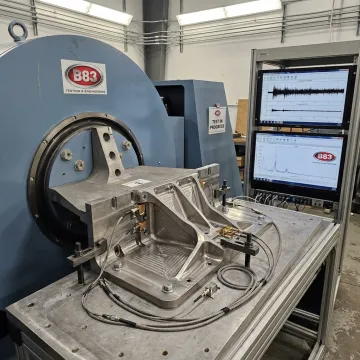
Comprehensive aerospace validation services for mechanical, environmental, structural, vibration, shock, and durability performance requirements.
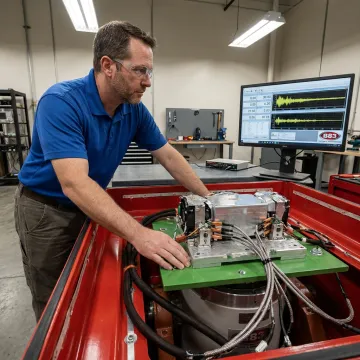
Evaluate aerospace components under random, sine, and sine-on-random vibration to identify resonance, durability concerns, dynamic stress response, and performance issues before field use.
Simulate temperature, humidity, and altitude exposure to verify aerospace product reliability under changing environmental conditions, storage requirements, and operational extremes.
Assess how components withstand sudden impacts, drops, and high-force events that may occur during transport, handling, launch support, or demanding operational environments.
Measure durability under repeated stress cycles to understand fatigue life, failure resistance, material behavior, and long-term reliability of aerospace parts and assemblies.
Expose products to rapid temperature transitions to uncover cracking, warping, material weakness, sealing problems, or performance failures caused by thermal expansion and contraction.
Verify that aerospace components safely withstand specified loads and determine ultimate capacity before failure, supporting structural confidence and risk reduction.
We review your component, application, applicable standards, expected operating conditions, and decision goals. This helps define whether vibration, shock, environmental, fatigue, load, or custom testing will produce the most useful validation data.
Choose a testing partner built around engineering judgment, accredited methods, and practical problem solving.
ANAB-accredited ISO/IEC 17025:2017 testing supports traceable, repeatable, and technically competent results.
Engineer-owned leadership brings practical design, manufacturing, and validation insight to every program.
Multiple disciplines under one roof simplify vibration, shock, fatigue, environmental, and load testing.
Custom fixtures, flexible scheduling, and RPC capability help meet complex aerospace testing demands.
Engineer-owned testing expertise backed by accredited lab systems.
Founded in 2002 by engineers, B83 Testing & Engineering is an independent, engineer-owned testing laboratory headquartered in Milwaukee, Wisconsin. The company was built to help manufacturers and engineering teams make informed quality decisions through reliable, accurate testing. Over more than two decades, B83 has expanded from its Milwaukee roots into a globally recognized lab serving aerospace, aviation, automotive, rail, medical device, power controls, and industrial clients. With advanced environmental chambers, five electro-dynamic shakers, field data replication capability, and ISO/IEC 17025 accreditation through ANAB, the team remains focused on practical engineering support, flexible scheduling, and results clients can use with confidence.
Non-destructive testing in aerospace refers to inspection methods that evaluate a material, part, or assembly without damaging its ability to function. Common NDT methods may identify cracks, voids, corrosion, or bond issues. It differs from many validation tests, such as fatigue, vibration, shock, or ultimate strength testing, which measure performance limits under controlled lab conditions.
Get practical guidance on test methods, timelines, and documentation.

Internationally recognized laboratory accreditation.
Accredited testing quality management standard.
Engineer-led independent testing since 2002.
Share your test requirements, standards, timelines, or component details, and the B83 Testing & Engineering team will help define the right validation approach.
For immediate assistance, feel free to give us a direct call at (414) 449-9396. You can also send us a quick email at sales@b83test.com.
For immediate assistance, feel free to give us a direct call at (414) 449-9396. You can also send us a quick email at sales@b83test.com.