Method 516.8 is the U.S. military's standardized approach to evaluating mechanical shock resistance: how well a system survives the drops, bumps, and impacts of handling, transportation, and operational service. The current standard, MIL-STD-810H with Change 1, was issued in 2019 and updated in 2022, according to DLA's ASSIST database record.
If you're an engineer, product designer, or program manager in defense, aerospace, automotive, or rugged industrial equipment, you've probably seen Method 516.8 referenced in a spec sheet or RFQ. Few documents get cited so often and understood so loosely.
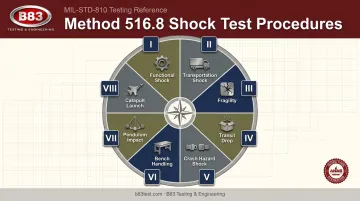
This article covers what Method 516.8 actually tests, its eight procedures, where it applies, and when running all eight isn't the right call.
Key Takeaways
- Method 516.8 evaluates mechanical shock resilience only, not electrical shock or sustained vibration
- Eight procedures span scenarios from functional shock to catapult launch, each with unique pass/fail criteria
- Pulse shape, peak G, and duration must match your product's real service environment, not a generic template
- Compliance supports contract eligibility while reducing field failures and liability exposure
- Accredited labs like B83 Testing & Engineering deliver traceable data customers and regulators trust
What Is MIL-STD-810H Method 516.8 Shock Testing?
Method 516.8 is the shock-testing chapter of MIL-STD-810H, the Department of Defense's "Environmental Engineering Considerations and Laboratory Tests" standard. It defines procedures for evaluating a system's resistance to mechanical, not electrical, shock encountered during handling, transport, and field use.
The goal isn't just a pass/fail stamp. Method 516.8 aims to give engineers verified confidence that a product's structure and function survive real-world impacts, along with a defined fragility threshold that guides packaging, mounting, and stowage design.
Meeting that goal starts with separating shock from a related but distinct hazard: vibration. Shock involves short-duration, high-magnitude events measured in milliseconds. Vibration, covered separately under Method 514.8, simulates sustained oscillatory motion over minutes or hours. A connector that survives 45 minutes of random vibration can still crack from a single 3-millisecond drop, and vice versa.
Shock severity comes down to three variables:
- Peak acceleration (G) — how hard the impact hits
- Pulse duration — how long the event lasts, typically milliseconds
- Waveform shape — classical profiles like half-sine or terminal-peak sawtooth
Method 516.8 covers both packaged and unpackaged conditions, and both operational and non-operational states, depending on which of its eight procedures applies. There's no single test article configuration common across all eight.
Why Method 516.8 Matters
Many defense, aerospace, and industrial procurement specs cite Method 516.8 by name. That makes shock qualification less an abstract best practice and more a practical gateway to the contract itself. No test data, no bid.
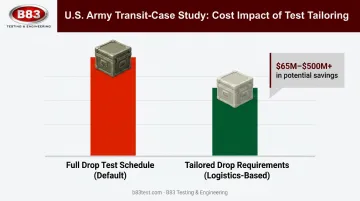
A 2020 U.S. Army acquisition study on transit-case drop testing found that tailoring drop requirements to a program's actual logistics profile, rather than defaulting to the full drop schedule, could avoid $65 million to more than $500 million in cost. Reliability wasn't sacrificed in the process.
Skip shock qualification and you're gambling on:
- Cracked housings or circuit boards
- Electronic connector separation under impact
- Loosened fasteners that work free over repeated shocks
- Structural deformation that changes fit or function
- Hazardous detachment of mounted equipment during a crash
This testing is largely customer- or contract-driven. But even outside a defense contract, it's widely treated as sound engineering practice for anything expected to survive rough handling.
The 8 Procedures of Method 516.8: How Shock Testing Works
Every Method 516.8 test follows the same basic logic, even though the eight procedures serve different purposes. A lab selects the procedure, then defines the pulse shape, peak amplitude, and duration to match the product's real-world exposure.
The general process looks like this:
- Set up the test item: mount it packaged or unpackaged, per its lifecycle configuration
- Select the delivery method, choosing a drop tester, pneumatic shock machine, or one of B83's electro-dynamic shakers based on the procedure
- Deliver the controlled shock pulse, a precisely timed impact matching the chosen waveform
- Verify with instrumentation: accelerometers and data acquisition confirm the pulse meets the tolerances specified in the standard
- Inspect for damage: structural and functional checks determine pass/fail against operational or non-operational criteria
What changes is which of the eight procedures applies. Here's how each one differs:
| Procedure | What It Verifies |
|---|---|
| I – Functional Shock | Powered systems keep working after shocks representative of normal operational service; no functional damage allowed |
| II – Transportation Shock | Repetitive terminal-peak sawtooth pulses simulate ground transit (not a substitute for Method 514.8 vibration testing) |
| III – Fragility | Shock magnitude increases step by step until damage occurs, setting thresholds for packaging and mounting decisions |
| IV – Transit Drop | The item, in or out of its case, drops onto a hard surface to confirm it survives accidental handling drops |
| V – Crash Hazard Shock | Mounted equipment and restraints stay attached during a vehicle or aircraft crash, preventing hazards to occupants |
| VI – Bench Handling | Shocks a unit might see on a workbench during maintenance, tested outside its transit case |
| VII – Pendulum Impact | Large shipping containers resist horizontal impact, testing whether internal packaging protects contents |
| VIII – Catapult Launch/Arrested Landing | Fixed-wing aircraft equipment survives the shock of carrier catapult launches and arrested landings |
Where Method 516.8 Testing Is Applied & Key Factors That Affect Results
Where the Testing Is Used
Method 516.8 shows up across a wide range of hardware:
- Rugged electronics and avionics
- Ground vehicle components and mounted equipment
- Shipping containers and protective packaging
- Communications and control systems built for field deployment
Testing typically happens at three points in a program:
- Design qualification confirms a new design meets spec before tooling is locked.
- Pre-production validation checks early units against qualification results.
- Customer-mandated acceptance testing verifies delivered units meet contract terms.
At each of these stages, procedure selection is driven by the contract or the product's known service environment, not applied as a recurring, default checklist.
A rugged tablet destined for a maintenance bay needs Bench Handling data. A pod mounted on a carrier-based aircraft needs Procedure VIII. Rarely does one program need all eight.
Key Factors That Affect Test Outcomes
Getting a valid result depends on more than picking a procedure off the list.
- Match the pulse to the use case. Civilian handling and combat or carrier-deck conditions produce very different shock profiles.
- Account for mass and structure. The test item's weight, rigidity, and material composition affect how it responds to a given shock input.
- Get the fixture right. Mounting orientation and fixture design determine whether the delivered pulse actually represents the intended event at the item's interface.
- Use calibrated, accredited equipment. ISO/IEC 17025 accreditation confirms a laboratory operates competently and produces traceable results, which is what customers and regulators actually need to see.
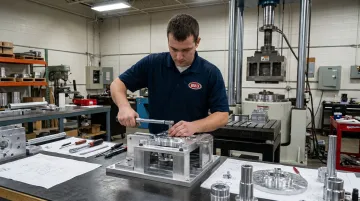
B83 Testing & Engineering, an ANAB-accredited ISO/IEC 17025 lab in Milwaukee, designs custom fixtures in-house for each project. A fixture built around the mass, mounting geometry, and expected service load of your specific hardware is what keeps a shock pulse honest.
Common Misconceptions & When Shock Testing May Not Be Appropriate
Common Misconceptions
Shock and vibration aren't interchangeable, since they evaluate distinct failure modes: one short and violent, one sustained and cyclical. Passing vibration testing proves nothing about shock survivability.
Passing one procedure doesn't mean passing all eight. A unit that survives Transit Drop hasn't demonstrated it will survive Crash Hazard Shock or Catapult Launch, since each procedure tests a distinct scenario with its own criteria.
A higher G-rating isn't automatically "more rugged," since peak acceleration means little without pulse duration and waveform context. A brief, sharp 40G pulse and a longer 20G pulse can stress the same structure very differently.
When It May Not Be the Right Fit
Shock testing isn't free, and it isn't always necessary.
- Skip generic drop testing for products with no realistic exposure to handling or transit shock
- Watch for mismatched test parameters that produce failures unrelated to real-world risk, wasting time and budget
- Avoid blanket testing: running all eight procedures without justification from the product's actual use profile usually signals habit, not a real requirement
Conclusion
Method 516.8 gives engineers a structured way to answer one question: will this survive the shocks it will actually encounter? Eight procedures, eight different real-world scenarios, from a dropped case in a loading bay to a jet slamming onto a carrier deck.
Understanding the method matters because safety, reliability, and contract eligibility all ride on defensible shock data. The procedures that matter for your product depend on its service environment, not on running every test in the standard because it exists.
Correct procedure selection, properly designed fixtures, and accredited execution matter more than checking every box on the list. B83 Testing & Engineering provides all three from its Milwaukee lab.
Frequently Asked Questions
What is the MIL-STD-810H standard?
MIL-STD-810H is a U.S. Department of Defense standard defining environmental test methods, including climatic, shock, and vibration testing, used to qualify military and rugged commercial equipment.
What does MIL-STD-810H certified mean?
There's no formal "certification" issued under MIL-STD-810H. A product is considered compliant when it's tested per the relevant methods and shown to meet the specified acceptance criteria.
What is MIL-STD-810H Method 516.8 (shock/transit drop)?
Method 516.8 is the shock-testing method within MIL-STD-810H, containing eight distinct procedures. Transit Drop (Procedure IV) is the one most often referenced when people say "drop testing."
What is the difference between shock testing and vibration testing?
Shock testing evaluates a brief, high-magnitude impact event measured in milliseconds. Vibration testing, covered under Method 514.8, evaluates sustained oscillatory stress over extended periods.
How is mechanical shock measured in Method 516.8 testing?
Shock severity is captured through peak acceleration (Gs), pulse duration, and waveform shape, all recorded via accelerometers and data acquisition systems during the test.
How many procedures does Method 516.8 include?
Procedures I through VIII, each addressing a different scenario such as functional shock, transit drop, bench handling, or crash hazard.