
Mishandling during shipping and handling remains one of the leading causes of product damage claims across industries. Distribution centers report an average of 2%, and up to 11%, of unit loads arriving with some form of case damage, according to Packaging Digest's supply chain research.
A package drop test is the standard method engineers use to simulate these real-world impacts before a product ever leaves the warehouse. This article covers what the test involves, why it matters, and which standards govern it — whether you're shipping e-commerce parcels or crating aerospace components where a packaging failure means costly downtime or a safety incident.
Key Takeaways
- A package drop test drops a package from set heights onto faces, edges, and corners to expose weaknesses
- Drop testing cuts damage claims, returns, and liability while meeting carrier and retailer requirements
- ASTM D5276, the ISTA series, and MIL-STD-810 define how these tests are run and scored
- Accredited labs provide documented, defensible results for quality, insurance, and compliance decisions
What Is a Package Drop Test?
A package drop test is a controlled simulation. The complete shipping unit, meaning the product plus all interior cushioning and the exterior box, gets dropped from a specified height onto a rigid surface. The goal is simple: find weaknesses before a customer does.
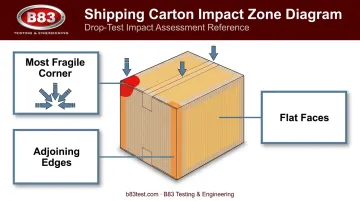
Testing doesn't stop at one drop. Engineers target multiple orientations to expose failures from every angle:
- The most fragile corner (typically identified by weight distribution)
- Adjoining edges connected to that corner
- Flat faces of the package
Drop Height Isn't Arbitrary
Height depends on package weight and the governing standard. ASTM D5276 covers free-fall drop testing of loaded containers and is particularly suited to boxes handled manually during part of the distribution cycle. Heavier packages generally get tested at lower drop heights than lighter ones, since a 60-pound crate hits with far more force than a 5-pound parcel at the same height.
Surviving the drop is only half the equation — the package also has to hold up structurally. What "passing" looks like:
- No functional failure of the product
- No structural failure of the packaging (crushed corners, torn seams, popped flaps)
- Minor cosmetic marks are typically acceptable
Drop testing is rarely a standalone exercise. It's usually one piece of a larger test battery that includes vibration, compression, and environmental conditioning, since real shipping conditions stack multiple stresses at once.
This differs from component-level mechanical shock testing, a separate service B83 performs. Shock testing measures how the product itself responds to sudden impact using electro-dynamic shaker equipment. Package drop testing evaluates the shipping container as a system, not the internal shock tolerance of the part.
Why Conduct a Package Drop Test?
Damage Prevention Is the Primary Driver
The 2% to 11% case-damage figure at distribution centers reflects real costs: returned products, replacement shipments, and customer complaints that trace back to packaging that was never stress-tested before launch.
Drop testing catches these weaknesses in the lab instead of in the field:
- Reduces liability exposure by identifying packaging failures before mass production
- Lowers warranty costs since fewer damaged units mean fewer claims
- Protects brand reputation, since damaged deliveries drive negative reviews and lost repeat business
Compliance Isn't Optional for Many Shippers
Large retail and marketplace programs increasingly require documented drop test evidence before accepting vendor packaging. Amazon's Ships in Product Packaging program, for example, requires either a self-conducted drop test or a lab report from an ISTA-6 certified facility within its APASS network, depending on product eligibility. Carriers like UPS also recommend testing to ISTA 3A standards, even where it isn't a strict mandate.
Smarter Packaging Design and Risk Documentation
Drop test data shows engineers exactly where a package fails. That precision matters:
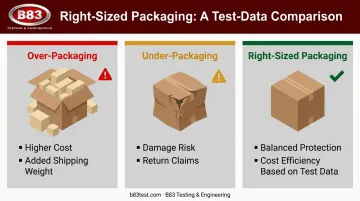
- Over-packaging wastes material and adds shipping weight, driving up cost
- Under-packaging risks damage claims and returns
- Right-sized packaging, informed by actual test failure points, hits the balance
Right-sized packaging also strengthens your position with insurers and auditors. Cargo insurers, including Chubb, advise testing fragile products to ISTA or ASTM standards and recommend keeping formal packaging specifications, photographs, and incident records. Documented, accredited reports from an ISO/IEC 17025-accredited lab like B83 Testing & Engineering won't guarantee a claim outcome, but they do serve as evidence of due diligence when disputes arise.
Package Drop Test Standards You Should Know
Choosing the right standard depends on package weight, industry, and shipping environment. Here's how the major frameworks break down.
ASTM Standards
ASTM D5276 is the primary free-fall drop test method for loaded boxes, cylindrical containers, bags, and sacks, particularly those handled manually somewhere in the distribution chain, according to ASTM's official scope for D5276. It's a method for the impact event itself, not a complete distribution-cycle simulation.
Two companion standards extend the picture. ASTM D4169 evaluates shipping units against a full distribution cycle, combining multiple hazard elements in sequence, while ASTM D6179 covers rough handling of unitized loads and large shipping cases or crates.
ISTA Protocols
ISTA (International Safe Transit Association) protocols combine drop testing with vibration and compression into full transit simulations.
| Series | Purpose |
|---|---|
| 1-Series | Non-simulation integrity tests; basic strength screening |
| 2-Series | Partial simulation, combining basic and general elements |
| 3-Series | General simulation across broad distribution circumstances |
| 6-Series | Member-specific protocols (retailer or carrier programs) |
Major retailers frequently specify which ISTA series a supplier's packaging must pass. Amazon's own 6-Amazon.com-SIOC protocol is one example, developed specifically for its Ships in Own Container program.
Military and Industrial Standards
MIL-STD-810 governs packaging that must protect equipment through defense, aerospace, automotive, and heavy industrial supply chains. Method 516.8, Procedure IV (Transit Drop) evaluates physical and functional integrity under shocks encountered during loading, unloading, or transport.
This standard aligns closely with the client base B83 serves across defense, aerospace, and off-road equipment sectors. Because MIL-STD-810 requires tailoring to a documented life-cycle profile, it isn't a one-size-fits-all certification the way some ASTM methods are.
The takeaway: don't guess which protocol applies. Involve a testing lab early to confirm the correct standard for your product weight, industry, and shipping route.
How the Package Drop Test Process Works
A credible drop test follows a repeatable sequence, not a one-off toss off a table.
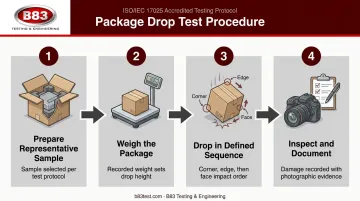
- Prepare a representative sample: the real product, real interior packaging (foam, dividers, void fill), sealed exactly as it will ship. Conditioning at standard temperature and humidity beforehand keeps results consistent and comparable across test runs.
- Weigh the package: weight determines drop height under standards such as ISTA 3A or ASTM D4169.
- Drop in a defined sequence: typically starting with the most vulnerable corner, then adjoining edges, then faces.
- Inspect and document: both the outer packaging and the product are evaluated for cosmetic versus functional damage, with photos and written reports capturing every result.
That documentation step matters more than it sounds. A report that just says "pass" or "fail" isn't useful for design decisions or for a retailer's compliance file.
A thorough report should show:
- Which orientation and drop height caused the failure
- Whether the damage was cosmetic or functional
- Before-and-after photos of the package and product
That level of detail lets engineers make targeted fixes rather than over-engineering the whole package.
Why Work With an Accredited Independent Testing Lab
In-house testing has a credibility problem: results generated without accreditation may not be recognized by customers, carriers, or auditors. ISO/IEC 17025 accreditation exists specifically to demonstrate that a lab's methods, equipment, and personnel produce consistent, valid results, and that recognition carries weight across borders and industries.
That standard is exactly what backs B83 Testing & Engineering, an ANAB-accredited ISO/IEC 17025:2017 independent lab, engineer-owned and operating out of Milwaukee, Wisconsin since 2002. Beyond package and shipping simulation testing, the lab performs mechanical shock, vibration, and environmental testing across sectors including automotive, medical devices, aerospace, and industrial equipment.
Working with an experienced, accredited lab gives manufacturers:
- Documented, defensible results that hold up with customers and auditors
- Data that supports internal design and quality decisions
- Reports formatted for compliance submissions, whether for a retailer program or an insurer
If your packaging hasn't been stress-tested against a recognized standard, that's a gap worth closing before the next shipment goes out. Contact B83 at (414) 449-9396 or sales@b83test.com to discuss package or product testing needs.
Frequently Asked Questions
What is a drop test in packaging?
It's a controlled test that drops a fully packaged product from set heights and orientations to evaluate whether the packaging protects its contents during shipping and handling. Testers then assess both cosmetic and functional damage.
What is the standard for drop test for packaging?
ASTM D5276 and the ISTA series (1, 2, 3, 6) are the most widely used packaging drop test standards. MIL-STD-810 applies for defense, aerospace, and heavy industrial equipment.
How high should a package be dropped during testing?
The chosen standard determines drop height based on package weight. Standards generally drop heavier packages from lower heights than lighter packages to reflect realistic handling forces.
How many times is a package dropped in a standard test?
Most protocols call for multiple drops, often five to ten, covering the weakest corner, adjoining edges, and faces to fully evaluate vulnerability from every angle.
What's the difference between ASTM D5276 and ISTA drop test protocols?
ASTM D5276 isolates the free-fall drop event itself. ISTA protocols combine drop testing with vibration and compression to simulate a complete shipping journey.
What happens if a package fails a drop test?
Engineers use the failure point, such as a seam opening, crushed corner, or damaged product, to identify design weaknesses. They adjust materials or cushioning, then retest the package to confirm the fix holds.