This guide is written for design, reliability, and quality engineers working in automotive, medical device, aerospace, and industrial equipment manufacturing, industries where a single field failure can mean a recall, a safety incident, or a compliance audit. Getting these tests right matters.
Despite being referenced constantly in reliability engineering circles, accelerated stress testing is frequently misapplied at the operational level. Teams skip steps, misjudge stress levels, or run production screening without a proper development-phase stress foundation, undermining the entire program.
Here, we'll break down what development-phase stress testing and production stress screening actually are, how the process works step by step, where each is applied, and - just as importantly - when they aren't the right fit for your product.
Key Takeaways
- Development-phase stress testing finds design flaws before production; production stress screening catches defects on the manufacturing line.
- Both apply extreme thermal and vibration stress beyond spec to reveal failures fast.
- Production screening is most effective when preceded by a thorough development-phase stress program that establishes safe stress limits.
- Automotive, aerospace, medical device, and electronics makers rely on this pairing to cut warranty costs.
- Results depend on chamber capability, fixture design, and experienced testing partners.
What Is Accelerated Stress Testing?
Development-phase stress testing is a methodology applied during product development. Engineers push prototypes past their specified limits, using extreme temperatures and multi-axis vibration, to find weak points in the design before it ever reaches production.
Production stress screening is different: it's a production-phase process. Using stress levels derived from prior development testing results, production screening applies calibrated thermal and vibration stress to manufactured units to catch workmanship and process defects before they ship.
Put simply: development stress testing builds a more robust design, and production stress screening keeps that design manufactured consistently.
How These Methods Differ From ALT and ESS
People often lump accelerated stress testing in with accelerated life testing (ALT) and environmental stress screening (ESS). They're related, but not interchangeable:
| Method | Purpose | Output |
|---|---|---|
| Development stress testing | Discover design weaknesses through step-stress | Failure modes, corrective actions, safe limits |
| Production stress screening | Screen production units using development-derived limits | Pass/fail disposition, process feedback |
| ALT/QALT | Quantify reliability of a fixed, finished design | Life estimates, MTBF-type figures |
| Conventional ESS | Screen production against a predefined profile | Detection of workmanship defects |
The key takeaway: development and production stress testing are discovery-based, not compliance or certification tests. They don't predict exact field life, but they find and fix problems fast.
Why Accelerated Stress Testing Matters
Manufacturers adopt accelerated stress testing for three practical reasons: faster time-to-market, fewer field failures, and lower warranty costs. An IPC-published review of accelerated stress testing describes these as consistent, qualitative benefits across the electronics industry, alongside shortened development cycles and improved reliability margins.
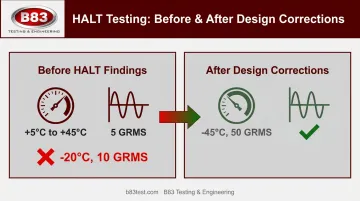
The evidence isn't just theoretical. A NASA-published review of accelerated stress methods applied to aerospace programs documents an electro-optical assembly that originally failed at -20°C and 10 GRMS against a spec of just +5°C to +45°C and 5 GRMS.
After engineers corrected PCB flatness, pad design, and solder-paste issues, the same board survived -45°C and 50 GRMS. This is a real, measurable design-margin improvement documented in NASA's own program records.
These design-margin gains matter most to industries with zero tolerance for field failures. Automotive, aerospace, and medical device manufacturers all share the same non-negotiables:
- Long service life in harsh, unpredictable environments
- Strict safety and regulatory compliance
- Consistent reliability across every production batch
Accelerated stress testing directly supports all three.
Skip this process, though, and you're gambling with:
- Undetected design margins that leave you unaware how close to failure your product actually operates
- Infant mortality failures reaching customers within weeks of shipment
- Costly recalls that dwarf the cost of testing upfront
- Reputational damage that outlasts the recall itself
Accelerated stress testing is generally an industry best practice, not a regulatory mandate. IEC 62506, the international standard for accelerated reliability testing, explicitly frames its content as guidance rather than a compliance requirement. Standards like IPC-9592 apply narrowly to power-conversion devices, so don't treat them as universal law.
Getting reliable results requires an ISO/IEC 17025-accredited, engineer-led lab with the right combination of thermal and vibration equipment.
This is where a lab like B83 Testing & Engineering fits in, operating nine environmental chambers spanning -100°F to +500°F and five electro-dynamic shakers from 4,000 to 18,000 lbf that give programs the thermal range and vibration force needed to find real limits.
How Accelerated Stress Testing Works
At a high level, a test unit goes into a combined thermal/vibration chamber and gets stressed progressively while engineers monitor its function. Stress increases step by step until operational limits or destruct limits appear, or until manufacturing defects surface.
What goes into the process:
- Prototype or production units
- An environmental chamber with a wide temperature range and multi-axis vibration
- Custom test fixtures matched to the product's mass and mounting geometry
- Functional test instrumentation to monitor performance in real time
During testing, engineers watch for two outcomes:
- Soft failure: the unit loses function but recovers once stress is reduced (an operational limit)
- Hard failure: the unit doesn't recover; permanent damage has occurred (a destruct limit)
Reliability engineers set the step increments and decide when to stop based on these results. Development-phase test outputs feed directly into design corrective actions and become the foundation for setting safe production screening stress levels.
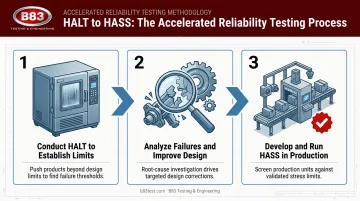
Step 1: Establish Operational and Destruct Limits Through Development Testing
Engineers apply progressively increasing thermal and vibration stress to a small sample of units, hunting for operational and destruct limits. As weaknesses surface, they fix them and retest, repeating the cycle until no new design flaws appear.
Step 2: Analyze Failures and Improve the Design
Every discovered weakness goes through a precipitation-detection-failure analysis-corrective action cycle. Engineers diagnose the root cause, redesign the affected component or process, then retest to verify the fix actually worked.
Step 3: Develop and Run Production Stress Screening
Production screening stress profiles get set somewhere between normal operating limits and the destruct limits found during development testing. That screen then runs against a high percentage of production units, often 100%, catching manufacturing defects before they ship out the door.
Where Accelerated Stress Testing Is Applied
Accelerated stress testing shows up across a wide range of product categories:
- Electronic assemblies and power-conversion modules
- Automotive subassemblies and electrical controls
- Medical devices and life-support equipment
- Aerospace and defense components
- Industrial and agricultural equipment
Typical triggers for running these tests include a new product introduction, a design phase ahead of qualification testing, a supplier or component change, or an update to the manufacturing process itself.
What Affects Your Results
Several factors determine whether your accelerated stress testing program actually delivers useful data:
- Fixture design and vibration transmission: a poor setup can distort or dampen the actual stress reaching the product, hiding real failure points
- Chamber capability: temperature range, ramp rate, and degrees of freedom all matter
- Sample size and production scale: enough units to find real patterns, not noise
- Functional monitoring setup: you can't catch a soft failure you're not measuring
Running accelerated stress testing properly requires a capable chamber, well-designed fixtures, functional test equipment, and engineers who know how to read the results.
At B83, custom fixture design is a core part of how we approach vibration and shock programs. Our servo-hydraulic systems complement electro-dynamic testing, covering lower-frequency, higher-force mechanical loading alongside thermal and vibration stress.
Common Misconceptions and When Accelerated Stress Testing May Not Fit
A few myths persist around this methodology, and they cause real problems when teams act on them.
Misconception: Development stress testing predicts exact field life or MTBF. It doesn't. It is a discovery, test-to-fail method meant to find weak points, not a reliability demonstration test that produces a life estimate.
Misconception: Production stress screening works fine without prior development-phase testing. Skipping development testing means you don't know your product's actual operational and destruct limits. Without that data, you can't safely set aggressive production screening stress levels, and you risk either damaging good units or missing real defects.
When accelerated stress testing may not be the right call:
- Extremely low-volume or one-off custom products where the learning doesn't justify the cost
- Mature, field-proven designs with a long track record and no recent changes
- Projects where budget or timeline genuinely can't support a proper development-to-production screening implementation
Applying development and production stress testing in the correct sequence is what delivers value here, not blind adoption because a competitor does it.
Partnering with an experienced, ISO-accredited independent lab like B83 Testing & Engineering helps ensure your test profiles and equipment match your product's real-world requirements, rather than a generic template.
Frequently Asked Questions
What is accelerated stress testing?
Accelerated stress testing is a reliability methodology that applies elevated thermal, vibration, and other environmental stresses to products - beyond their normal operating limits - to expose design weaknesses during development and screen for manufacturing defects during production.
What is the difference between development stress testing and production stress screening?
Development stress testing happens during the design phase and is exploratory by nature, pushing units to operational and destruct limits to learn where weaknesses exist. Production stress screening happens during manufacturing, uses non-destructive stress levels derived from prior development testing, and screens for workmanship defects.
What are the requirements for accelerated stress testing?
You need a combined thermal/vibration chamber with a wide operating range, product-specific fixtures, functional monitoring instrumentation, and experienced reliability engineers to interpret results and guide stress increments.
How long does an accelerated stress testing campaign typically take?
A development-phase stress test typically runs several days to a few weeks depending on product complexity and how many design iterations are needed. Production screening cycles are generally shorter per unit, since the stress profile is already established and focused on defect detection.
Is production stress screening necessary for every manufactured product?
Not necessarily. Production stress screening delivers the most value for high-reliability, high-volume, or safety-critical products. Simple, low-risk, low-volume items often don't justify the cost and complexity of a full screening program.
Which industries rely most on accelerated stress testing?
Automotive, aerospace and defense, medical devices, and industrial electronics rely on it most, driven by strict reliability and safety demands. Usage varies by sector based on product complexity and regulatory requirements.