Introduction
You've spent weeks perfecting your product, sourcing suppliers, and building your listing. Then your FBA shipment gets flagged at the fulfillment center.
Wrong barcode placement. Insufficient cushioning. A missing suffocation warning on a poly bag. Now you're staring at a rejected shipment, mounting fees, and inventory that isn't generating a single sale.
This scenario plays out for sellers every week. Amazon's packaging rules aren't suggestions. They're strict, detailed, and enforced through automated scanning systems that don't make exceptions for "close enough."
This guide breaks down what actually matters: box specifications, barcode requirements, product-specific prep rules, approved materials, and the durability benchmark every shipment needs to clear — the 3-foot drop test.
We'll also cover the most common mistakes that trigger rejections and how pre-shipment validation testing can catch problems before they cost you a full shipment run.
Key Takeaways
- Boxes must be six-sided, corrugated, and within Amazon's weight and dimension limits, with a scannable barcode and unique Box ID label
- Product category dictates extra prep: poly bags, fragile goods, liquids, and electronics each carry distinct requirements
- Only approved cushioning materials pass inspection; packing peanuts, foam strips, and shredded paper are banned outright
- The 3-foot drop test (five drops across base, top, sides, and a corner) is the industry benchmark for durability
- Non-compliant inventory risks refusal or disposal at your expense, so validate packaging before shipping
Amazon's General FBA Packaging Requirements
Before you touch a single product category, there's a baseline every FBA shipment must clear. These rules apply whether you're shipping phone cases or power tools.
Box Dimensions, Weight & Durability Standards
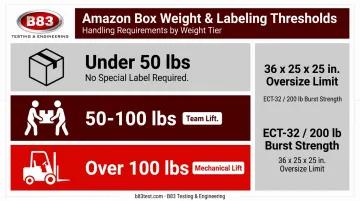
Amazon's current shipping and routing requirements allow boxes up to 50 lbs as standard, with a ceiling of 65 lbs for single oversized items that can't reasonably be split into smaller units. Dimensions matter too: boxes permitted to exceed 50 lbs must stay within 36 x 25 x 25 inches (length x width x height).
Weight triggers labeling requirements:
- Over 50 lbs: Requires "Team Lift" labels on the top and sides
- Over 100 lbs: Requires "Mechanical Lift" labels on the top and sides
Construction matters just as much as size. Every box needs to be six-sided and rigid, holding its shape under medium pressure without collapsing. Amazon points to ECT-32 edge-crush strength or 200 lb burst strength as the corrugated benchmark. Double-wall corrugate is worth the extra cost for heavier items or anything shipping across multiple legs of Amazon's network.
Independent labs test packaging against these exact benchmarks before a design goes into production. B83 Testing & Engineering, for instance, runs ISTA and Amazon-specific package simulation testing to confirm a box construction meets ECT and burst-strength requirements ahead of a full shipment run.
Barcode & FNSKU Requirements
Every unit needs a scannable barcode, but which one depends on your setup. Manufacturer barcodes (UPC, EAN, JAN, ISBN) work if you're a brand owner selling your own goods with no mixed inventory risk. Amazon's own barcode, the FNSKU, becomes necessary when multiple sellers list the same product under one listing.
A few things sellers get wrong here:
- If you use an Amazon barcode, any other scannable barcode on the unit must be covered to prevent scan conflicts
- Barcodes must stay scannable after prep: bubble wrap, poly bagging, or shrink film can obscure them if applied carelessly
- A GTIN exemption applies only when your product lacks an approved identifier; it doesn't remove the requirement for unit-level identification
Note that reseller commingling practices are changing. Starting March 31, 2026, brand owners can continue using manufacturer barcodes without stickers, but resellers will be required to use Amazon barcodes. If you're reselling branded goods, plan for that shift now.
Box, Pallet & Label Placement Rules
Every carton needs its own unique FBA Box ID label. Reusing one from a prior shipment is a fast way to create receiving errors. Place both the Box ID and carrier label on a flat surface, never wrapped around a corner or laid over a seam where the scanner can't read it cleanly.
Pallet shipments follow a different rule: Seller Central generates four copies of each pallet label, and each one goes on the top center of a different side. Missing even one side can slow receiving at the fulfillment center.
Label and placement errors (overlapping barcodes, missing suffocation warnings, mislabeled sets) remain one of the most common reasons shipments get flagged before they even reach the sorting floor.
Product-Specific Packaging Rules You Can't Ignore
General box rules only get you halfway there. Amazon's prep guidance spans over a dozen product categories, and category-specific errors can sink an otherwise compliant shipment.
Poly Bags, Sets & Loose Items
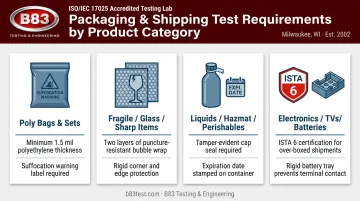
Poly bags need to be transparent and at least 1.5 mil thick. If the bag's opening measures 5 inches or larger when laid flat, it requires a suffocation warning label in a readable font size. This trips up more sellers than almost any other single rule.
For bundled products, Amazon expects one enclosed package labeled clearly:
- "Sold as set"
- "Ready to ship"
- "This is a set. Do not separate."
Item-level barcodes inside a set need to be covered so scanners don't mistake individual pieces for standalone units.
Fragile, Glass & Sharp Items
Fragile and glass products require two layers of bubble wrap minimum, with no part of the product exposed. Multi-item sets need each piece wrapped individually, not just bundled together under one layer. Sharp items, including knives, blades, and tools with exposed edges, need puncture-resistant packaging that won't tear during handling or sorting. For example, ceramic mugs and glass ornaments shipped as a set each need their own wrap layer, even when boxed together.
Liquids, Hazmat & Perishables
Liquid products with a manufactured double seal generally need less additional prep. Without one, Amazon's cap seal requirements apply to non-hazmat, non-fragile items at 4.2 oz (125 mL) or more, using an eligible closure like a twist cap, flip-top, or hand pump.
Hazmat liquids fall under Amazon's separate dangerous goods program, and prep requirements vary by classification. Don't assume a single bagging rule covers every hazmat product.
For food, supplements, and OTC items, expiration dates need to appear on each unit. If the outer carton contains multiple expiration-dated units, the date must also appear on the carton in 36-point type or larger, using an accepted format like MM-DD-YYYY.
Electronics, TVs & Batteries
TVs meeting certain size thresholds require ISTA 6-Amazon.com-SIOC certification: 2018 models at 40 inches or larger, and 2019-or-later models at 32 inches or larger. Meeting this standard typically means running your packaging through independent lab testing rather than guessing based on in-house drop tests. Independent labs such as B83 Testing & Engineering can run this certification testing to confirm compliance before a shipment reaches Amazon's fulfillment network.
Batteries need rigid packaging that keeps them from shifting and prevents terminals from contacting metal, including other batteries' terminals. Loose batteries rattling around in a poly bag are an easy way to fail inspection.
Best Practices to Prevent Damage & Validate Drop-Test Compliance
Meeting the letter of Amazon's rules is one thing. Building packaging that actually survives the fulfillment network is another. Here's what separates shipments that arrive intact from the ones that don't.
Cushioning and sizing basics:
- Leave a minimum of 2 inches of cushioning on all sides using approved materials, such as bubble wrap, kraft paper, or air pillows
- Choose a box close to the product's actual dimensions; too much empty space lets contents shift during transit
- Use the H-taping method: one seam down the center, plus both edge seams, using 2-3 inch tape. Heavier items benefit from reinforced corners
Understanding the 3-Foot Drop Test
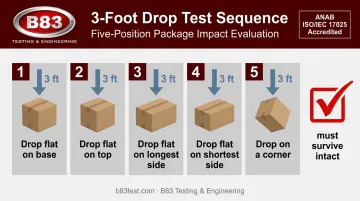
Amazon's fragile products policy outlines a five-drop sequence from 3 feet onto a hard surface:
- Flat on the base
- Flat on the top
- Flat on the longest side
- Flat on the shortest side
- On a corner
The package must survive all five drops without breakage, leakage, or exposed damage. Informal in-house testing, dropping a box off a table a few times, rarely replicates these exact conditions, which is why packaging that "seems fine" at home still fails in the field.
Consider this: industry data on unit loads arriving at distribution centers shows average case damage around 2%, with some loads running as high as 11%. Yet less than 1% of products inside those cases actually arrive damaged. The lesson: solid packaging absorbs that abuse long before it reaches your product.
For fragile, high-value, or electronics products requiring ISTA 6 certification, validating your design through an ISO/IEC 17025-accredited independent lab removes the guesswork. This is where a facility like B83 Testing & Engineering fits in.
As an ISO/IEC 17025-accredited lab with hands-on ISTA package testing experience, B83 runs vibration, mechanical shock, and drop-test simulation to confirm packaging holds up under Amazon's real-world handling conditions, before you commit to a full shipment run and find out the hard way.
Keep your test results on file. Photos and lab reports become supporting evidence if you ever need to dispute a damage claim or push back on a reimbursement denial.
Approved vs. Prohibited FBA Packaging Materials
Not all cushioning is created equal in Amazon's eyes. Some materials interfere with the automated systems that sort and scan every shipment moving through a fulfillment center.
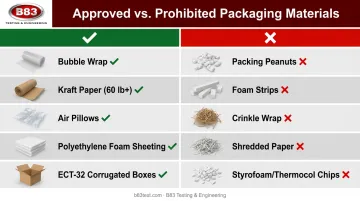
Approved materials:
- Bubble wrap or small-cell bubble sheeting
- Kraft paper (60 lb+ basis weight)
- Air pillows
- Polyethylene foam sheeting
- RSC or B-flute corrugated boxes rated at ECT-32 or higher
Prohibited materials:
- Packing peanuts (including biodegradable versions)
- Foam strips
- Crinkle wrap
- Shredded paper
- Thermocol chips and Styrofoam
If you're already using these approved materials, consider Amazon's Ships in Product Packaging (SIPP) program, formerly known as SIOC. Enrolled products ship without Amazon's added delivery packaging, cutting prep steps and appealing to buyers who care about excess packaging waste.
SIPP isn't a blanket exemption, though. Barcode, fragile-item, and battery prep rules still apply — the program only reduces outer packaging layers for qualifying products.
Common Packaging Mistakes That Trigger Rejected FBA Shipments
Most rejections trace back to a handful of repeat offenders.
Insufficient cushioning or flimsy boxes. Thin single-wall corrugate on heavy items, or skimping on void fill, leads to damaged goods showing up at customers' doors. That translates directly into negative reviews and returns you'll have to absorb.
Incorrect or missing labeling. Missing suffocation warnings, overlapping barcodes, and mislabeled sets remain the single biggest cause of receiving delays. Inventory can sit stranded at the fulfillment center while you sort out a labeling fix. That's time your competitors don't have to lose.
Over-packaging. Oversized boxes stuffed with excess dunnage cost more to ship and work against Amazon's sustainability push. It's also just wasted money — you're paying for cardboard and cushioning your product doesn't need.
Noncompliant inventory can be refused or disposed of at your expense, and it typically isn't eligible for reimbursement. With Amazon having phased out its general US FBA prep and labeling services, catching these mistakes before you ship matters more than ever. Independent package testing, like the ISTA and Amazon simulations B83 Testing & Engineering performs, can catch these failures before a single box leaves your warehouse.
Frequently Asked Questions
What are the packaging requirements for Amazon?
Amazon's core requirements cover compliant six-sided box construction within weight and size limits, scannable barcodes with proper Box ID labeling, and product-specific prep like bubble wrap or suffocation warnings depending on category.
What is Amazon's 3-foot drop test and how is it performed?
It's a five-drop sequence from 3 feet onto a hard surface: base, top, longest side, shortest side, and one corner. The package must survive intact with no breakage or leakage.
What box sizes and weight limits does Amazon allow for FBA shipments?
Standard boxes max out at 50 lbs, with a 65 lb ceiling for single oversized items within 36 x 25 x 25 inches. Boxes over 50 lbs need Team Lift labels; over 100 lbs require Mechanical Lift labels.
What packaging materials are prohibited by Amazon?
Amazon bans packing peanuts (including biodegradable versions), foam strips, crinkle wrap, shredded paper, and Styrofoam from FBA shipments, regardless of the product inside.
Do all poly bags need a suffocation warning label?
Only bags with an opening of 5 inches or larger, measured flat, require the warning label. Smaller openings are exempt, but the bag still needs to meet the 1.5 mil thickness requirement.
What happens if my FBA shipment doesn't meet Amazon's packaging requirements?
Noncompliant shipments can be rejected outright, and inventory that arrives unsafe or out of spec may be refused or disposed of at your expense without reimbursement. Repeated issues can also delay or block future shipments.