Terms like "environmental testing" and "climatic testing" get thrown around constantly, but the actual mechanics — control parameters, standards, and the decisions behind a valid test program — are often poorly understood at an operational level. That gap has real consequences. This article breaks down what the process is, why it matters, how it actually works, and where it gets applied.
Key Takeaways
- Thermal and moisture exposure reveals design weaknesses before they cause field failures.
- Testing validates reliability, supports ISO, ASTM, MIL-STD, and IEC compliance, and cuts warranty costs.
- The process follows three phases: preconditioning, exposure, and evaluation.
- Chamber accuracy, test duration, and cycling profile determine whether results are meaningful.
- Accredited ISO/IEC 17025 labs deliver traceable, legally defensible data for critical applications.
What Is Temperature and Humidity Testing?
Temperature and humidity testing is the controlled exposure of a product or material to specified relative humidity (RH) levels (held steady or cycled) inside an environmental chamber. Engineers monitor the sample throughout for performance changes, degradation, or outright failure.
The goal is verified confidence: a product will function reliably across the range of climates it's expected to encounter during its service life.
A control panel that runs fine at 72°F in a dry lab tells you nothing about how it behaves during a humid summer in Houston or a cold snap at altitude. Controlled chamber testing closes that gap before the product ever ships.
How It Differs From Thermal Shock and Salt Spray Testing
Temperature and humidity testing shares the environmental-testing category with related methods, but each one isolates a different stressor:
- Thermal shock testing forces rapid temperature transitions (minutes, not hours) to stress material expansion and contraction limits, distinct from steady or gradually cycled humidity exposure
- Salt spray/corrosion testing adds a corrosive salt fog into the mix, evaluating corrosion resistance on metals and coatings specifically, per methods like ASTM B117
- Combined temperature/humidity testing isolates moisture-driven effects (condensation, corrosion, seal degradation) and can pair with cyclic temperature swings to mimic real seasonal weather
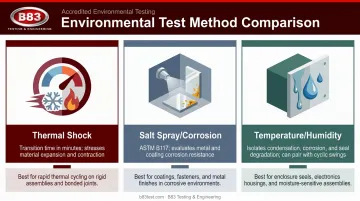
Picking the wrong method wastes budget. A connector housing prone to condensation-driven corrosion needs damp heat exposure, not a rapid thermal shock cycle designed for a completely different failure mode.
Why This Testing Matters for Product Development
Manufacturers run this testing for three practical reasons:
- Consistency across production batches
- Safety by catching moisture-related risks before they reach the field
- Compliance with industry and regulatory standards
Skip it, and problems surface after the product is already in a customer's hands, which is the expensive way to find out.
The cost case is significant. According to a landmark study conducted for the FHWA and NACE, metallic corrosion costs the U.S. economy more than $276 billion annually, or roughly 3.1% of GDP.
That figure spans infrastructure, transportation, and manufacturing broadly. It's not a warranty-claims number, but it puts real weight behind why moisture-driven degradation deserves attention before a product leaves the design phase.
Without proper testing, common failure modes go undetected until field deployment:
- Corrosion on connectors, fasteners, or exposed metal surfaces
- Electrical shorts caused by condensation inside enclosures
- Seal and gasket failures that let moisture infiltrate over time
- Material degradation in polymers, coatings, or composites exposed to humidity cycling
Whether this testing is mandatory or optional depends on the industry:
- Automotive electronics – ISO 16750-4
- Aerospace equipment – RTCA DO-160's humidity section
- Medical devices – IEC 60601-1
- Agricultural and construction equipment – SAE J1455 or ISO 19014-3
In some cases the testing is regulatory. In others, it's simply the industry benchmark nobody skips. B83 Testing & Engineering runs humidity, thermal cycling, and environmental chamber profiles that map directly to these standards, giving manufacturers documented proof before a product ships.
How Temperature and Humidity Testing Works (Conceptual Flow)
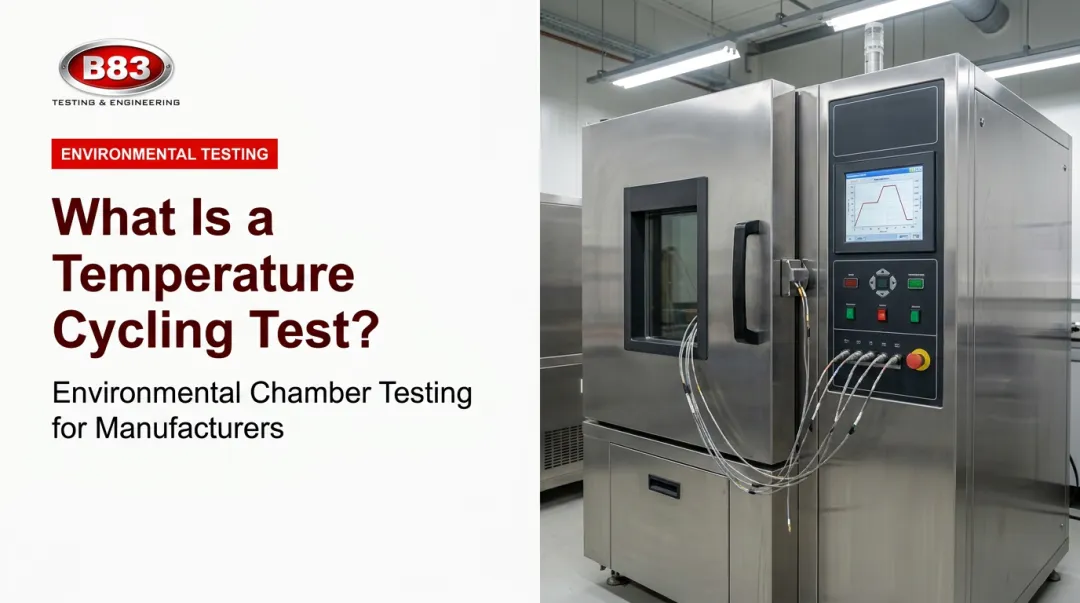
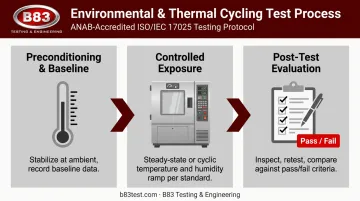
At a high level, the process is simple: a product goes into an environmental chamber and gets brought to specified temperature and humidity setpoints. It then holds or cycles through a defined profile while being monitored throughout for changes. What goes into it matters just as much as what comes out.
Every test program needs three inputs:
- The test sample itself
- A target specification: a customer requirement or a standard like ISO, ASTM, or MIL-STD
- A defined duration or number of cycles
Calibrated sensors, PID control loops, and uniform air circulation keep the chamber locked onto setpoints throughout the run. Without that precision, results aren't repeatable, and a test that can't be repeated isn't worth much to anyone reviewing the data later.
Step 1: Preconditioning and Baseline Measurement
Before exposure begins, the product stabilizes at ambient or reference conditions. Engineers record baseline functional or dimensional data at this stage, establishing the comparison point for everything that follows.
Step 2: Controlled Exposure (Steady-State or Cyclic)
The chamber ramps to target temperature and RH setpoints. Depending on the governing standard, it either holds those conditions for an extended dwell (steady-state) or cycles between extremes on a defined profile (cyclic).
IEC 60068-2-78, for example, specifies preferred durations ranging from 12 hours up to 56 days for steady-state damp heat testing. Cyclic methods often run on 12-hour-on, 12-hour-off structures designed to intentionally produce surface condensation.
Step 3: Post-Test Evaluation and Data Analysis
After exposure, the product gets inspected and functionally tested again. Engineers compare results against the baseline and pre-defined pass/fail criteria to determine whether performance degraded, and by how much.
Where It's Applied and Key Factors That Affect Results
Where the Process Is Applied
Temperature and humidity testing shows up wherever a product needs to survive real-world climate variation:
- Electronic assemblies and wiring harnesses
- Automotive components and connector systems
- Medical devices and electrical equipment
- Aerospace parts and avionics
- Agricultural and construction equipment electronics
Testing typically happens at four points in a product's lifecycle: design validation, pre-production qualification, periodic requalification, and field-failure investigation.
Common triggers include a new product launch, a material or supplier change, a new regulatory requirement, or a customer complaint that points back to environmental exposure. Depending on the situation, it's one-time qualification work, a periodic requalification cycle, or an ongoing reliability monitoring program.
Key Factors That Affect the Process
Results depend on more than just the setpoints you dial in.
- Material properties — hygroscopicity, coatings, and seal or gasket quality all shape how a product responds to moisture exposure
- Operating conditions — rate of temperature change, dwell time, and RH uniformity inside the chamber directly affect whether results are representative
- Equipment dependencies — chamber calibration accuracy is critical; run tests through an ISO/IEC 17025-accredited lab with well-maintained chambers for defensible data
- Scale and frequency — single-unit screening versus batch testing, or short screening versus extended-duration reliability testing, changes both project scope and cost
- Standards-driven constraints — MIL-STD-810, IEC 60068-2-78, ISO 6270-2, and various ASTM standards each dictate specific temperature/RH ranges and cycle counts for their respective industries
This is where lab capability actually matters. B83 Testing & Engineering runs nine environmental chambers spanning -100°F to +500°F under ANAB-accredited ISO/IEC 17025 procedures, which supports both wide-range temperature work and combined temperature/humidity programs without shuffling samples between facilities.
Common Issues, Misconceptions, and When Testing May Not Be Appropriate
A few misconceptions come up constantly, and they're worth clearing up before they cause an expensive mistake.
One test condition doesn't represent every real-world climate. A product tested at a single humidity severity band doesn't automatically prove reliability across a full climate range; the test only validates the specific profile it ran.
Passing a test isn't the same as guaranteeing field performance. Standards like ASTM D2247 explicitly caution against representing chamber results as equivalent to natural environmental exposure without an established correlation. A pass means the product met a defined profile, not that it's bulletproof everywhere.
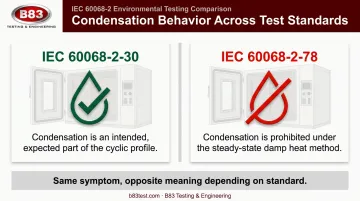
Misinterpretation happens often, too. Visible condensation on a specimen doesn't automatically mean failure — some test methods (like IEC 60068-2-30) intentionally produce condensation as part of the profile, while others (like IEC 60068-2-78) prohibit it entirely. Reading a cosmetic artifact as a functional failure, or vice versa, skews conclusions.
That same logic applies to how much testing a product actually needs. Full testing isn't always necessary. A low-risk, indoor-only product with no moisture exposure path probably doesn't need an 85°C/85% RH reliability program.
One clear warning sign that testing is being run "by default" rather than by actual need: there are no pass/fail criteria tied to how the product is actually used.
Conclusion
Temperature and humidity testing validates real-world reliability by exposing products to controlled, standards-based thermal and moisture conditions. Simply running a test isn't enough, though: choosing the correct standard, chamber profile, and accredited lab is what determines whether the results hold up.
B83 Testing & Engineering is an engineer-owned, ISO/IEC 17025 ANAB-accredited independent testing laboratory in Milwaukee, Wisconsin. We offer environmental and climatic testing, including temperature/humidity, thermal shock, and combined environmental programs, for automotive, aerospace, medical device, and industrial equipment clients. If you're planning a qualification or requalification program, reach out to our engineering team to talk through your specific requirements.
Frequently Asked Questions
Is 70% humidity really humid?
Yes, 70% relative humidity is generally considered high for indoor comfort and for most product environments. Accelerated product testing typically pushes even higher, often in the 82-96% RH range, to compress years of exposure into weeks.
What are signs of high humidity in a home?
Common indicators include condensation on windows, musty odors, and visible moisture on walls or pipes, according to the EPA's guide to mold and moisture. Controlled humidity testing evaluates these same principles (condensation and corrosion) in products rather than living spaces.
Can mold grow in 50% humidity?
Mold risk generally increases once relative humidity climbs above roughly 60%, though 50% isn't risk-free for every material. Products meant for humid environments get tested at controlled RH levels specifically to verify resistance to moisture-related and microbial degradation.
What standards govern temperature and humidity testing?
Common standards include MIL-STD-810 (Method 507), IEC 60068-2-78, ASTM D2247, and ISO 6270-2. The right standard depends heavily on the industry and the specific product type being evaluated.
What's the difference between temperature testing and humidity testing?
Temperature testing isolates thermal effects like expansion, contraction, and material limits. Humidity testing isolates moisture effects like corrosion and condensation. Combined temperature/humidity testing evaluates both simultaneously for a more realistic picture.
How long does a typical temperature and humidity test take?
Duration ranges from a few hours for basic screening to several weeks for accelerated life or reliability testing. It depends on the governing standard, the number of cycles required, and the specific product's service-life expectations.