Introduction
A package leaves your warehouse in perfect condition. It gets dropped on a conveyor belt, vibrated for six hours in the back of a truck, stacked under 400 pounds of other freight, and baked in a hot trailer during a layover.
Most of that damage never gets logged anywhere — it just shows up as a broken product, a return, or a one-star review.
Product damage during shipping drives returns, warranty claims, regulatory rejections, and lost customer trust. For medical device and automotive component manufacturers, a packaging failure can also mean a failed audit or a delayed launch.
One clarification up front: this guide covers distribution testing as it applies to packaging and transit performance (think ASTM D4169 and ISTA), not statistical "distribution testing" used in data analysis. If you're here for packaging science, you're in the right place.
From here, we'll break down how distribution testing works, which standards apply, and what a solid testing program looks like in practice.
Key Takeaways
- Distribution testing recreates shipping hazards, shock, vibration, compression, and climate, in a controlled lab
- ASTM D4169 and ISTA are the two leading standards for regulated and consumer industries
- Test plans follow a structured "distribution cycle" that sequences multiple hazards together
- Benefits include fewer damage claims, lower warranty costs, and stronger regulatory standing
- Working with an ISO/IEC 17025-accredited lab produces repeatable, defensible test data
What Is Distribution Testing?
Distribution testing is a lab-based simulation of the shipping and handling environment. It answers one practical question: will this package and its contents survive real-world distribution?
Instead of shipping product and waiting to see what breaks, manufacturers run controlled tests that mimic the bumps, drops, stacking pressure, and temperature swings a shipment will actually experience. This gives engineering teams a repeatable way to catch problems before committing to full production runs.
Common reasons companies run distribution testing include:
- Qualifying a new package design before scaling production
- Reducing cost or material use, such as lightweighting cartons or switching cushioning materials
- Troubleshooting recurring damage claims from customers or distribution centers
- Supporting regulatory submissions, particularly for medical devices and pharmaceuticals
Common Standards Used
Two standards dominate this space, and picking the right one shapes the entire test plan.
ASTM D4169 — officially titled Standard Practice for Performance Testing of Shipping Containers and Systems — is widely used in FDA-regulated industries. The standard works by assigning a "Distribution Cycle" to a shipment, then sequencing hazard elements (shock, vibration, compression, and more) to match that cycle.
Tests run sequentially on the same unopened shipping unit, so labs can evaluate cumulative damage rather than isolated events. According to ASTM's current standard listing, the practice does not replace existing material specifications, and it hasn't determined suitability for hazardous materials shipments.
The most common cycle referenced in practice is DC-13, built for single packages up to 150 lbs moving through small parcel and overnight air/motor freight. A typical DC-13 sequence runs through these hazard elements, in order:
- Manual handling
- Warehouse and vehicle stacking
- Vibration
- Low-pressure (altitude) exposure
- Concentrated impact testing
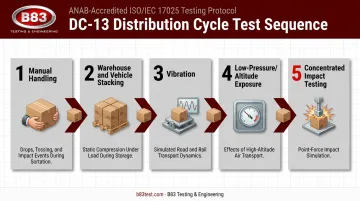
Custom cycles can be built when a shipment follows a known or unusual path.
ISTA (International Safe Transit Association) develops its own family of test procedures, ranging from basic screening tests (1-Series) to fully custom, field-data-driven protocols (4-Series and beyond). ISTA is used heavily in retail and e-commerce, with procedures like ISTA 3L, a data-driven test built specifically for single-parcel and LTL e-commerce fulfillment shipments.
ASTM D4169 skews toward regulated and industrial applications; ISTA skews toward retail and consumer packaging, though overlap between the two is common.
Why Distribution Testing Matters (Key Benefits)
Skipping distribution testing doesn't eliminate risk. It just moves that risk from your test lab to your customer's doorstep, and that's a far more expensive place for it to show up.
Core benefits of a distribution testing program:
- Reduces product damage and shipment-related returns before packaging enters full production
- Lowers warranty costs and insurance premiums through documented, repeatable risk mitigation
- Validates whether sustainability changes, like lighter materials or reduced cushioning, actually hold up under stress
- Supports regulatory and retailer compliance, especially for medical device packaging systems
- Builds confidence in design decisions before locking in expensive tooling or large production runs
- Strengthens brand reputation through demonstrated, third-party-verified quality assurance
The value of catching failures early isn't theoretical. One documented package test, described in Packaging Digest's review of real-world testing outcomes, involved 48 hours of conditioning followed by impact, compression, and vibration testing.
The result: 90% of tested pouches developed punctures during end-down impact drops. That's a failure mode a company would much rather discover on a lab bench than in a customer's mailbox.
Even so, a passing result doesn't guarantee permanent protection. Supply chains shift, carriers change, and distances grow. A packaging system validated for one distribution path can still fail if the actual shipping conditions evolve without a retest.
How Distribution Testing Works – Step by Step
This reflects how testing labs actually structure a project from intake to final report. Three mistakes come up again and again: skipping pre-test product inspection, using a generic test plan instead of shipment-specific data, and only inspecting the outer box post-test while missing damage to the actual product inside.
Here's how a distribution testing project unfolds, step by step:
- Define the objective and applicable standard. Identify the product, packaging system, and intended distribution mode — small parcel, LTL, ocean freight, air, or rail. This determines whether ASTM D4169, an ISTA protocol, or a custom cycle fits best.
- Gather package and shipment data. Collect package dimensions, weight, product configuration and quantity, and buffer materials like foam inserts, dividers, or loose-fill peanuts. This data drives an accurate, shipment-specific test plan rather than a generic one.
- Select the test plan and distribution cycle. Choose or customize a Distribution Cycle, such as DC-13, or an ISTA procedure that sequences hazard elements to mirror the real shipment path the product will travel.
- Apply the core hazard tests. Four hazard categories form the backbone of most distribution test plans:
- Vibration — simulates truck, rail, or conveyor transport over time
- Shock/drop testing — replicates impact from manual handling and mishandling
- Compression — recreates stacked pallet loads in warehouses and trailers
- Atmospheric/climatic testing — exposes packaging to altitude and temperature extremes
- Inspect and interpret results. Conduct pre- and post-test inspection of both the exterior packaging and the actual contents, checking for broken glass, leaking seals, or chipped components, against pre-defined acceptance criteria. This step catches what a passing outer box can hide: a product that didn't survive.
- Act on findings and optimize. Use results to redesign packaging — thicker foam liners, alternate cushioning materials, revised carton structure — then retest to confirm the fix works before finalizing the packaging system.
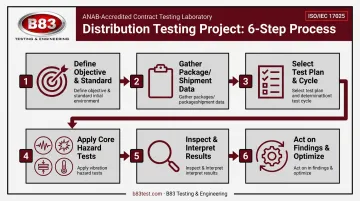
Here's how these steps play out on an actual shipment.
Example Case Walkthrough
Picture a fragile glass-bottled product headed for small-parcel shipment. The objective: confirm the bottle survives typical parcel handling. The team pulls shipment data (package weight, bottle configuration, cushioning type) and selects DC-13 as the closest match to the real distribution path.
During testing, a common mistake surfaces: inspecting only the outer carton and missing that the bottle inside cracked during the concentrated impact schedule. A thorough post-test inspection catches it. The fix? Adding a thicker foam insert around the bottle's shoulder, then retesting the revised package against the same DC-13 sequence to confirm the crack no longer occurs.
How B83 Testing & Engineering Can Help
B83 Testing & Engineering is an ISO/IEC 17025:2017 ANAB-accredited, engineer-owned independent lab based in Milwaukee, Wisconsin. The lab performs package and pallet testing designed to simulate real-world distribution conditions, evaluating how well packaging protects its contents through shipping and handling. This includes testing to Amazon, ISTA, and SAMS packaging requirements.
B83's equipment supports the core hazard elements that drive a distribution test plan:
- Five electro-dynamic shakers, ranging from 4,000 to 18,000 lbf, for vibration and shock testing
- Nine environmental chambers, spanning -100°F to +500°F, for thermal cycling and climatic exposure
- Custom fixture design capabilities for packages with unusual geometries or non-standard configurations
B83 also offers field data replication (RPC®), a capability that lets clients replicate actual field or transit conditions rather than relying solely on generic standard cycles. That distinction matters: a test built from real measured data tends to produce more representative, more defensible results than a one-size-fits-all cycle.
Working with B83 means:
- Accredited, repeatable test data backed by ISO/IEC 17025 processes
- Flexible scheduling that accommodates shifting project timelines
- Custom fixtures built for unique package shapes and sizes
- Long-term partnership support across automotive, medical device, consumer product, and industrial equipment sectors
Conclusion
Distribution testing replaces guesswork with repeatable, standards-based proof of how packaging will actually perform in transit. Rather than a single checkbox exercise, it functions as a decision-support tool that saves money and protects reputation long before a product ships.
As materials, shipping lanes, and sustainability goals continue to shift, test plans built years ago may no longer reflect the distribution path a product actually travels. Periodic review and revalidation, ideally through an ISO/IEC 17025-accredited lab like B83 Testing & Engineering, matter just as much as the original test.
Frequently Asked Questions
What is a distribution test?
A distribution test simulates shipping hazards, including shock, vibration, compression, and climate exposure, to verify that packaging protects its contents through the full distribution cycle. It catches failures before they reach customers.
What standards govern package distribution testing?
The two leading standards are ASTM D4169, used in regulated industries, and the ISTA series, common in retail and consumer goods. Teams use custom cycles for unique shipment paths.
What is the difference between ASTM D4169 and ISTA testing?
ASTM D4169 is a recognized practice frequently used by FDA-regulated industries and listed in FDA's recognized consensus standards database. ISTA offers a broader global series of protocols for retail and e-commerce use.
How much product is needed to run a distribution test?
Sample quantity depends on package size, product configuration, and the chosen distribution cycle. Testing labs typically advise on minimum quantities while designing the test plan with you.
How long does distribution testing typically take?
Duration depends on how many hazard elements and cycle repetitions the test plan includes. Labs can usually estimate timing during the quoting process once the distribution cycle is defined.
Is distribution testing required for FDA-regulated products?
It's not always mandated by name, but transit validation is commonly expected for medical device and pharmaceutical packaging qualification. Manufacturers must demonstrate that packaging protects the product through shipping and handling.