Fatigue gets discussed in technical terms: S-N curves, crack propagation, stress ratios. But its real value shows up somewhere else entirely: fewer field failures, lower long-term costs, and stronger customer trust. According to ASM International's Elements of Metallurgy and Engineering Alloys, fatigue is estimated to contribute to approximately 90% of all mechanical service failures.
This article breaks down what fatigue testing involves, why it matters for engineering and business decisions alike, and how to get the most value from a testing program before problems show up in the field.
TL;DR
- Fatigue testing evaluates how materials and components withstand repeated cyclic loading, often well below their yield strength
- Biggest payoffs: fewer catastrophic field failures and smarter material or design decisions, plus stronger regulatory and customer trust
- Skipping it invites inconsistent field performance and costly, reactive redesigns
- Full value comes from testing consistently across the product lifecycle with an accredited, independent lab
What Is Fatigue Testing?
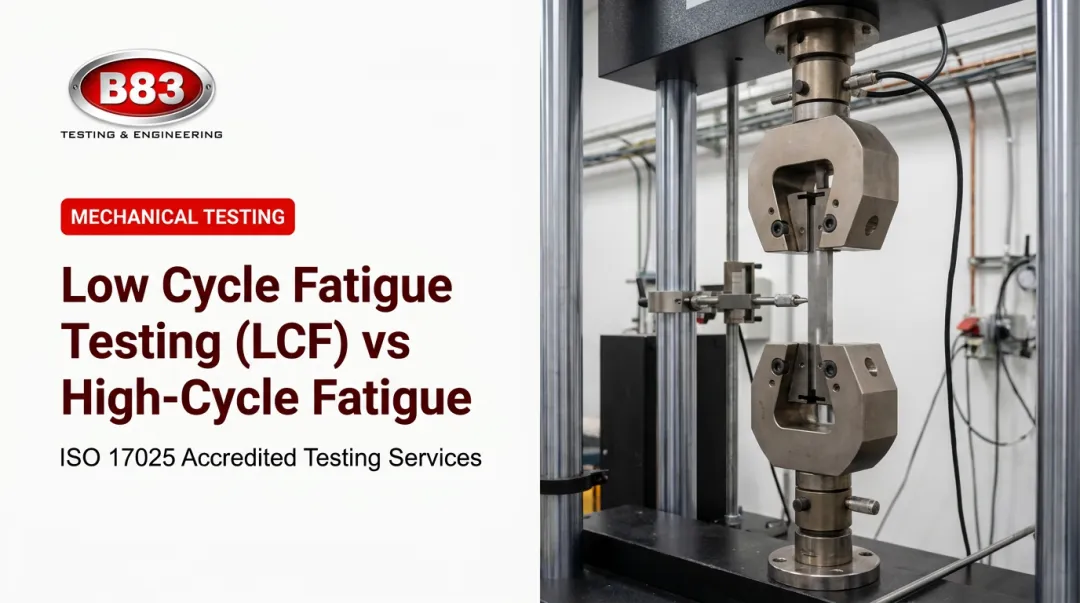
Fatigue testing applies repeated, or cyclic, loads to a material or component to see how it holds up over time. That load might be tension, compression, bending, or torsion. The key detail: components can crack and fail from cyclic stress even when the stress level sits well below the material's ultimate strength.
Think of a paperclip. Bend it once, and it survives fine. Bend it back and forth a hundred times, and it snaps. That's fatigue in its simplest form, and it's exactly why one-time load testing isn't enough for anything that experiences repeated motion or vibration in service.
Where fatigue testing shows up most:
- Automotive components (suspension parts, chassis, fasteners)
- Aerospace structures and airframe components
- Medical implants and devices
- Rail equipment and rolling stock
- Agricultural and construction machinery
- Consumer products with repeated moving parts
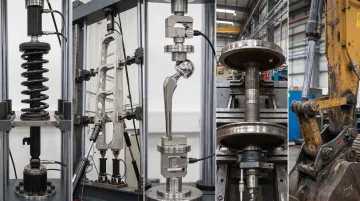
Fatigue testing isn't about watching something break for its own sake. It exists to predict real-world service life and catch failure points before they become field problems.
Labs like B83 Testing & Engineering run axial fatigue, torsional fatigue, and cyclic fatigue testing under an ISO/IEC 17025-accredited scope. The goal is a defensible answer: will this part survive its intended service life, and for how long?
Key Advantages of Fatigue Testing
The advantages below focus on outcomes businesses actively track: liability exposure, R&D and material spend, and market or regulatory trust. Not abstract material science theory.
Advantage 1: Prevents Catastrophic Failures and Reduces Liability Risk
Fatigue testing identifies crack initiation points and weak zones before a product reaches a customer. Cyclic loading under application-specific conditions, meaning matched temperature, environment, and stress range, surfaces failure modes that a single static load test cannot reveal.
Undetected fatigue weaknesses have driven some of the most severe failures in engineering history. The 1954 de Havilland Comet breakups remain a textbook example.
More recently, the ATSB traced the 2010 Qantas Flight 32 uncontained engine failure to a fatigue crack in an oil-feed stub pipe caused by a manufacturing defect. Rolls-Royce didn't disclose a fatigue-specific cost figure, but the corrective actions alone spanned nonconforming assembly removal, manufacturing changes, and a software update across the fleet.
That's the real cost of skipping thorough fatigue validation: it compounds across inspection, redesign, and reputational damage long after the initial failure.
KPIs impacted:
- Warranty claim rate
- Recall frequency and cost
- Liability exposure
- Insurance premiums
This advantage carries the highest stakes in safety-critical or heavily regulated industries, aerospace, medical devices, automotive, and rail, where failure has severe safety and financial consequences.
Advantage 2: Optimizes Material Selection and Product Design
Generic supplier spec sheets tell you very little about how a material actually performs under your application's specific cyclic stress. Fatigue testing fills that gap by comparing material grades or design iterations under identical cyclic conditions, then identifying the option that meets durability requirements without unnecessary cost.
Choosing based on spec sheets alone cuts both ways. Under-engineer, and parts fail prematurely. Over-engineer, and you're paying for durability you didn't need.
A study on 2024-T4 aluminum illustrates just how much a finishing process alone can swing fatigue performance: under matched rotating-bending conditions, hard anodizing reduced fatigue life by roughly 70%, while a PEO coating combined with epoxy impregnation increased high-cycle fatigue life by approximately 50% versus the untreated alloy. Same base material, dramatically different outcomes depending on surface treatment.
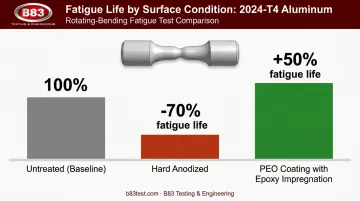
The takeaway: test the finished part, not just the raw material.
B83's mechanical testing lineup (tensile, compression, shear, torsion, plus axial and torsional fatigue) gives engineers a complete performance profile for comparing candidate materials or design variants side by side.
KPIs impacted:
- Material and production cost
- R&D time-to-market
- Product weight and efficiency
Impact runs highest in high-volume production, weight-sensitive designs like aerospace or automotive lightweighting, and cost-competitive consumer product development.
Advantage 3: Builds Regulatory Compliance and Market Trust
Fatigue testing validates product durability against recognized industry standards such as ASTM E466, ASTM E606, and ISO 1099. Documented, third-party accredited test reports create defensible evidence for design certification, customer audits, and regulatory submissions.
Data from an ISO/IEC 17025-accredited lab simply carries more weight than in-house testing. ISO notes that ISO/IEC 17025:2017 accreditation demonstrates laboratory competence and can support acceptance of test reports across borders without further retesting, reducing duplicate work and friction during audits.
Working with an engineer-owned, ANAB-accredited independent lab such as B83 Testing & Engineering means test data meets ISO/IEC 17025:2017 requirements trusted across industries, from OEM audits to regulatory submissions.
KPIs impacted:
- Certification and approval time
- Customer trust and satisfaction scores
- Insurance and compliance costs
This matters most when entering regulated markets, undergoing customer or OEM audits, or introducing new products in industries like medical devices, aerospace, and power controls.
What Happens When Fatigue Testing Is Missing or Ignored
Skip fatigue testing, or under-invest in it, and the consequences tend to show up later and cost more:
- Produces inconsistent, unpredictable field performance across production batches
- Increases rates of unexpected cracking or fracture in service
- Triggers reactive, costly redesign cycles instead of proactive fixes
- Drives up warranty, recall, and insurance costs over time
- Limits the ability to scale into regulated markets without validated durability data
These aren't hypothetical risks. The de Havilland Comet remains the clearest cautionary tale in aviation history: the FAA's official findings attributed the 1954 breakup of Comet G-ALYP, which killed all 35 occupants, to structural failure of the pressure cabin caused by fatigue.
Full-scale water-tank cycling later reproduced the failure at a corner near a squarish window opening, with the test fuselage failing after roughly 3,060 simulated pressurized flights.
Here's the part that should give every engineer pause: earlier proof-load testing had actually cold-worked the high-stress areas of the development aircraft, making that test article unrepresentative of production planes. The lesson didn't just change how testing was done. It reshaped aviation certification requirements permanently, requiring complete pressure cabins that hadn't been previously loaded for strength testing.
The takeaway carries forward decades later: a test that doesn't reproduce the actual production structure and service cycle can produce a falsely reassuring result.
How to Get the Most Value from Fatigue Testing
Fatigue testing delivers the most value when it's applied consistently across the product lifecycle, not treated as a single pre-launch checkbox. That means testing during early material selection, again during design validation, and again during production verification.
Results should get benchmarked against S-N curves, industry standards, and prior test data, then fed back into design iterations rather than filed away and forgotten.
A few practical ways to extract more value from a testing program:
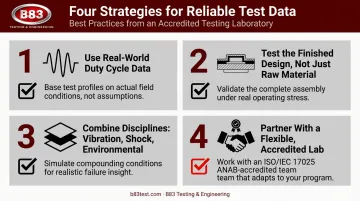
- Use real-world duty cycle data. Field data replication (RPC) captures actual operating loads, so lab testing reflects genuine service stress instead of generic assumptions.
- Test the finished design, not just the raw material. Coatings, surface treatments, and joint configurations can shift fatigue life dramatically, as the 2024-T4 coating example above shows.
- Combine disciplines when it makes sense. Many products face fatigue alongside vibration, shock, or environmental extremes in the field. Testing these together produces a more realistic durability picture than isolated tests.
- Partner with a lab that can flex with your schedule. Development timelines shift, and a lab offering custom fixture design and engineer-level support can adapt testing as project needs evolve.
B83 Testing & Engineering runs servo-hydraulic and electro-dynamic fatigue testing alongside environmental chambers spanning -100°F to +500°F. This gives manufacturers the flexibility to combine fatigue with other stress conditions under one accredited engagement, rather than juggling multiple labs.
Conclusion
Fatigue testing matters for reasons that build on each other: it prevents catastrophic failure, sharpens material and design decisions, and earns the regulatory approval and customer trust manufacturers need to compete. None of that happens from a single test run late in development.
They compound. Consistent testing throughout a product's lifecycle reduces long-term risk and cost far more than a one-off validation squeezed in before launch. Treat fatigue testing as an ongoing engineering practice, executed through an ISO/IEC 17025 ANAB-accredited partner like B83 Testing & Engineering, and durability stops being a guessing game.
Frequently Asked Questions
What is fatigue testing?
Fatigue testing applies repeated cyclic loads to a material to evaluate durability and predict service life below its ultimate strength. It shows how a part degrades over time, not just whether it breaks under one load.
How do you conduct a fatigue test?
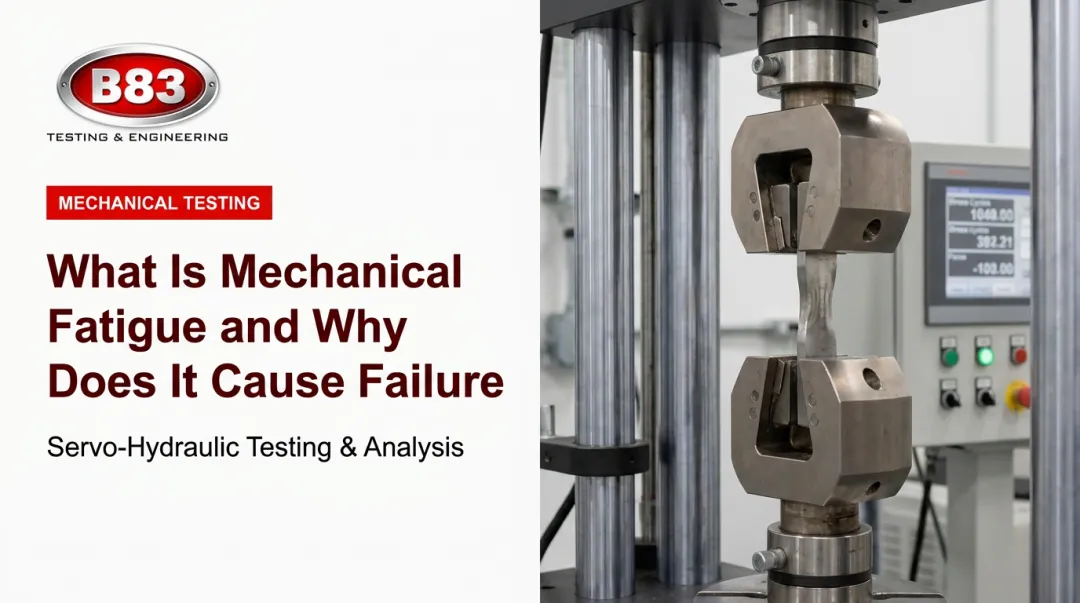
A specimen gets mounted in a fatigue tester and subjected to cyclic tension, compression, bending, or torsion loading. Testing continues until failure or a set number of cycles is reached.
What's the difference between low cycle fatigue (LCF) and high cycle fatigue (HCF) testing?
LCF involves fewer cycles at higher stress with noticeable plastic deformation, tested using strain control. HCF involves many more cycles at low, mostly elastic stress, tested via force or stress control methods like ASTM E466.
Which industries rely on fatigue testing the most?
Aerospace, automotive, rail, medical devices, and industrial or construction equipment lean on fatigue testing heavily, since their components face constant cyclic loading under safety-critical requirements. Agricultural machinery and consumer products with moving parts rely on it too.
What standards govern fatigue testing?
Common standards include ASTM E466 for force-controlled axial fatigue, ASTM E606 for strain-controlled fatigue, and ISO 1099 for axial fatigue testing of metals. Accredited labs follow these frameworks for recognized credibility.
How long does a typical fatigue test take?
Duration varies based on required load cycles, ranging from thousands to millions, plus test frequency. A fixed-cycle pass/fail test runs on a set schedule, while a run-to-failure test can take much longer.