Introduction
Ship an oversized or overweight product to Amazon without proper certification, and you'll pay for it. Literally. Amazon charges a per-unit chargeback of $1.80 to $4.40, based on shipping weight, for eligible products that skip the Ships in Product Packaging certification process.
Beyond the fees, brands face delayed onboarding, damaged inventory, and frustrated customers. Many sellers also struggle just distinguishing SIOC from FFP and PFP, or figuring out what ISTA 6 testing actually requires.
This guide breaks down what SIOC certification means, Amazon's current size and weight thresholds, and what happens during ISTA 6 testing. It also covers how to pick a testing partner that won't waste your samples or your launch timeline.
Key Takeaways
- Products exceeding 18" x 14" x 8" or 20 lbs typically trigger mandatory SIOC certification
- ISTA 6-Amazon.com defines eight package types (A-H) by weight and handling method
- Three certification paths exist: self-testing, Amazon's free Packaging Lab, or ISTA-certified third-party labs
- ISO/IEC 17025-accredited labs reduce failed tests, wasted samples, and stalled launches
What Is SIOC Packaging Certification?
SIOC stands for "Ships in Own Container." It means a product's existing packaging is sturdy enough to serve as the sole shipping container. No overbox, no additional prep at Amazon's fulfillment center — the box you send is the box that reaches the customer.
SIOC sits inside Amazon's broader Frustration-Free Packaging program, developed jointly with the International Safe Transit Association and codified as ISTA Project 6-Amazon.com. The stated goals are straightforward:
- Eliminate excess packaging materials
- Reduce product damage during transit
- Improve the unboxing experience across Amazon's network
Vendors and sellers submit packaging for testing through self-testing, Amazon's own lab, or an approved third-party lab. Once it passes, the ASIN gets certified and the chargeback risk disappears.
Comparing SIOC, FFP, and PFP: What's the Difference?
These three tiers get confused constantly, so here's the breakdown:
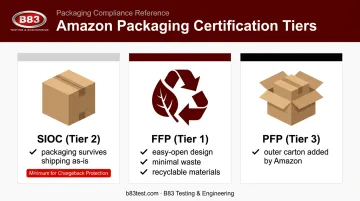
- SIOC (Tier 2): Packaging survives shipping as-is. No overbox needed.
- FFP (Tier 1): Meets all SIOC standards, plus requires easy-open design, minimal waste measured by a Box Utilization Score, and fully recyclable materials.
- PFP (Tier 3): Packaging still needs an outer carton added by Amazon before it ships.
Here's the part that trips people up: meeting SIOC requirements alone is enough to avoid chargebacks. FFP is optional and adds sustainability credentials, but it's not mandatory for chargeback protection. If your team is stretched thin, SIOC compliance should come first.
Amazon's SIOC Requirements: Size, Weight & Chargeback Rules
Amazon's published threshold for mandatory Ships in Product Packaging certification sits at 18" x 14" x 8" or 20 lbs. Cross either boundary, and certification becomes mandatory rather than optional. These figures do shift periodically, so confirm current numbers in Vendor Central or Seller Central before finalizing packaging designs.
On the smaller end, there's a floor too: products and packaging must measure at least 6" x 4" x 0.375" to even qualify for SIOC or FFP participation. Anything smaller falls outside the program's scope entirely.
Exemptions from mandatory certification include:
- Hazmat-classified ASINs with special transportation requirements
- Amazon Fresh items
- Dangerous goods and size-restricted products (EU-specific exemption)
Claims about exemptions for low-volume aged ASINs or multi-item consolidated shipments circulate among sellers, but they aren't documented in Amazon's current public policy. If a certified ASIN ships alongside other items, Amazon may still place it inside a box, bag, or envelope regardless of its SIOC status.
Beyond these exemption nuances, the real cost of non-compliance shows up in chargebacks, and they recur with every shipment. Non-compliant, qualifying ASINs incur a per-unit fee ranging from $1.80 to $4.40, scaled to shipping weight. That fee applies to every unit shipped until certification is complete, not just a single penalty. Verify the exact current fee schedule directly through your Vendor Central account, since Amazon updates these figures without much fanfare.
Who Must Comply: Vendors, Sellers & Seller Fulfilled Prime
Requirements shift depending on your relationship with Amazon:
- Retail Vendors (1P): Face mandatory ISTA 6-Series testing. Non-compliance triggers automatic SIOC chargebacks.
- FBA Sellers (3P): Enroll through Seller Central voluntarily. Certification via self-test or accredited lab testing, such as ISTA 6-Series validation performed by independent labs like B83 Testing & Engineering, can lower fulfillment fees rather than avoid penalties.
- Seller Fulfilled Prime (SFP): No explicit SIOC or FFP mandate currently published for SFP participants, though best practices still apply if you're shipping directly to Prime customers.
If you're a 1P vendor, treat certification as non-negotiable. If you're 3P, treat it as a cost-saving opportunity worth pursuing early.
Inside the ISTA 6-Amazon.com Test: What Your Packaging Must Survive
ISTA 6-Amazon.com is a general simulation test, not a carrier-specific one.
It recreates the bumps, drops, and pressure your package experiences moving through Amazon's fulfillment network, including conveyor drops, truck vibration, and stacked pallet loads, without mimicking any single shipping carrier's exact handling.
Packages get classified into eight distinct types (A through H), based on shipment method, handling approach, weight, and product category:
| Type | Shipment Mode | Key Trigger |
|---|---|---|
| A, B, C | Parcel delivery | Weight bands under/over 50 lb, 100 lb |
| D, E | LTL delivery | Weight or girth exceeds parcel limits |
| F | LTL, palletized | Standard palletized freight |
| G, H | TV/Monitor specific | Weight and girth thresholds for electronics |
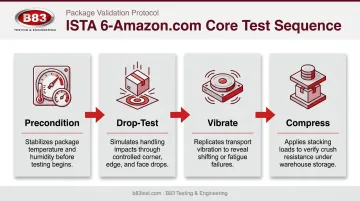
The core test sequence generally includes:
- Precondition packages to controlled temperature and humidity before testing begins
- Drop-test packages using scaled free-fall methods that simulate conveyor and handling impacts
- Vibrate packages under random conditions, run both with and without top load to mimic stacked shipments
- Compress packages horizontally and vertically to check how the box holds up under stacking pressure
Beyond this core sequence, elongated or flat packages face additional stress points: rotational drops, bridge impacts, and concentrated edge impacts designed to expose weak corners and seams.
Package geometry isn't the only variable shaping the test plan; fragility matters too. Sample requirements depend on it: non-fragile products typically need just one sample, while fragile products, meaning glass, ceramics, or liquids, generally require five samples to account for variability in how breakable materials respond to repeated shock.
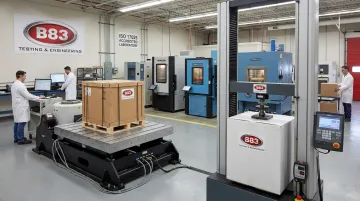
None of this happens with off-the-shelf equipment. These protocols demand electrodynamic shakers, drop testers, and compression machines, the same equipment classes you'd find inside an ISO/IEC 17025-accredited testing facility like B83 Testing & Engineering's Milwaukee lab.
How to Get Your Packaging SIOC Certified: 3 Pathways
You've got three routes to certification, and picking the right one depends on your product's weight, fragility, and category.
Vendor self-drop-test. Available for non-fragile ASINs under 23 kg (roughly 50 lbs). The process involves numbering and photographing your packages, running drop tests according to Amazon's documented procedure, and submitting an evaluation form. Low cost, but you own the risk if your methodology doesn't hold up to review.
Amazon Packaging Lab. A free option, but restricted to fragile ASINs under 23 kg for Retail Vendors. You'll need a vendor enrollment template and physical samples shipped to Amazon's lab. Free is appealing, though lab capacity constraints can mean longer waits than you'd expect.
ISTA-certified third-party labs (APASS network). Required for oversized products, heavy items, or TV/monitor products regardless of weight. Independent labs such as B83 Testing & Engineering, an ISO/IEC 17025-accredited facility, handle this route's testing and documentation. It offers scheduling flexibility and thorough documentation support beyond Amazon's other two pathways.
| Pathway | Weight Limit | Fragility Requirement | Cost |
|---|---|---|---|
| Vendor self-drop-test | Under 23 kg (50 lbs) | Non-fragile only | Low (self-funded) |
| Amazon Packaging Lab | Under 23 kg (50 lbs) | Fragile ASINs, Retail Vendors only | Free (capacity-limited) |
| ISTA-certified third-party labs | No limit | Any category; required for oversized or TV/monitor items | Quote-based |
Third-party testing costs vary by lab, product complexity, and how many test sequences your package type requires. Expect a quote-based process rather than a fixed price list.
Turnaround also varies, though many labs report roughly one to three weeks from sample intake to final report. Confirm both figures directly with any lab before committing samples.
Why Work With an Accredited Independent Testing Lab
Failed or inconsistent testing costs more than money. You lose product samples, delay Amazon onboarding, pay for repeat freight, and lose sales momentum while competitors fill the shelf space you were targeting.
ISO/IEC 17025:2017 accreditation matters here for a specific reason: it signals impartial methodology, properly calibrated equipment, and documentation that meets internationally recognized standards. That's the kind of paper trail that stands up when Amazon or a retail partner scrutinizes your results.
B83 Testing & Engineering is an ANAB-accredited, engineer-owned independent lab in Milwaukee, Wisconsin. Its capabilities line up directly with what ISTA 6 demands:
- Mechanical shock and drop testing infrastructure
- A fleet of electro-dynamic shakers ranging from 4,000 to 18,000 lbf, covering vibration testing across a wide range of package sizes
- Compression and load testing equipment for stacking and crush simulations
- Nine environmental chambers spanning -100°F to +500°F for preconditioning
With that equipment lineup in place, timing matters as much as capability. Bring in an accredited testing partner during the packaging design phase, not after you've already submitted to Amazon. Catching a structural weakness before certification saves you a redesign cycle, a second round of samples, and weeks of delay.
Reach out through B83's contact page if you're planning a packaging test cycle and want engineering input before you commit to a design.
Frequently Asked Questions
What does SIOC mean on Amazon?
SIOC stands for "Ships in Own Container." It means a product ships in its original packaging without Amazon adding an extra overbox during fulfillment.
How do I get an ASIN on Amazon?
An ASIN is generated automatically when you list a product through Seller or Vendor Central. It's separate from SIOC certification but required before you can enroll a product in the program.
What size and weight triggers mandatory SIOC certification?
Amazon's general threshold is 18" x 14" x 8" or 20 lbs. Always verify current figures in your Vendor or Seller Central account, since these numbers change periodically.
How much does ISTA 6/SIOC testing typically cost?
Costs vary by product fragility, package type, and lab. Fragile ASINs under 23 kg from Retail Vendors may qualify for free testing through Amazon's own Packaging Lab.
Can I test my own packaging, or do I need an accredited lab?
Self-testing is allowed only for eligible non-fragile ASINs under 23 kg. Fragile, oversized, or TV/monitor products require certification through Amazon's lab or an accredited third-party lab, such as B83 Testing & Engineering.
What happens if my product isn't SIOC certified?
Qualifying, non-compliant ASINs incur a recurring per-unit chargeback ranging from $1.80 to $4.40, based on shipping weight, applied to every unit shipped until certification is complete.