The mechanism inside your dyno directly shapes the sinusoidal waveform driving the test. That waveform determines how accurate your force-vs-velocity data really is. Many shops don't realize that the "sine wave" on their dyno readout isn't always a true sine wave at all.
This article breaks down how each mechanism works, where each fits best, and when in-house dyno results need backing from independent, accredited testing to hold up under scrutiny.
Key Takeaways
- Scotch yoke mechanisms generate a true sine wave at every test speed
- Crank-slider designs add harmonic distortion as rod length shortens relative to crank throw
- This precision makes scotch yoke the standard for R&D and certification-grade damper testing
- Budget-conscious teams choose crank-slider rigs for low-speed, comparative screening work
- Independent, accredited validation matters regardless of which in-house mechanism you use
Scotch Yoke vs Crank Dyno: Quick Comparison
Before covering the mechanics, here's how the two stack up on the factors that matter most to test engineers and shop owners.
| Factor | Scotch Yoke | Crank (Slider-Crank) |
|---|---|---|
| Cost | Moderate upfront investment; requires precision-machined slots and pins | Lower to fabricate, often reusing engine-style crank/rod components |
| Motion Precision | Pure sinusoidal displacement and velocity at all speeds | Quasi-sinusoidal; distortion increases with shorter rod-to-crank ratios |
| Maintenance | Fewer wear points once lubricated; consistent long-term performance | Additional wear at rod-crank and rod-slider joints affects repeatability over time |
Cost Considerations
Scotch yoke systems carry a price premium because the slot-and-pin interface needs tight tolerances to avoid backlash. Commercial scotch yoke models have been listed anywhere from roughly $9,700 to $30,000, depending on load capacity and speed range.
Crank-slider builds, by contrast, can borrow off-the-shelf automotive crank and connecting-rod hardware. That's why hobbyist and educational builds have been assembled for well under $100 in new parts. Those figures aren't comparable, though, to a commercial-grade machine with instrumentation and support included.
Motion Precision and Maintenance
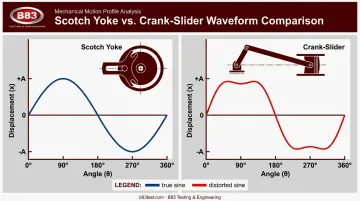
Precision is where the two designs really diverge. A scotch yoke's slot removes the horizontal component of pin travel instantly, so the resulting motion is a clean sine function regardless of speed.
A slider-crank's connecting rod, however, swings through a changing angle as it rotates. That angle change introduces a second-harmonic term into the displacement curve, an effect that grows as the rod gets shorter relative to the crank throw. This isn't a mechanism you can simply run faster to "average out." This distinction matters beyond theory: in accredited testing environments, motion repeatability directly affects whether shock and fatigue results can be trusted and compared across test runs.
What Is a Scotch Yoke Shock Dyno?
A scotch yoke mechanism uses a rotating disk with an offset pin that engages a slot in a yoke. The yoke itself is constrained to travel in one direction only, typically vertical.
As the disk rotates, the pin slides within the slot, and the yoke reciprocates. Because the slot geometry cancels out any off-axis component of the pin's motion, the yoke's position follows x = r cos(θ) exactly, with velocity as its derivative. That relationship holds exactly at every point in the stroke, derived directly from the mechanism's geometry.
Why This Matters for Damper Testing
Damper characterization depends on knowing the exact velocity at each instant so you can plot force against it accurately. When your velocity input is a true sine derivative, your resulting force-vs-velocity (PVP) and force-vs-displacement (CVP) plots reflect the damper's actual hysteresis, cavitation behavior, and damping curve. Those curves show the hardware's real behavior, unaffected by drive-mechanism artifacts.
Commercial scotch yoke dynos reinforce this with hardware design choices:
- Precision wear-plate systems and zero-lash gearboxes to eliminate mechanical slop
- Stiffened yoke construction to reduce hysteresis from structural deflection
- Displacement sensors mounted on the actuation centerline to avoid off-axis measurement error
Use Cases of Scotch Yoke Dynos
Scotch yoke dynos show up wherever data confidence matters more than upfront cost:
- Motorsports shock services running iterative valve-tuning sessions between race weekends
- Automotive OEM suspension QA, verifying every unit before it ships
- Motorcycle and mountain bike suspension shops doing rebuild verification and warranty checks
- Production quality checks, catching an out-of-tolerance damper before a customer ever sees it
Shops running consistent PVP and CVP tests on a scotch yoke rig gain a documented baseline. When a rebuilt shock's curve drifts even slightly from its known signature, that deviation is real, not a measurement artifact from waveform distortion.
What Is a Crank (Slider-Crank) Shock Dyno?
A slider-crank mechanism looks a lot like the piston-crank assembly inside a combustion engine. A crank arm connects to a linear slider through a connecting rod, converting rotary motion into reciprocating motion, just like a scotch yoke, but through a different geometric path.
The exact position equation includes a square-root term: x = r cos(θ) + √(l² − r² sin²θ), where l is rod length and r is crank radius. That square root is the source of all the trouble.
Why the Waveform Distorts
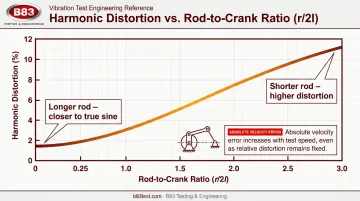
Expand that equation for typical rod-to-crank ratios and a second-harmonic term appears in both displacement and velocity. The distortion's relative size scales with r/(2l). In practical terms:
- Shorter connecting rods relative to crank throw = more distortion
- Longer rods bring the motion closer to true sine, but never eliminate the effect entirely
- The velocity error grows in absolute terms as test speed increases, even though the relative harmonic content stays tied to geometry
That's a subtle but important distinction. A crank-slider rig doesn't get proportionally worse at high speed relative to itself, but the absolute error it introduces becomes harder to ignore when you're trying to characterize high-speed damping behavior.
Use Cases of Crank Shock Dynos
Crank-slider designs earn their place in situations where cost and simplicity outweigh waveform purity:
- Entry-level or budget-conscious setups where a full R&D-grade rig isn't justified
- Low-speed valve-rate benchmarking, where distortion has minimal practical impact
- Educational and training builds, teaching dyno fundamentals without a large capital outlay
- DIY comparative rigs, useful for relative shock-to-shock comparisons rather than absolute characterization
One documented low-cost build used a retired motorcycle crankshaft with a 42.5mm stroke, strain-gauge instrumentation, and a repurposed milling machine as the drive source, all for under $100 in parts. It successfully compared a production shock's measured curve against manufacturer data. That's a legitimate use case.
It's also a build that struggled to hold constant angular velocity under load, a limitation that directly affects the velocity value assigned to each force reading.
Scotch Yoke vs Crank: Which Is Better for Your Testing Needs?
The right answer depends on four questions, not a universal ranking.
- Velocity range: Low-speed comparative work tolerates crank-slider distortion better than high-speed characterization does, since waveform errors compound as speed increases.
- How critical is waveform purity to your analysis? R&D and tuning decisions need clean, repeatable data, while pass/fail screening tolerates more noise in the signal.
- Budget constraints: Precision machining costs money, but reused engine components keep the price down.
- Where do results go? Internal tuning notes carry lower stakes than customer-facing certification or an OEM sign-off report.
Weighing these four factors together usually points toward one of two clear testing paths:
Choose a scotch yoke dyno if you need industry-standard, high-confidence sinusoidal data across a wide velocity range, whether for damper development, production QA, or motorsport tuning.
Choose a simpler crank-based rig only for low-speed, cost-constrained, or comparative screening where minor waveform distortion won't change your decision.
Either way, in-house dyno choice is a day-to-day tuning decision, not a compliance or liability one.
Real-World Application: When In-House Dyno Data Needs Independent Validation
An in-house scotch yoke or crank-slider dyno is excellent for day-to-day valve tuning, rebuild verification, and internal QA. Where it starts to fall short is when results need to survive scrutiny outside your own shop. That scrutiny might come from an OEM compliance requirement, a warranty dispute, or a new customer asking for defensible documentation.
That's the gap accredited independent labs are built to close.
What Independent Validation Actually Adds
ISO/IEC 17025 accreditation demonstrates that a lab operates competently and produces valid results. That's what builds confidence in test data across company lines and, in many cases, across international borders.
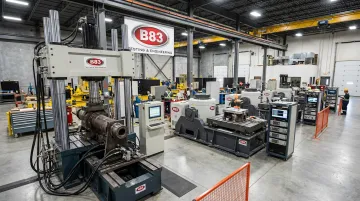
B83 Testing & Engineering, an engineer-owned, ANAB-accredited ISO/IEC 17025 lab based in Milwaukee, Wisconsin, approaches damper and shock validation differently than a production dyno. Rather than using a motor-driven scotch yoke or crank-slider mechanism, B83 applies:
- Servo-hydraulic load/displacement testing to independently replicate force-displacement curves generated on an in-house dyno
- Field Data Replication (RPC®) to recreate actual road, vehicle, or equipment loads in a controlled lab setting
- Mechanical shock testing to evaluate transient impulse response beyond steady-state sinusoidal cycling
- Sine, random, and sine-on-random vibration testing across a fleet of five electro-dynamic shakers rated from 4,000 to 18,000 lbf
Why Manufacturers Make the Call
A manufacturer might rely on in-house dyno data for months of internal tuning without issue. What typically changes the equation? A new OEM customer requirement, a warranty claim that needs a defensible answer, or a decision to reduce liability exposure before a product ships at scale.
When that happens, pairing in-house dyno curves with accredited, third-party test data gives engineering and quality teams a documented answer they can hand to a customer or auditor, not just an internal readout.
Conclusion
There's no universal winner between scotch yoke and crank-slider dynos. Match the mechanism to the job:
- Scotch yoke for precision, wide velocity range, and industry-standard sinusoidal testing
- Crank-slider for low-cost, low-speed screening where minor distortion won't sway your decision
Whichever mechanism runs in your shop, pairing it with periodic, accredited validation protects against liability, lowers warranty exposure, and builds the kind of customer trust that in-house data alone can't provide. B83 Testing & Engineering offers mechanical shock, vibration, and servo-hydraulic testing services built for exactly that purpose.
Frequently Asked Questions
What is the main difference between a scotch yoke and a crank (slider-crank) mechanism in shock dynos?
A scotch yoke uses a pin-and-slot design that produces pure sinusoidal motion at any speed. A crank-slider uses a connecting rod whose changing angle introduces harmonic distortion into the waveform.
Why does sinusoidal motion accuracy matter for damper testing?
Damper force-velocity characterization depends on knowing the exact velocity at each point in the stroke. Pure sine motion provides that reliably; distorted waveforms introduce error into the resulting curves.
Can a crank-slider dyno be used for high-speed or high-precision damper testing?
It can, but harmonic distortion becomes harder to ignore as velocity increases. This makes crank-slider designs less suitable for high-precision, R&D-grade testing than scotch yoke systems.
Which mechanism produces more consistent, repeatable test data?
Scotch yoke mechanisms generally offer better repeatability, thanks to fewer wear points and a fixed geometric relationship between rotation and stroke that doesn't drift over time.
Are scotch yoke shock dynos more expensive than crank-based dynos?
Scotch yoke systems can carry a moderate cost premium for precision machining, but that's often offset by lower long-term maintenance and higher confidence in the data they produce.
Do independent testing labs verify results from in-house shock dynos?
Yes. ISO/IEC 17025-accredited labs like B83 Testing & Engineering perform mechanical shock and vibration testing that can validate in-house dyno findings for compliance, warranty, and design-confidence purposes.